The Body That Changed Western Art
On May 30, 1640, Peter Paul Rubens died in Antwerp at the age of 62. He left behind one of the most influential bodies of work in Western art — and a redefinition of the human body itself.
Before Rubens, the nude in European painting was largely defined by the Italian Renaissance ideal: precise, proportioned, and polished. Michelangelo’s heroic figures and Raphael’s graceful forms set a standard based on classical sculpture — mathematically perfect, physically unattainable.
Rubens didn’t reject that tradition. He absorbed it, then superseded it.
Where the Italian Renaissance gave us nudes that aspired to marble, Rubens gave us nudes that breathed. His figures have flesh that yields, stomachs that fold, thighs that press together. They sweat, they blush, they reach for each other. They are not ideals — they are people.
The Radical Act of Painting Real Bodies
Consider The Three Graces (1630–1635), now in the Museo del Prado. Three women embrace in a circle, their bodies pressed together in a composition of unparalleled warmth. They are not posed for the viewer’s approval. They exist in their own world — laughing, touching, being.
This is Rubens’s great gift: he made the nude intimate rather than monumental. His nudes are not objects to be admired from a distance. They are bodies to be occupied, experiences to be felt.
The term “Rubenesque” was coined precisely because his figures were so distinct from the prevailing ideal. In art history, having a word named after you — meaning a specific type of body — is rare. We don’t say “Michelangeloesque” to describe a body type. But “Rubenesque” remains in common usage because Rubens changed how we see fullness, abundance, and life in the human form.
Mythology as an Excuse for Life
Rubens used mythological subjects — the Judgment of Paris, Venus and Adonis, the Rape of the Daughters of Leucippus — to paint the human body in motion. His goddesses are not ethereal beings. They are Flemish women with translucent skin, golden hair, and bodies shaped by the same gravity the rest of us answer to.
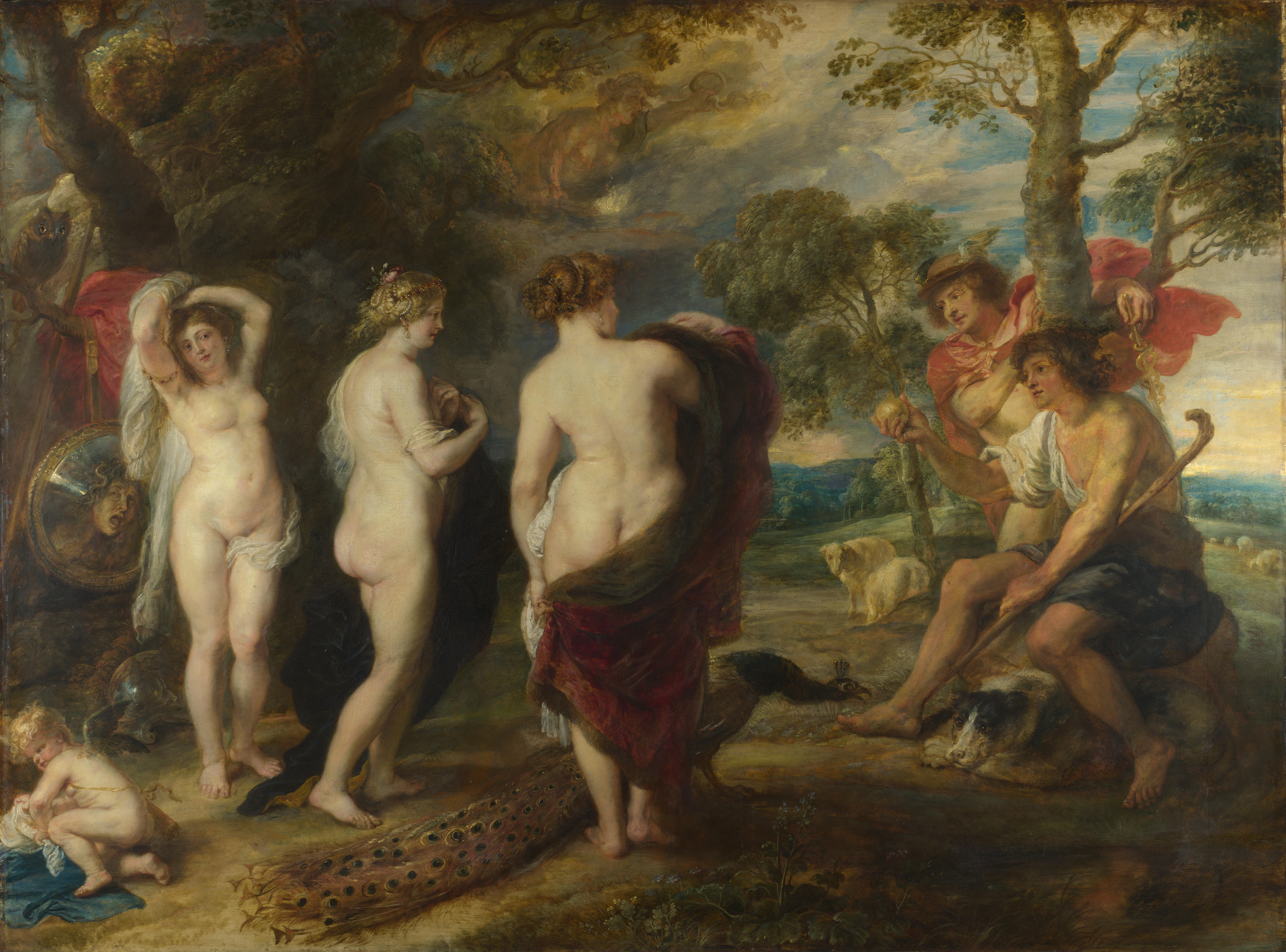
In The Judgment of Paris (multiple versions, 1597–1639), the three goddesses competing for the golden apple are painted with Rubens’s signature fullness. Paris is given the impossible task of choosing among three women — and Rubens makes us feel the difficulty. Each is distinct, each is beautiful, each is real.
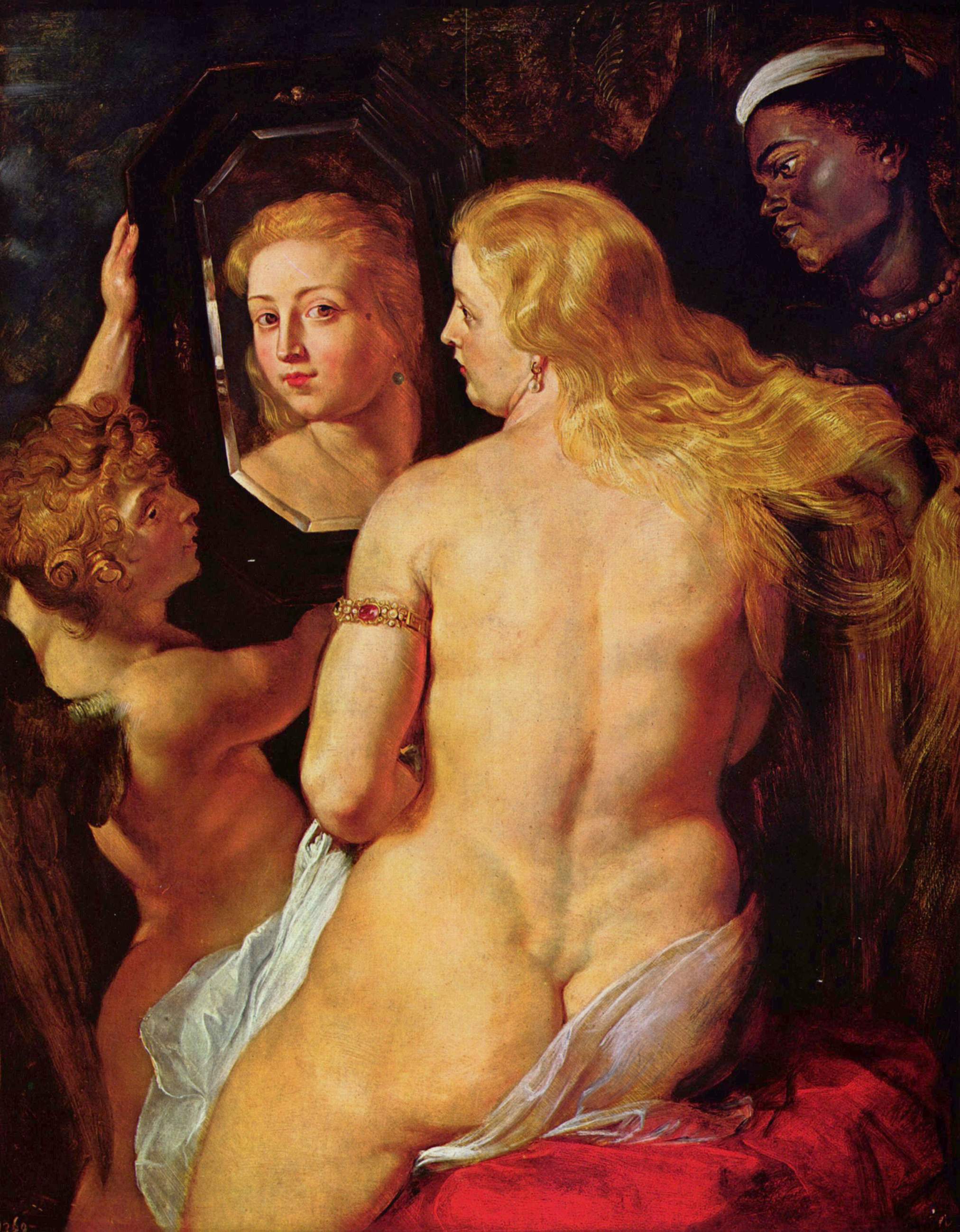
His Venus at a Mirror (1615) shows the goddess of love gazing at her own reflection — not with vanity, but with the quiet self-possession of a woman who knows her own body. Cupid holds the mirror. The reflection gazes back, unapologetically present. It is one of the most tender depictions of a woman alone with herself in Western art.
Rubens and the Male Nude
Rubens didn’t reserve his bodily revolution for women. His male nudes — in The Fall of the Damned, Prometheus Bound, and his hunting scenes — are muscular, straining, and full of physical consequence. These are not idealized athletes. They are men caught in the middle of action, their bodies carrying the weight of the drama. The male nude in Rubens’s hands becomes a record of effort, not an advertisement for perfection.
The Legacy of Rubenesque
In the centuries since his death, the Rubenesque body has been alternately celebrated and dismissed. Nineteenth-century academic painting rejected his fullness in favor of neoclassical sleekness. Modernism found his work too theatrical. But contemporary body-positivity movements have rediscovered Rubens with a new appreciation.
What Rubens understood — intuitively, without the language of modern body politics — was that the nude in art had become too narrow. The idealized body, he seemed to say, is a lie. The living body is the truth.
Today, 386 years after his death, we are still catching up to that insight. When we talk about body diversity, about representation, about seeing ourselves in art — we are talking about what Rubens already knew. The body is not an idea. It is a home.
Rubens gave us permission to live in ours.