
The Reclining Nude: How Three Paintings Changed the Way We See the Body Forever
\n\n
There is a pose so enduring in Western art that it has survived revolutions, scandals, and centuries of aesthetic upheaval. The reclining nude \u2014 a body at rest, horizontal, exposed, and yet somehow commanding \u2014 has captivated artists since antiquity. But three paintings, separated by three centuries, define its evolution: Titian’s Venus of Urbino (1538), Vel\u00e1zquez’s The Toilet of Venus (1647\u20131651), and Manet’s Olympia (1863). Together, they tell the story of how the nude body went from idealized fantasy to confrontational reality.
\n\n
The Birth of a Pose
\n\n
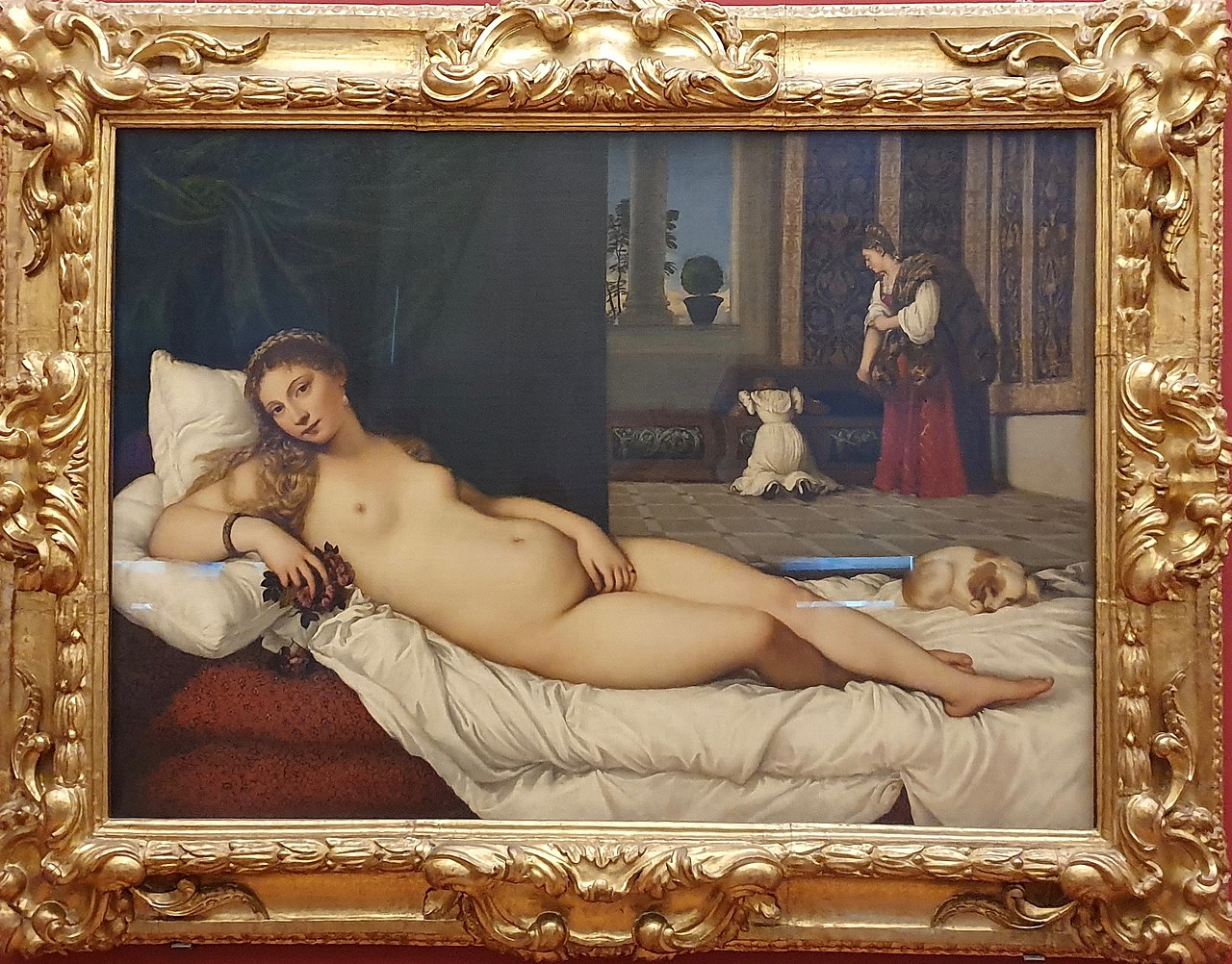
When Titian painted the Venus of Urbino for the Duke of Urbino, he was adapting a composition pioneered by his teacher Giorgione. But where Giorgione’s Sleeping Venus placed the goddess in a dreamlike landscape, Titian brought her indoors \u2014 onto a rumpled bed in a domestic interior, her eyes open, her hand casually positioned in a gesture that has sparked five centuries of debate.
\n\n
\n\n
The Venus of Urbino is the template. The body is arranged along the picture plane, head tilted, one arm curved behind the head, the other resting low on the torso \u2014 a pose that signals both availability and self-possession. A sleeping dog curls at her feet (domesticity, fidelity). A maid rummages through a wedding chest in the background (wealth, marriage). The painting was commissioned to celebrate a wedding, and it functions as a visual instruction manual for the male gaze: beauty, submission, and the promise of intimacy contained within the bounds of matrimony.
\n\n
Titian’s genius is tonal. The flesh is rendered with such warmth and naturalism that Venus seems to breathe. Her skin glows with a pearlescent light \u2014 the result of Titian’s layered glazes, each thin wash of oil paint building up a surface that optical science still struggles to explain. The composition is so powerful that every subsequent artist who attempted the reclining nude had to reckon with it.
\n\n
Turning Away: Vel\u00e1zquez and the Mirror
\n\n
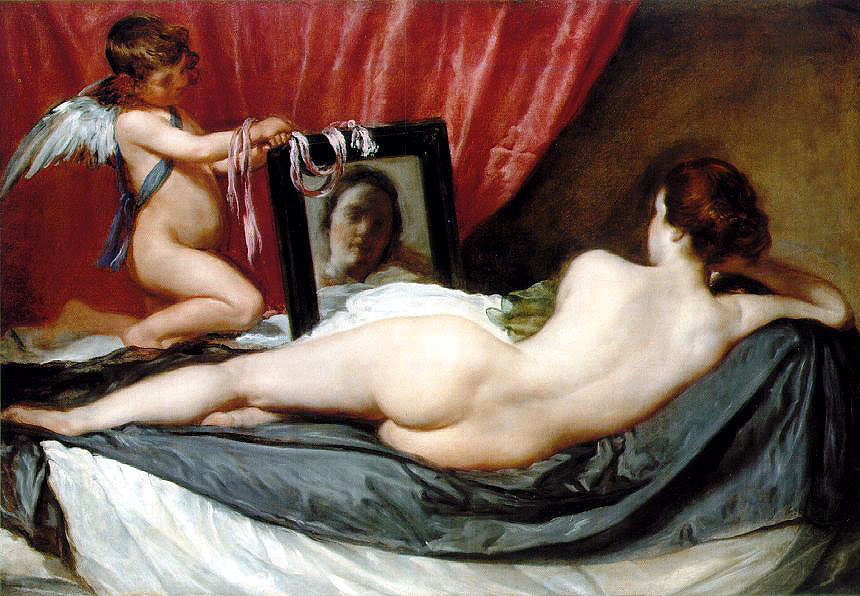
A century later, Diego Vel\u00e1zquez painted The Toilet of Venus \u2014 better known as the Rokeby Venus \u2014 and introduced a radical shift. His Venus lies in almost the same pose as Titian’s, but she faces away from us.
\n\n
\n\n
The Rokeby Venus is one of the few surviving female nudes from Spanish Golden Age painting (the Inquisition destroyed most of them). Vel\u00e1zquez subverts the Titianesque formula in a brilliant conceptual stroke: Venus looks at us not directly, but through the reflection in a mirror held by her son Cupid. We see her face \u2014 but only as a blurred, softened reflection. She is both present and withheld, available and untouchable.
\n\n
The mirror is the painting’s philosophical engine. In Titian’s work, the viewer is positioned as the intended recipient of Venus’s gaze. In Vel\u00e1zquez’s, the viewer is almost an intruder \u2014 catching a glimpse of a goddess who is absorbed in her own reflection. The painting participates in the tradition of vanitas: beauty is fleeting; even a goddess cannot hold onto it. The soft, silvery light of the room, the cool gray sheets, the liquid brushwork \u2014 all contribute to a sense of ethereality, as if Venus might dissolve at any moment.
\n\n
Vel\u00e1zquez painted this work in Rome, where the strict moral codes of Counter-Reformation Spain did not apply. But even in relatively permissive Italy, the painting was remarkable for its intimacy. Unlike Titian’s Venus, who performs for a spectator, Vel\u00e1zquez’s Venus performs for herself. The viewer is a guest \u2014 and not entirely a welcome one.
\n\n
The Scandal: Manet’s Olympia
\n\n
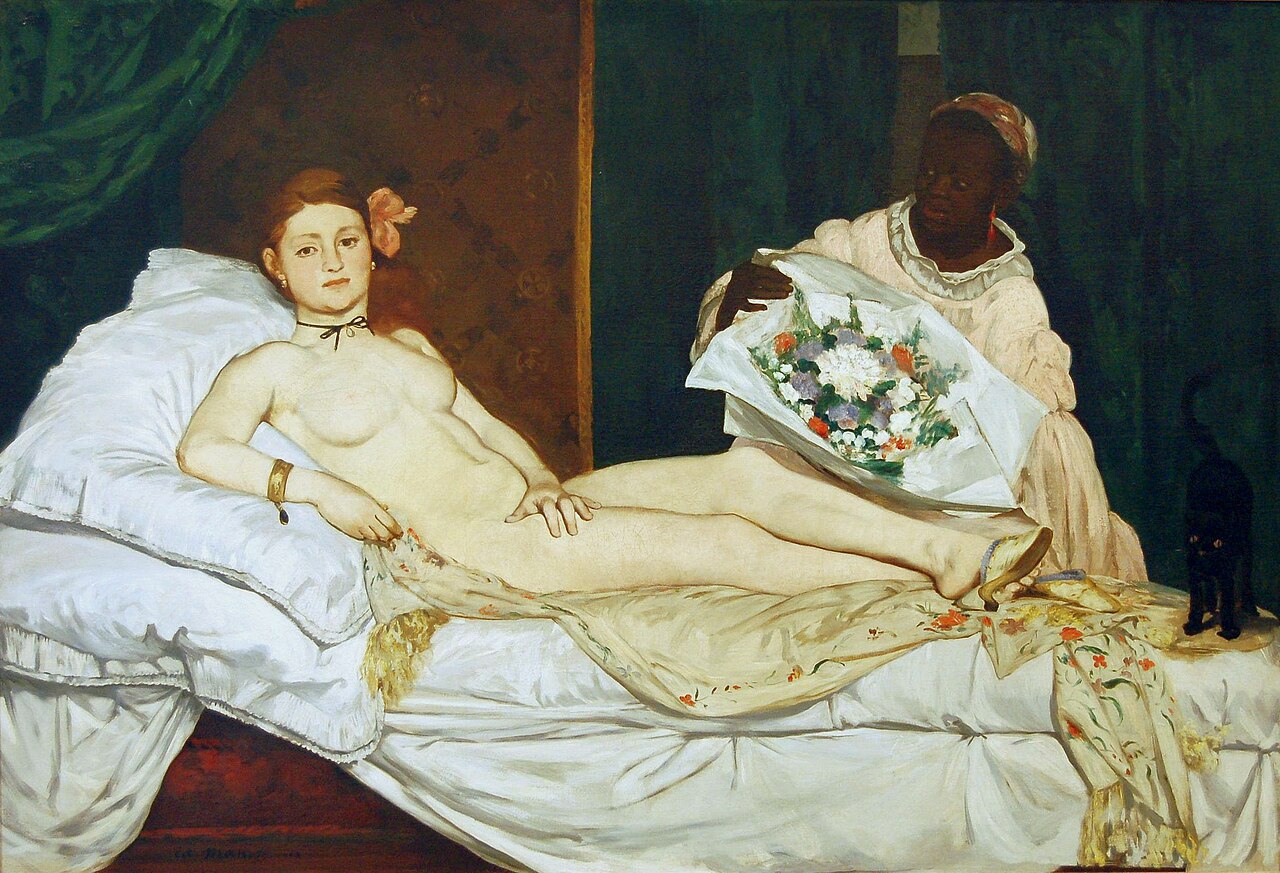
When \u00c9douard Manet exhibited Olympia at the 1865 Paris Salon, the pose was immediately recognizable. There she lay \u2014 the same arrangement of limbs, the same horizontal body, the same hand placed with calculated ambiguity. But the public was outraged.
\n\n
\n\n
The difference was everything. Manet’s model was not a mythologized goddess but a recognizable Parisian woman \u2014 Victorine Meurent, a painter and model known in the city’s artistic circles. The title “Olympia” was a name commonly used by Parisian courtesans. The black cat at the foot of the bed \u2014 replacing Titian’s sleeping dog \u2014 arched its back like a threat. The maid offered flowers from an anonymous admirer, but Olympia ignored them, fixing the viewer with a stare of cool, transactional authority.
\n\n
Critics called it vulgar. They called it “a yellow-bellied odalisque” and “a female gorilla.” The painting was moved to a higher wall to prevent the public from poking it with umbrellas. But the violence of the reaction tells us what Manet had achieved: he had taken the most conventional pose in Western art and stripped it of every convention that made it safe.
\n\n
Titian’s Venus belongs to a mythic past; Vel\u00e1zquez’s Venus belongs to a metaphysical dreamscape; Manet’s Olympia belongs to the present. She is a real woman in a real room, and her gaze says she knows exactly what the viewer is paying for. The shock of Olympia is not that it shows a naked woman \u2014 the Salon was full of naked women \u2014 but that it shows a woman who refuses to pretend she isn’t being watched.
\n\n
What the Pose Means
\n\n
The evolution of the reclining nude is the evolution of looking itself. Titian taught us how to look at a body \u2014 to consume it aesthetically. Vel\u00e1zquez taught us that looking could be reciprocated, that the subject might have an inner life beyond the viewer’s fantasy. Manet taught us that being looked at could be a confrontation \u2014 that the gaze is not neutral, and never has been.
\n\n
Every reclining nude painted since \u2014 from Modigliani’s elongated odalisques to Lucian Freud’s unflattering portraits of flesh \u2014 inherits this conversation. The pose has become a language, and each new artist either speaks it fluently or deliberately breaks the grammar.
\n\n
What makes these three paintings extraordinary is not just their beauty, but their self-awareness. Each one knows it is participating in a tradition. Each one comments on what came before. Titian invented the visual vocabulary. Vel\u00e1zquez questioned its assumptions. Manet annihilated its innocence.
\n\n
And we are still living with the consequences \u2014 because every time we look at a reclining nude, we are unconsciously comparing it to these three works. The body at rest, arranged across the canvas, has never recovered from what Titian, Vel\u00e1zquez, and Manet did to it.
\n\n
That is the power of art history: not a sequence of dead masterpieces, but a live conversation between artists who never met, conducted across centuries, about the most intimate subject of all.
\n\n
\n\n
NALA is a Los Angeles-based collective dedicated to celebrating the human figure in art. Get involved or visit our gallery to see how artists today are continuing this conversation.
\n