On September 14, 1883, Richard Gerstl was born into a prosperous Jewish merchant family in Vienna. He died twenty-five years later, alone in his studio, after burning most of his papers and killing himself. Between those two dates he produced a body of work so intense that the art world needed four decades to look at it again. At its center sits a self-portrait with no precedent: Gerstl, naked, standing full-length, palette in hand, staring out at whoever dares to meet his eyes.
For centuries the nude had carried an ideal, a myth, a pretext for beauty. Gerstl stripped all three away. His naked body is gaunt, pale, and electric with anxiety. It reads like a man undressing in front of a stranger because he has nothing left to hide.
Gerstl learned to paint inside a system he despised. At fifteen he entered the Academy of Fine Arts Vienna, where his teacher Christian Griepenkerl found the young man’s style so offensive that he snarled a line that survives in every account of the artist: “The way you paint, I piss in the snow.” Gerstl rejected the decorative elegance of the Vienna Secession and the ornamental glow of Gustav Klimt, the two forces that defined the city’s art. He wanted paint to behave like a nerve, and almost no one agreed with him.
His one ally was Arnold Schoenberg. Through the composer, Gerstl entered a circle of musicians and painters who believed art should leave bruises. He painted Schoenberg and his family with a candor that still unsettles. Then, in 1908, he fell in love with Mathilde Schoenberg, the composer’s wife.
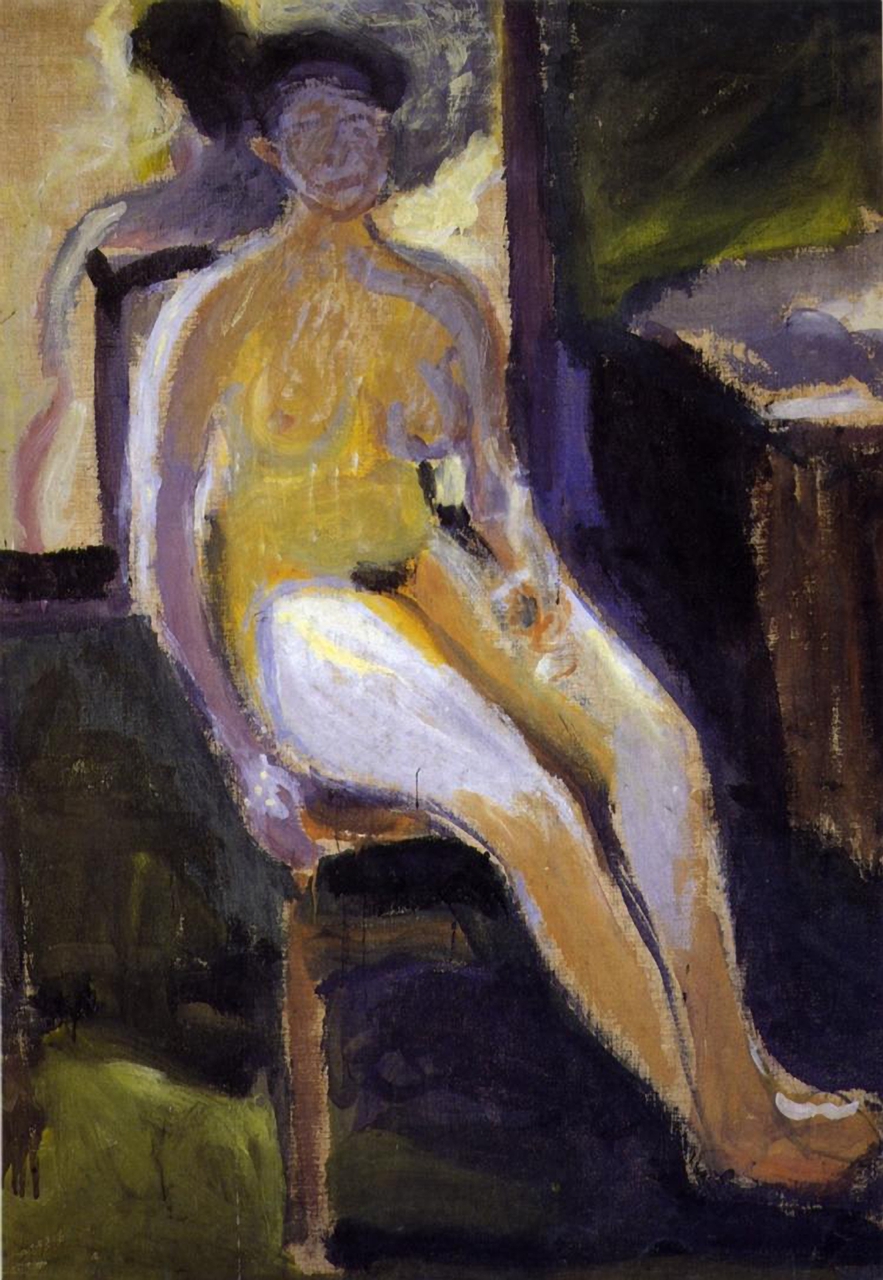
The affair unravelled, and Mathilde returned to her husband that summer. Gerstl spent his final months painting with a fury that produced his most famous images. In the Seated Female Nude of autumn 1908, the model sits slumped and unguarded, her body rendered in harsh, urgent strokes, as though the painter were trying to fix a memory before it vanished.
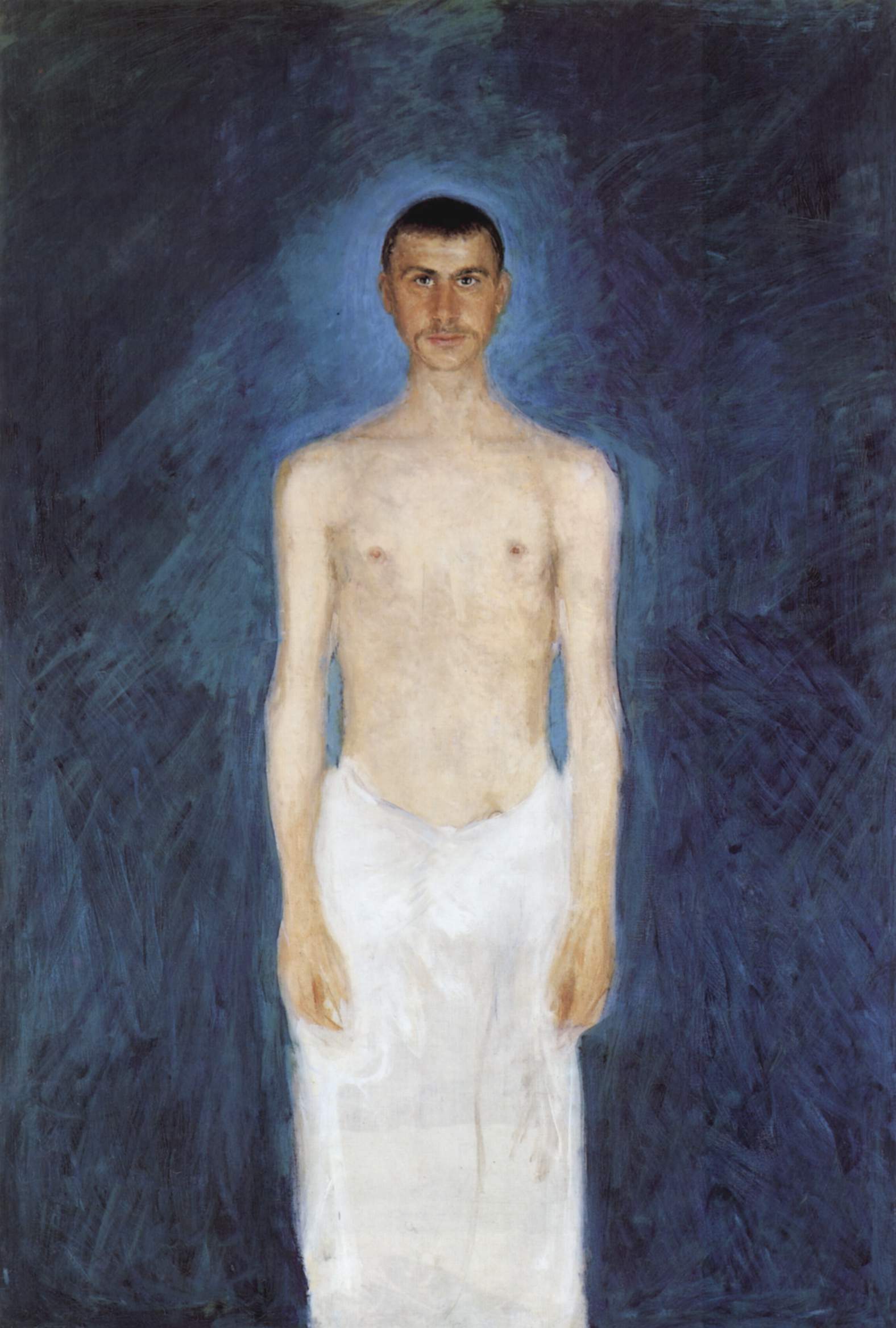
He had turned that unsparing eye on himself years earlier, in a Semi-Nude Self-Portrait from around 1904. Half-dressed and caught mid-thought, the young painter already refused the flattering self-image most artists reached for. By the end, that refusal became total.
The full nude arrived in his last months. In the Nude Self-Portrait with Palette, Gerstl painted himself naked before the canvas, holding the tools of his trade. It is an image of complete exposure. There is no costume, no allegory, no classical alibi. There is only a man insisting that the artist’s body belongs in the picture and that the truth of a life belongs on the canvas, whether or not anyone wants to see it.
On November 4, 1908, Gerstl killed himself. He was twenty-five. He burned his papers first, and he had shown almost nothing while he lived: a single exhibition, in 1907, was all he managed. Most of his paintings sat forgotten for years in his brother’s care, rescued from destruction by the dealer Otto Kallir, whose 1931 exhibition introduced the world to a painter who had already been dead for more than two decades.
What Gerstl left behind was a preview of the century to come. Austrian Expressionism, the raw figuration of Oskar Kokoschka and Egon Schiele, the idea that the body could carry a psychological charge heavier than any symbol: all of it points back toward Gerstl. He died before those movements took shape, but he painted their first sentences.
The nude self-portrait remains his most radical claim. Art history overflows with artists painting themselves in costume, in role, in triumph. Gerstl painted himself with nothing on and nowhere to hide. He treated his own body the way Expressionism treats the psyche: as the one honest subject left. A hundred and forty-three years after his birth, that image still does what it did in 1908. It asks the viewer to look at a human being who has decided, for once, to stop performing.