On August 14, 1905, the painter Simeon Solomon died in London at sixty-four, destitute and largely forgotten. Thirty years earlier, critics had called him a prodigy, the most gifted of the Pre-Raphaelites’ younger generation. He was buried in the Jewish Cemetery at Willesden. What happened in between is one of art history’s clearest lessons in what it costs to paint the body you are not allowed to love.
A prodigy who painted what he could not say
Solomon was born in London on October 9, 1840, the youngest of eight children in a prominent Anglo-Jewish family. Two of his siblings, Abraham and Rebecca Solomon, were painters, and Simeon followed them into art early. He entered Carey’s Art Academy at twelve and the Royal Academy Schools a few years later, where Dante Gabriel Rossetti introduced him to the Pre-Raphaelite circle. By his late teens he counted the poet Algernon Charles Swinburne and the painter Edward Burne-Jones among his friends.
The Pre-Raphaelites prized beauty, sincerity, and a return to medieval and Renaissance models. Solomon brought something of his own to that aesthetic: a frank and tender depiction of same-sex desire, dressed in classical and biblical costume. He exhibited at the Royal Academy from 1858 to 1872, and his reputation rose fast.
The androgynous body as a form of honesty
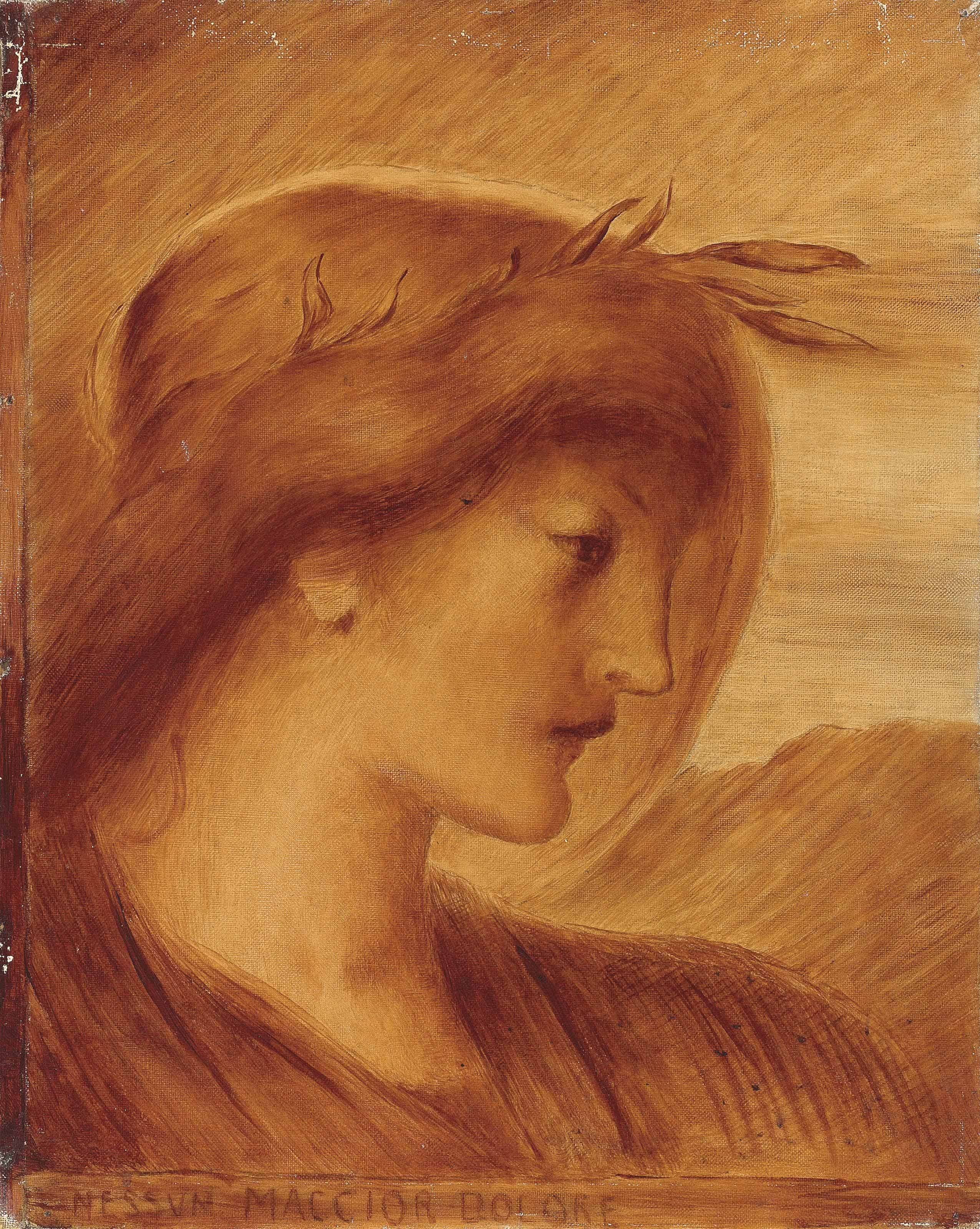
Solomon’s signature subject was the androgynous figure, a body suspended between masculine and feminine. In Bacchus (1867) he painted the god of wine as a dreamy youth with soft features and a bare shoulder, more beloved than triumphant. In Sappho and Erinna in a Garden at Mytilene (1864) two women embrace on Lesbos, a scene of female love rendered without shame or distance. In Nessun maggior dolore he reworked the doomed lovers of Dante’s Inferno into a pair of young men, the title borrowed from the line that there is no greater sorrow than to recall happiness in a time of misery.
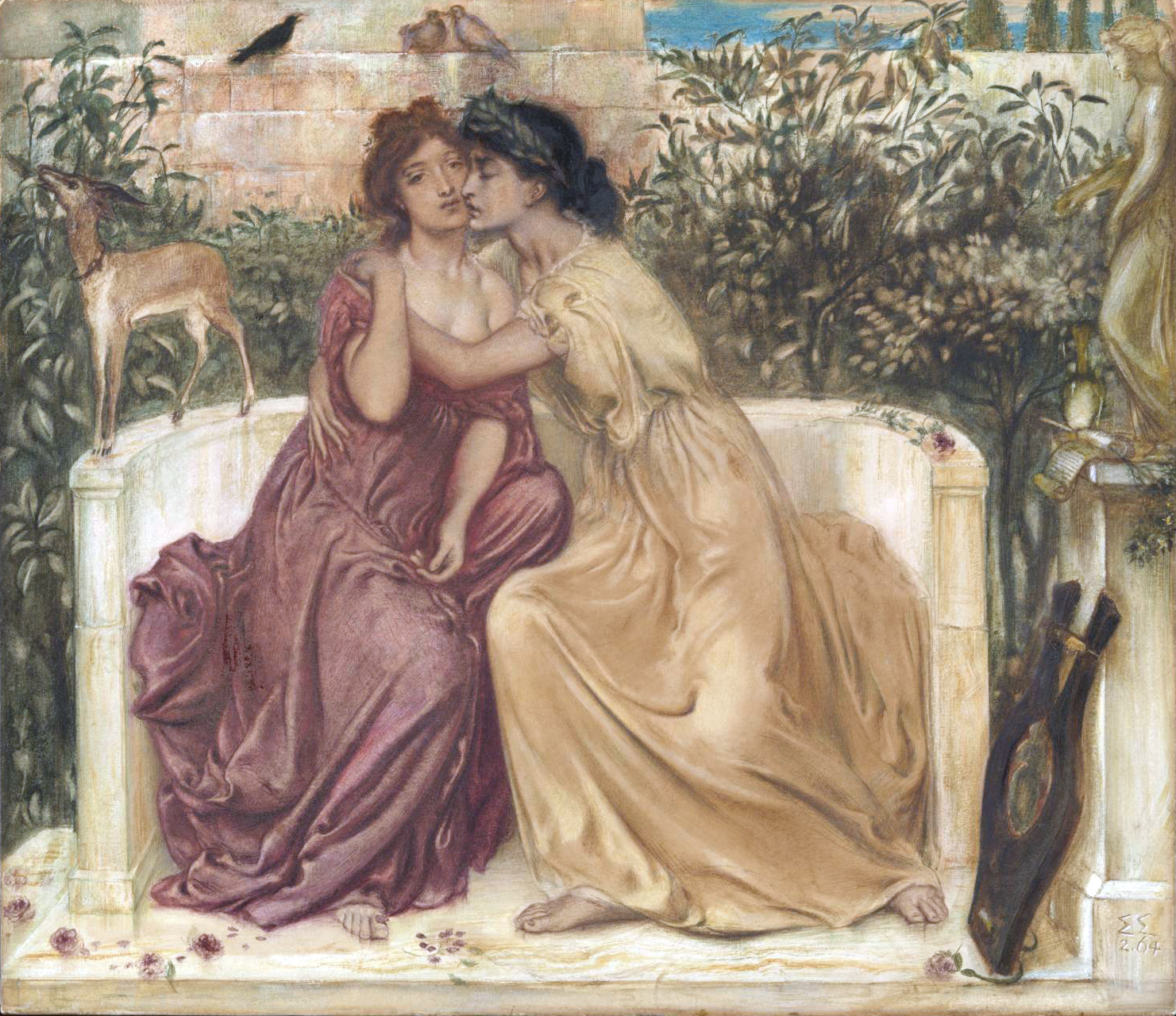
Solomon refused the safe, sanctioned allegory. He painted desire between people of the same sex as a subject worthy of beauty, and in a country where homosexual acts were a criminal offense, that was a quiet act of defiance. The Victorian art world could accept a female nude presented as Venus. A male body offered up as an object of male desire crossed a line no one would name out loud.
The fall
In February 1873, Solomon was arrested in a public toilet with a stableman named George Roberts. Both men were convicted of attempted sodomy, fined one hundred pounds, and sentenced to eighteen months of hard labour. He was arrested again in Paris in 1874 on a similar charge and served three months in prison.
The Pre-Raphaelite circle closed ranks against him. Rossetti and Swinburne, who had championed his work, cut him off, more anxious about their own reputations than his survival. Solomon was erased from the movement he had helped define.
He never exhibited again after 1872. For the next three decades he drifted through poverty and alcoholism, spending his final years in and out of the St. Giles Workhouse and supported fitfully by family and by friends such as the photographer Frederick Hollyer, who made reproductions of his work. He kept painting, and his drawings survived only because a handful of collectors refused to forget him.
A body of work that outlived the verdict
Solomon’s work was collected by Oscar Wilde, John Addington Symonds, Walter Pater, and Count Eric Stenbock, men who recognized in his figures their own desires rendered beautiful rather than shameful. His paintings now hang at Tate Britain, the Victoria and Albert Museum, and Leighton House. Retrospectives at the Birmingham Museum and Art Gallery in 2005 and the Ben Uri Gallery in 2006 began the long work of restoring him to the history he was cut out of.
Why Solomon matters now
Simeon Solomon matters because his story is about the cost of painting the body you are not allowed to love. The male nude has always occupied an uneasy place in Western art. It was celebrated in the classical academy and then buried under centuries of suspicion, because a male body on display raises questions about who is looking and what they want. Solomon made that question explicit, and the society around him answered it with a conviction and a workhouse.
He was one of many artists destroyed by the criminalization of same-sex desire, and one of the clearest cases, because the evidence of what he valued sits right there in the pictures. The androgynous youths, the embracing women, the entwined young men were not hidden messages. They were the work.
The lesson for anyone who cares about the human figure in art is plain. The nude has never been a neutral subject. Whose body gets painted, by whom, and for whom, has always been a political question. Solomon painted desire that the law called a crime, and he paid for it with his career and his life. The paintings survived the verdict. On the anniversary of his death, that is the point worth remembering.