The Default Nude
If I say "the nude in art," what comes to mind? A reclining Venus. A bathing woman. An odalisque. The female body, displayed, draped, or defiant — always the object of the gaze. Now try to name ten famous male nudes in Western painting. After David and maybe The Dying Gaul, most people stall out.
This isn’t an accident. It’s a systematic erasure — and it tells us as much about power, looking, and who gets to be art as any scandal in the canon.
The Body That Started Everything
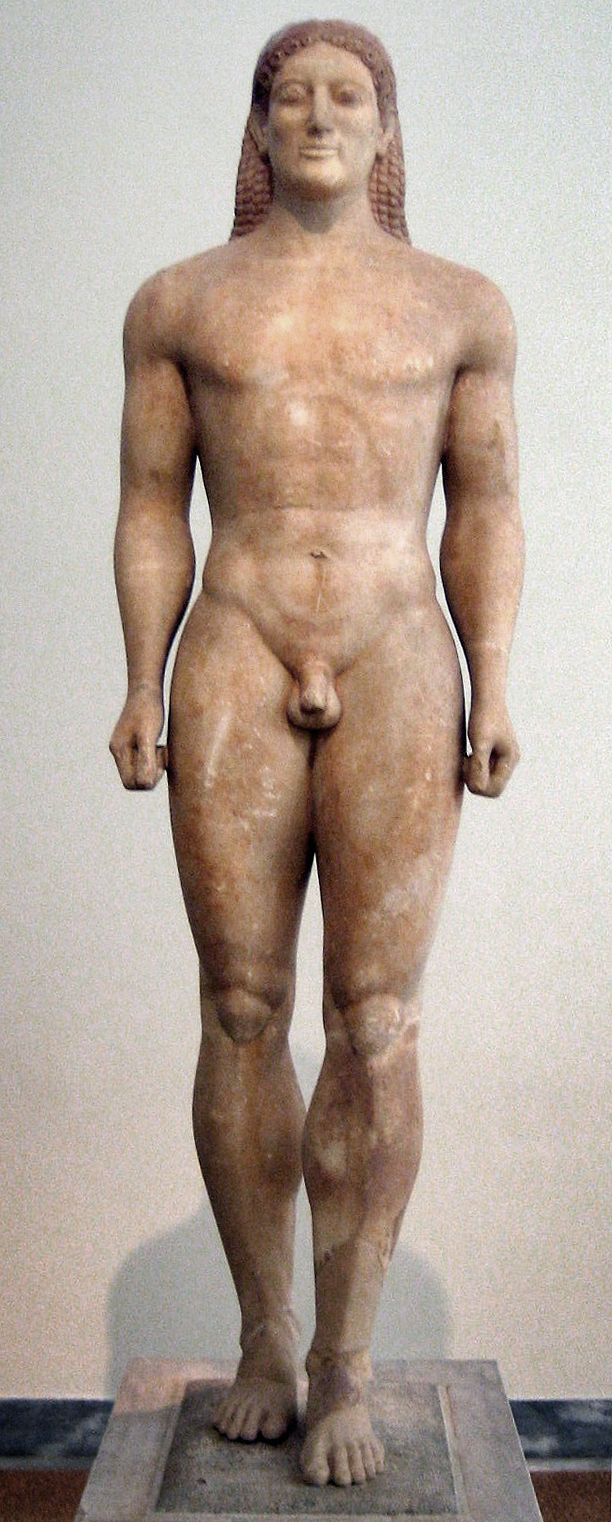
The male nude dominated the earliest Western art. The kouroi of Archaic Greece — life-sized marble youths, naked and unashamed — were the first monumental nudes in the Western tradition, standing in sanctuaries and cemeteries as offerings to the gods. The Greeks understood the male body as the site of virtue: athletic, martial, divine. The nude wasn’t a subject. It was a value system. To be naked was to be fully human, fully present, fully worthy of being seen.
Michelangelo inherited this tradition and weaponized it. His David (1501–1504) is the most famous male nude in history — a biblical shepherd rendered as a classical god, every muscle taut with potential energy. The Sistine Chapel ceiling is populated by twenty ignudi, nude male youths whose presence has no biblical justification whatsoever. Michelangelo put them there because the male body, for him, was the highest possible language. Nudity wasn’t exposure. It was revelation.
The Great Retreat
Then something happened.
Sometime between the Renaissance and the nineteenth century, the male nude retreated. It didn’t vanish — it was pushed. The female nude became the default nude. The male body, when it appeared at all, was draped, armored, or safely mythological. The life room of the academies employed male models almost exclusively — but the finished paintings almost never showed them. The male body was for practice. The female body was for display.
Why?
Part of the answer is the structure of looking itself. In the Western tradition, the gaze — the right to look, to judge, to possess visually — has been coded as male. The person looked at has been coded as female. A male nude disrupts this binary. A man who is naked and looked at is a man who has been, in some sense, feminized. That made the male nude dangerous in a way the female nude never was. The female nude reinforced the power structure. The male nude questioned it.
The Eakins Problem
Thomas Eakins understood this danger viscerally. In 1886, he was fired from the Pennsylvania Academy of the Fine Arts for removing a male model’s loincloth in a mixed-gender class. The scandal wasn’t about nudity — the academy had been drawing nudes for centuries. The scandal was about who was allowed to look at a naked man and under what circumstances. Eakins’ crime was treating the male nude as a legitimate object of study rather than a sacred body that required protection from the gaze. His painting The Swimming Hole (1884–1885) shows a group of nude young men by a lake — and it is one of the very few unapologetic male nudes in nineteenth-century American art. It was also, for decades, almost never shown.
The message was clear: the male body could be studied, but it could not be displayed. It could be practiced upon, but it could not be art.
The Criminal Male Nude
The twentieth century made things both more visible and more dangerous. Robert Mapplethorpe’s photographs of the male nude were so threatening to the social order that they became the centerpiece of a 1990 obscenity trial in Cincinnati — the first criminal prosecution of an American museum for the content of an exhibition. The male nude had become not just marginalized but criminalized. Meanwhile, the female nude sailed through museums largely unchallenged, its sheer ubiquity rendering it invisible as a political object.
And here we are in 2026. Walk through any major museum. Count the female nudes. Count the male nudes. The ratio hasn’t changed much since 1900. The algorithms of social media, which flag female-presenting nipples as obscene but leave male torsos alone, have only confused the matter further — creating a bizarre double standard where a female nude is simultaneously the most displayed and the most censored image in Western culture.
What We Lost
What’s lost when half the human body disappears from the walls? More than you might think.
The male body in art is not just the heroic body, the athletic body, the suffering body. It is the tender body, the aging body, the unguarded body — the body that is looked at without performing strength. Art history has given us David flexing but almost never David sleeping. It has given us the male nude as statement but almost never as vulnerability.
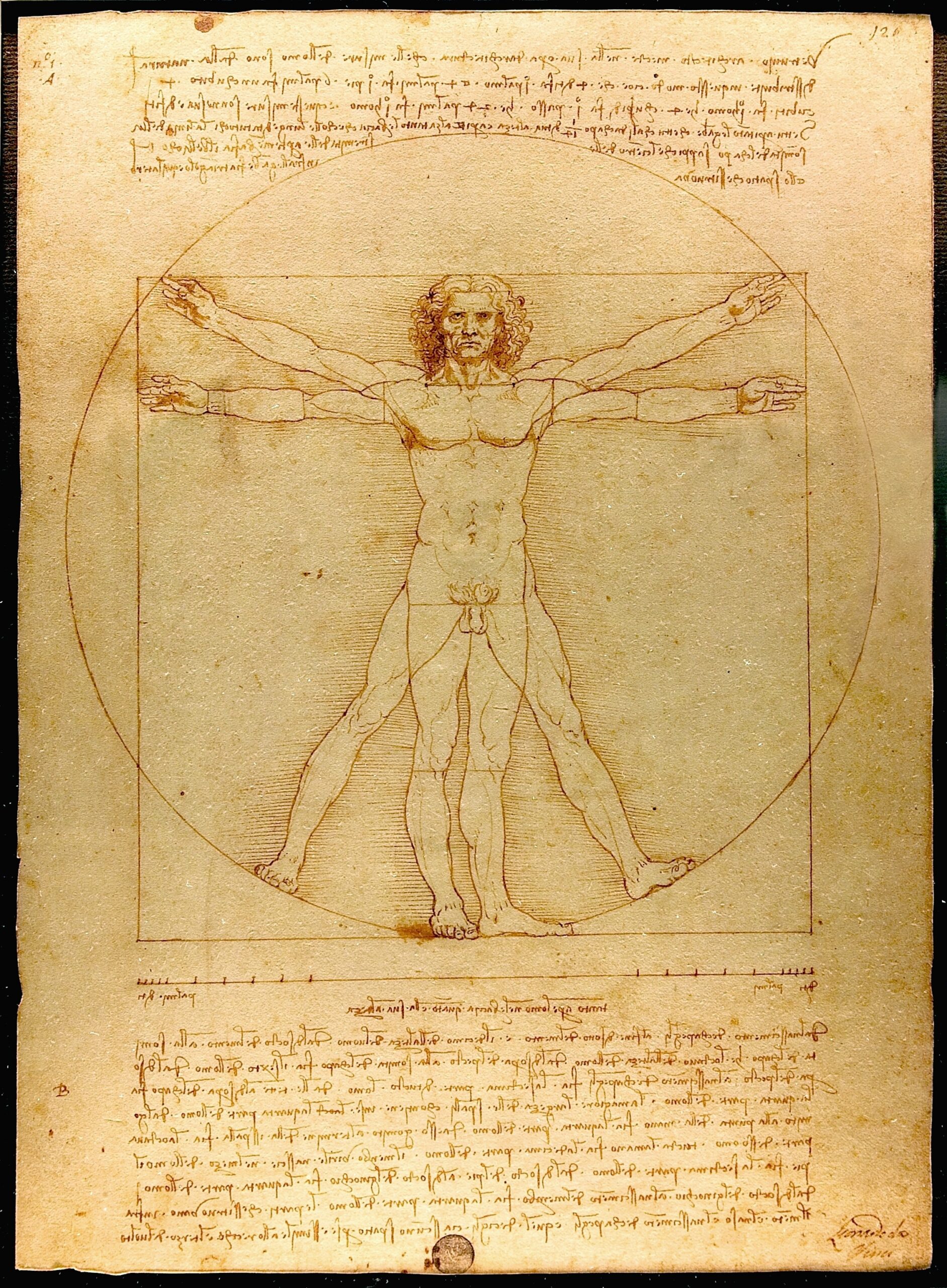
Leonardo da Vinci’s Vitruvian Man (c. 1490) is one of the most reproduced images in history — a male nude reduced to geometry, ideal proportions, pure mathematics. It is famous precisely because it depersonalizes the male body, turning it into a diagram. The male nude, when it survives, often survives by ceasing to be a person.
Reclaiming Half the Story
The arc of the male nude in Western art is not just a story about gender. It’s a story about who controls the power of looking, who is allowed to be seen as a full human being rather than a symbol, and what bodies are permitted complexity.
Reclaiming the male nude isn’t about making more statues of flexing gods. It’s about insisting that half the human body deserves the same artistic attention, the same nuance, the same permission to be imperfect, that the female nude has been granted for five centuries — even when that attention has often been exploitative rather than liberating. It’s about recognizing that the silence around the male body in art is not natural. It was built. And what is built can be rebuilt.
The kouroi stood naked in Greek sanctuaries, and no one called them obscene. Michelangelo’s David has stood in Florence for over five hundred years, and still, people argue about what he’s allowed to mean.
The male nude is not a gap in art history. It’s a silence that was engineered. And silences, once you learn to hear them, are the loudest things in the room.