The academic nude lived alone. Set on a pedestal or a couch, lit for inspection, stripped of every clue about where it was, the posed body belonged to no particular room. It was a specimen of ideal form, and the empty studio around it was neutral air.
Édouard Vuillard, born in Cuiseaux on this day in 1868, never saw the body that way. When he painted a nude, the room came with it. Wallpaper, a mirror, a chair, the warmth of a fire, the particular clutter of a lived apartment: the body arrived as one more pattern among many, dissolving into the domestic surface it shared with everything else.
This was the intimist nude, and it was quietly radical. The academy taught painters to isolate the figure so the eye could measure it against the ideal. Vuillard did the opposite. He buried the figure in its setting until you could hardly tell where flesh ended and wallpaper began. In his figure studies and the small oils of women undressing or seated before a fire, the body belongs to its room. It is at home.
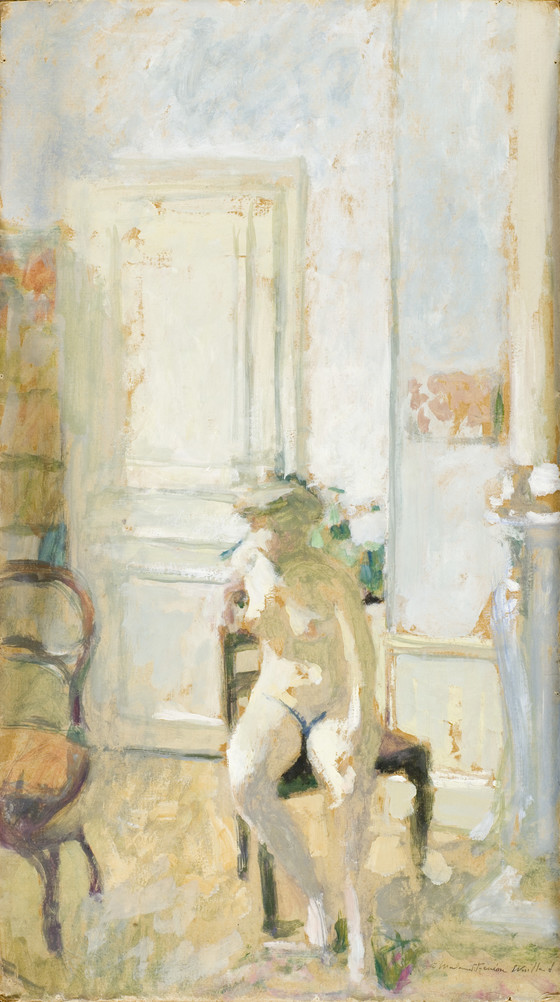
Part of this came from the Nabis, the group Vuillard helped found in the 1890s with Maurice Denis and Pierre Bonnard. The Nabis flattened painting into decoration and insisted a picture was “a flat surface covered with colors in a certain order.” Vuillard applied that decorative logic to the human body and discovered something the academy never allowed: a nude could be private.
The word matters. An academic nude presupposes an audience. The Venus reclines toward a viewer who is always already there. Vuillard’s women acknowledge no viewer at all. They bathe, dress, undo their hair, sit reading by a lamp. The body is occupied with ordinary life, and the painter, stationed close by, records it the way a family member would, without ceremony.
He did this in the cramped Montmartre apartments he shared with his mother, a dressmaker, and his sister. His great subjects were interiors: seamstresses, women at the toilette, the patterned, claustrophobic rooms of the Parisian middle class. The nude belonged to that world. It was the same world with one layer of clothing removed.
What Vuillard taught the twentieth century is that intimacy is a compositional decision. You can strip a body and keep its privacy, if you treat the body as belonging to a place and a life. Bonnard learned this from him and spent forty years painting his wife Marthe in the bath. Matisse, who admired Vuillard, pushed the same insight toward pure color. The private nude, the body caught off guard rather than posed, runs straight from these small patterned rooms to the modern figure at its most unguarded.
The intimist nude gives up monumentality, and Vuillard accepted the trade. It will never be a Venus, never a hero, never a symbol standing for all of humanity. What it offers instead is honesty about scale: most bodies exist in small rooms, under lamps, between meals, and most of what a body does is private. Vuillard chose to paint that.
One hundred and fifty-eight years after his birth, Vuillard’s nudes still feel like an intrusion avoided. They are the rarest thing in a tradition built on display: a body shown without being surrendered.