On May 4, 1875, Wojciech Weiss was born in Leorda, Bukovina — a territory then part of the Austro-Hungarian Empire, now in Romania. He would go on to become one of the most important Polish painters of the early twentieth century, a central figure of the Young Poland (Młoda Polska) movement, and an artist who used the nude body to explore spirituality, eroticism, and the human psyche in ways that still feel urgent today.
From Music to Painting: The Making of a Polish Modernist
Weiss initially trained in music before abandoning it for the visual arts. He enrolled at the Academy of Fine Arts in Kraków under the legendary Jan Matejko, and later studied under Leon Wyczółkowski. After graduating with a gold medal and a scholarship, he traveled across Europe — Rome, Florence, Paris — absorbing the currents that would define his work: Symbolism, Expressionism, Art Nouveau, and the emerging language of modern color.
In 1898, he debuted at the second exhibition of the “Sztuka” (Art) Association of Polish Artists with Melancholic, a portrait deeply influenced by Edvard Munch and the Norwegian writer-philosopher Stanisław Przybyszewski. It was Przybyszewski who would alter Weiss’s artistic trajectory — pulling him from historical and mythological painting into the charged, expressive world of Symbolist and Expressionist art.
The Nude in Young Poland: Between Symbol and Sensation
Polish painting was late to the nude. Until the late 1880s, the erotic and the naked body appeared only through carefully sanctioned classical or mythological framing. The Young Poland movement changed that. Artists like Weiss brought the nude into the open — not as allegory alone, but as a direct confrontation with desire, mortality, and the spiritual state of the nation itself.
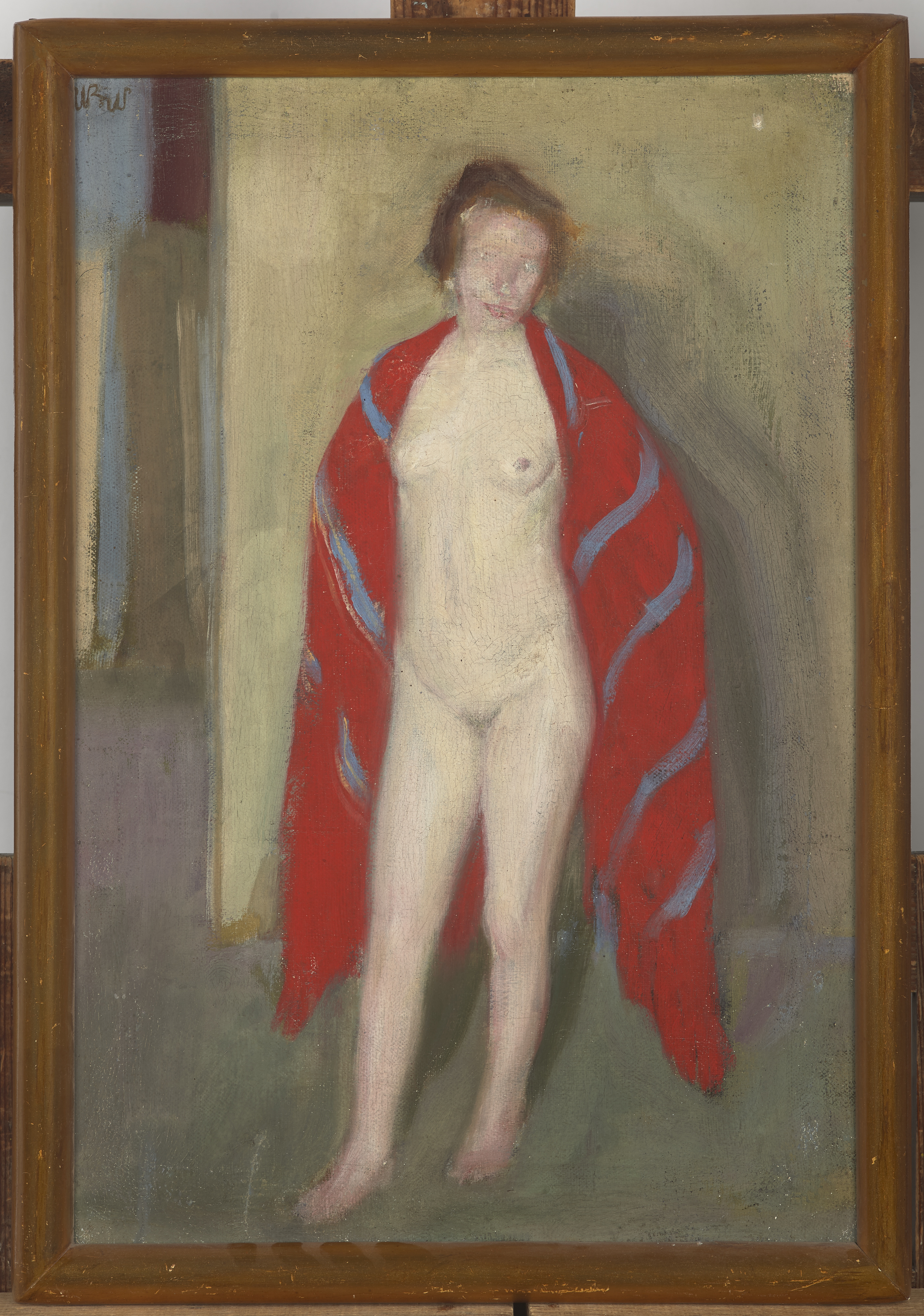
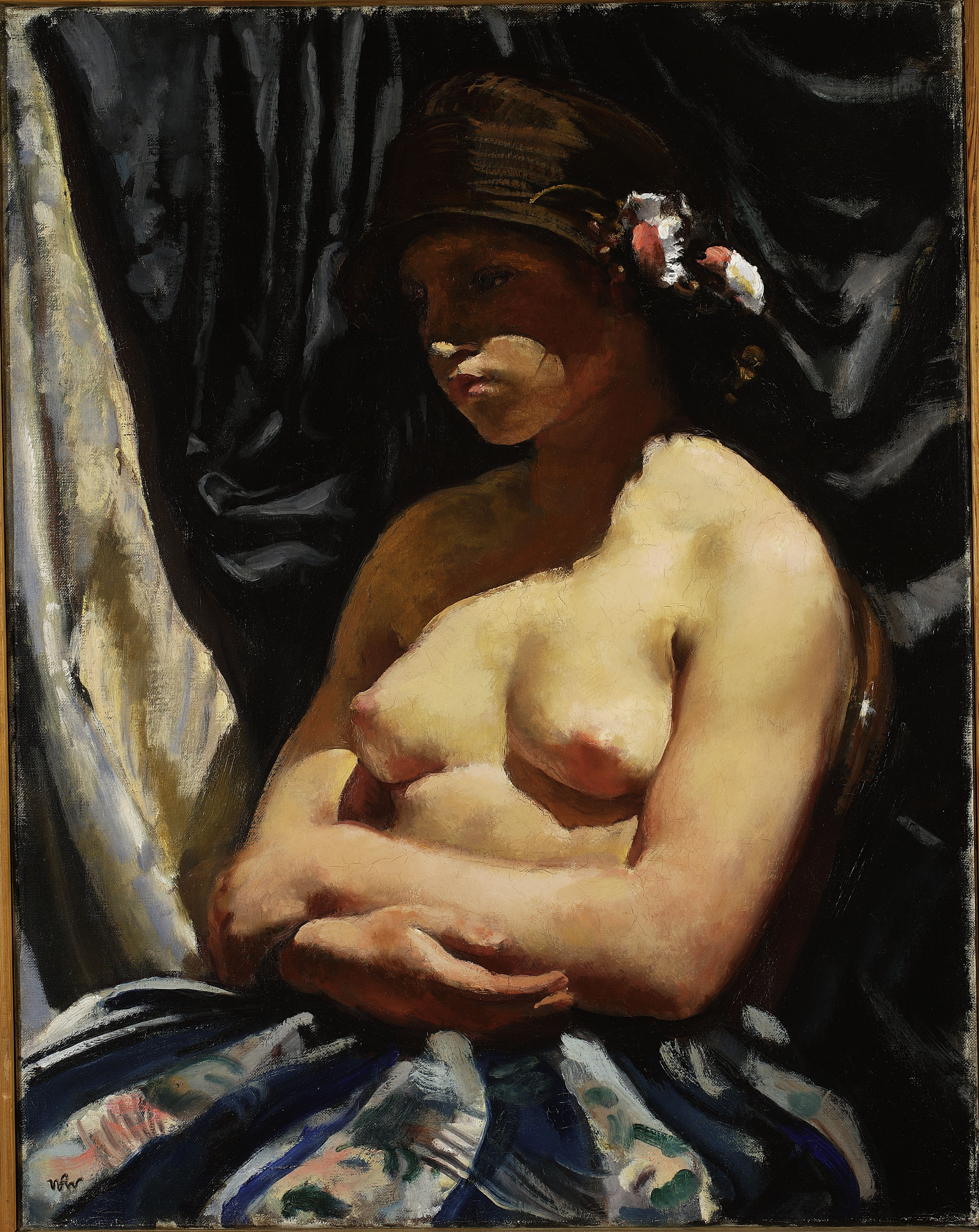
Weiss’s nudes from the 1900s through the 1930s are striking for their psychological intensity. His models are never passive objects of the male gaze — they are often caught mid-gesture, covering their faces, turning away, or staring back with unsettling directness. In works like Fallen Girl (1899), a silver coin at the woman’s feet and her gesture of hiding her face bring eroticism together with social critique in a way that echoes both Munch and Toulouse-Lautrec.
His engagement with the nude expanded dramatically in the years 1918–1935, a period during which he produced numerous female nudes in oil and monotype, introducing a frank eroticism to Polish visual art that had few precedents. The Polish Wikipedia notes that he “introduced open eroticism to Polish visual arts” — a significant statement in a culture still grappling with the legacy of partitioned national identity and Catholic moral codes.
Vienna Secession, Symbolism, and the “White Period”
Like his contemporary Gustav Klimt, Weiss became a member of the Vienna Secession, exhibiting alongside Klimt and the Dutch artist Jan Toorop. This placed him at the center of a pan-European movement that treated the body as a vessel for transcendent meaning — a reaction against both academic naturalism and industrial modernity.
Between 1905 and 1912, Weiss entered what art historians call his “white period” — a luminous phase inspired by Japanese art, characterized by a lightened palette and an almost spiritual approach to color. During these years he painted landscapes, interiors, and figures with a soft, pastel-like touch that pulsed with undertones of Symbolist yearning.
Later, in the 1920s and 1930s, his work grew more vibrant and volume-driven. He traveled annually to the South of France and Italy, and painted the Baltic coast — always returning to the figure, the landscape, and the quiet tension between them.
The Late Years: Socialist Realism and Ambiguity
Near the end of his life, Weiss contributed to the Socialist Realist canon with works like Manifesto (1949–1950) and Strike (1947). But these were not straightforward propaganda. Art historians argue that Weiss subtly undermined the Socialist Realist code from within — his late works carry compositional ambition and tonal nuance that resist easy ideological consumption.
He died on December 7, 1950, in Kraków, having served multiple terms as rector of the Academy of Fine Arts and having profoundly shaped the next generation of Polish artists.
Why Weiss Matters Now
Wojciech Weiss has remained largely unknown in Western Europe and North America — a casualty of the Iron Curtain and the one-sided art historical narratives that followed. But his work speaks directly to the questions we still ask about the nude: What does it mean to show a body? Whose desire is being represented? Can the body carry political meaning without becoming propaganda?
His nudes are sensual without being exploitative. They are psychological without being obscure. And they belong to a tradition — Polish modernism — that deserves far more attention than it has received in the West.
Today, on his 151st birthday, we look back at an artist who, in Młoda Polska‘s moment of cultural reawakening, used the nude to paint a nation into being — one body, one gesture, one charged surface at a time.
All images: Public Domain via Wikimedia Commons. Featured image: “Modelka (Model)” by Wojciech Weiss, National Museum Kraków.