Zinaida Serebriakova died in Paris on September 19, 1967, at the age of eighty-two. She left behind a life cut in half by revolution and exile, and a body of early paintings that no man could have made. When she painted the nude, the nude changed.
A painter born inside art
Born Zinaida Yevgenyevna Lansere in 1884 on the Neskuchnoye estate near Kharkov, she was raised inside art the way other children are raised inside a language. Her family, the Benois and Lansere clans, gave Russia its architects, painters, and stage designers. Her great-uncle Alexandre Benois helped found Mir iskusstva, the World of Art movement that pulled Russian painting toward European modernism. Serebriakova did not choose art. It was the family business.
The Bathhouse, 1913
Her essential painting is Bathhouse, finished in 1913. A group of nude women bathe, dry themselves, comb out their hair, and settle into the ordinary motions of a body at rest in its own company. There are no goddesses, no nymphs, no mythological excuse for the bare skin. Just women, unposed and mostly unaware of anyone watching.
The Western nude spent five hundred years as an arrangement built by men for men: the odalisque arranged on a couch, the Venus arranged in a landscape, the body angled for the benefit of a viewer who was always presumed male. Serebriakova’s bathers belong to a different tradition. They do not look out at the viewer. They do not perform. The viewer is allowed to watch only as an uninvited guest, and the difference is everything.
The body reclaimed
The same year, she painted Reclining Nude, a full-length body stretched on its back in golden light. The mood is warmth rather than provocation. The figure has weight and breath and a life of its own. A few years earlier, in At the Dressing-Table of 1909, she painted herself caught between two versions of her own face: a woman looking at a woman, with no man in the frame to mediate the exchange.
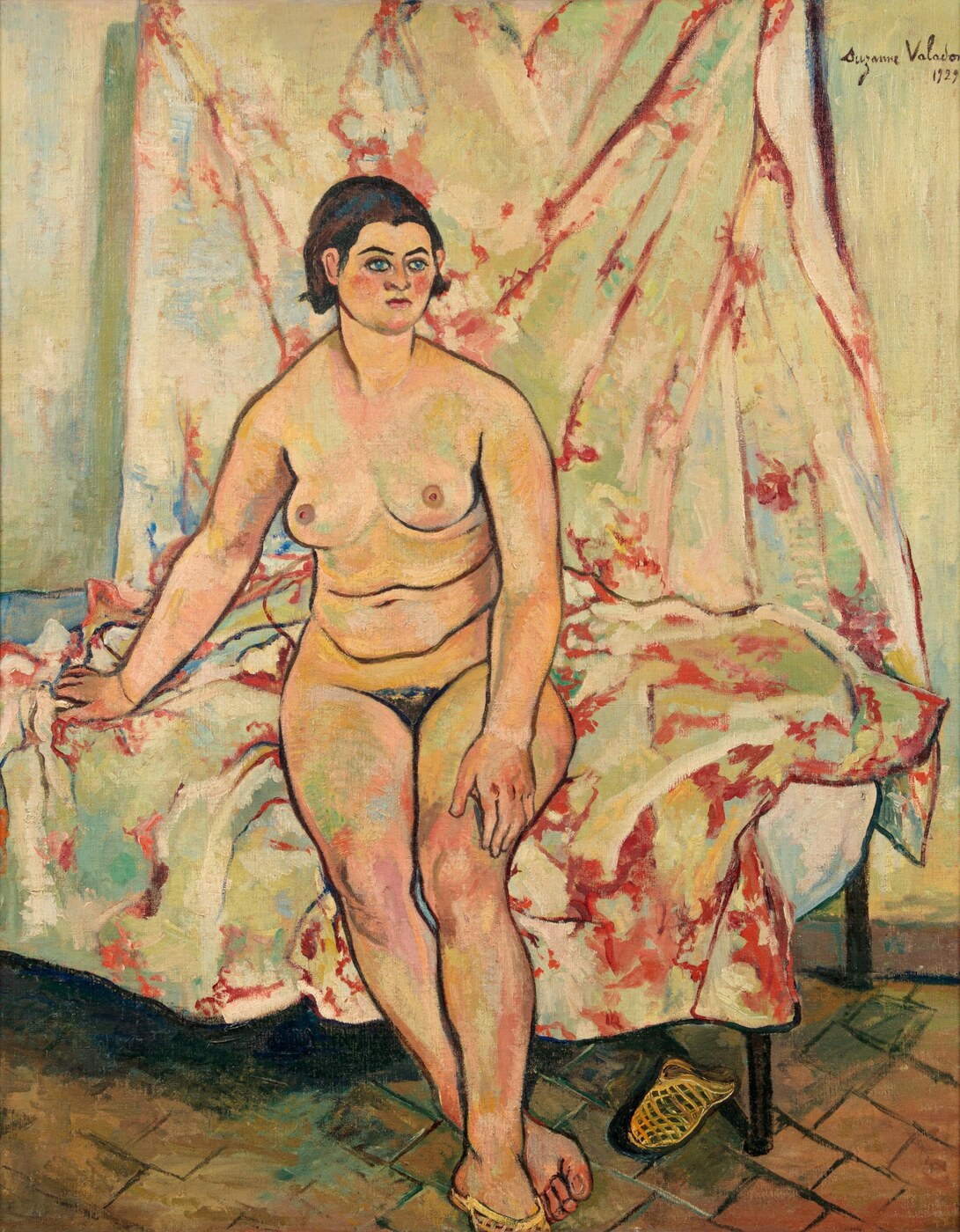
She was not alone in claiming the female body as her subject. Suzanne Valadon began as a model for Renoir, Puvis de Chavannes, and Toulouse-Lautrec, then took up the brush and painted the nude as a woman who had lived inside the pose. The paintings shown here are Valadon’s, a fellow woman painter of the nude standing in for Serebriakova, whose own canvases remain under copyright.
A life interrupted
The Revolution of 1917 ended the world she was born into. Her husband Boris died of typhus in 1919, leaving her with four children and a frozen estate. In 1924 she traveled to Paris for work, intending to return. She never did. For decades she painted commissions to bring her children west, and the late work grows quieter, as if the early confidence had been spent.
Why she still matters
She died in relative obscurity in the West, though Soviet audiences knew her name well. Today her early nudes read as decades ahead of their time: a woman claiming the female body as her own subject long before anyone had coined the phrase female gaze.
The argument over who gets to paint the female nude is far from settled. Museums, auction houses, and social platforms relitigate it every week. Serebriakova’s Bathhouse is an answer from 1913 that has not gone stale. The body looks different when the person painting it has lived in one.