On May 3, 1833, the British painter Philip Hermogenes Calderon was born in Poitiers, France to a Spanish father and French mother. Though his name hints at foreign roots, Calderon became one of Victorian England’s most intriguing — and at times controversial — painters of the human form.
From Pre-Raphaelite Roots to the Royal Academy
Calderon trained at Leigh’s Art School in London and later under François-Édouard Picot in Paris. His early work showed clear Pre-Raphaelite influence — rich colors, meticulous detail, and emotionally charged storytelling. Paintings like Broken Vows (1856) made his reputation, and by 1867 he was elected a full member of the Royal Academy.
His career took a pivotal turn in 1887 when he was appointed Keeper of the Royal Academy. In this influential role, Calderon became a passionate advocate for teaching anatomy through nude life models — a practice that was far from universally accepted at the time, even within the art establishment.
The Nude in Calderon’s Art
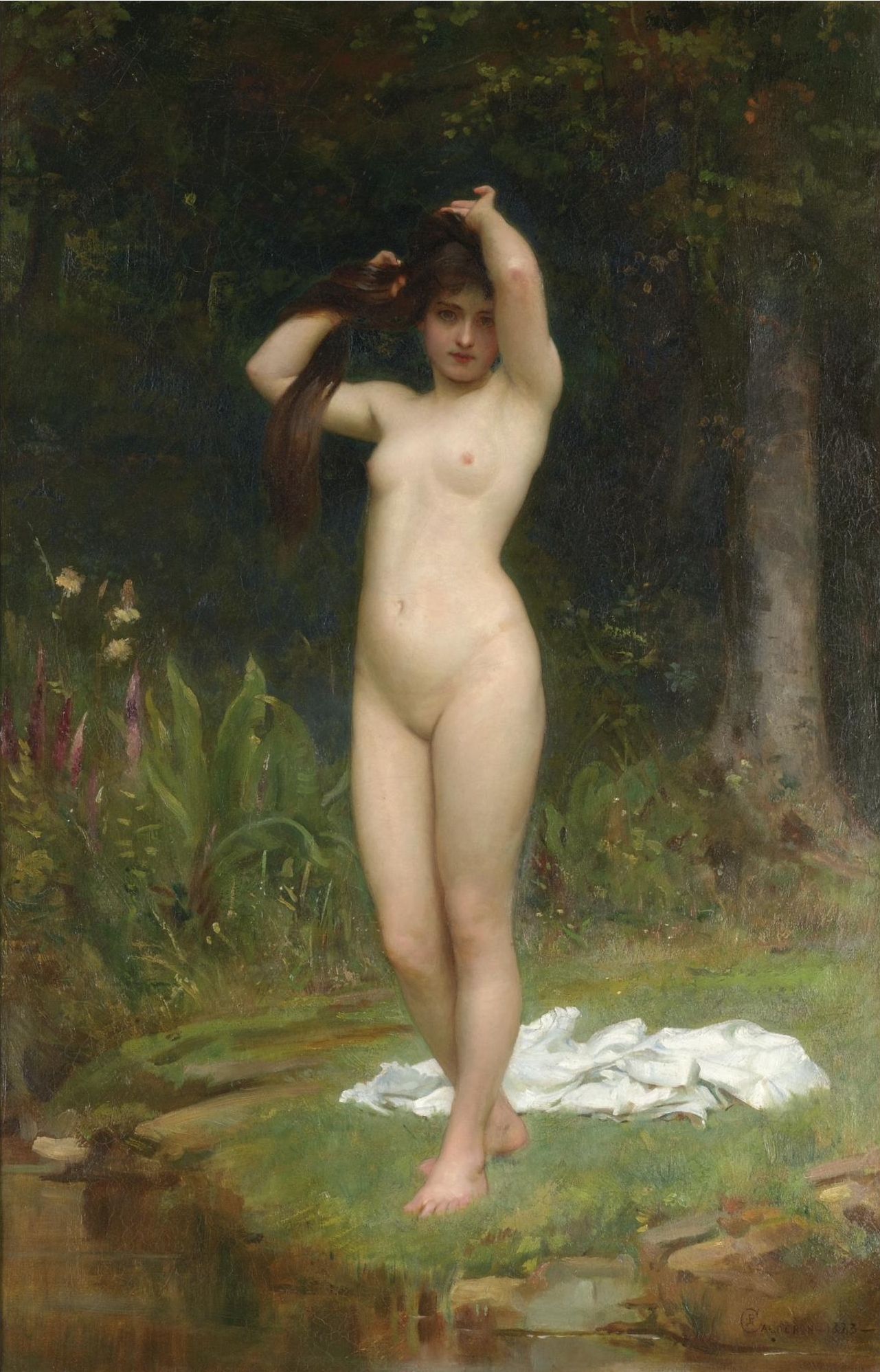
Calderon approached the nude figure through two distinct lenses: mythological grace and religious conviction. His 1883 painting A Woodland Nymph exemplifies the former — a solitary female nude set in a hushed forest landscape, more chaste than sensual, belonging to the long tradition of nymphs in Western painting.
The Scandal of St. Elizabeth
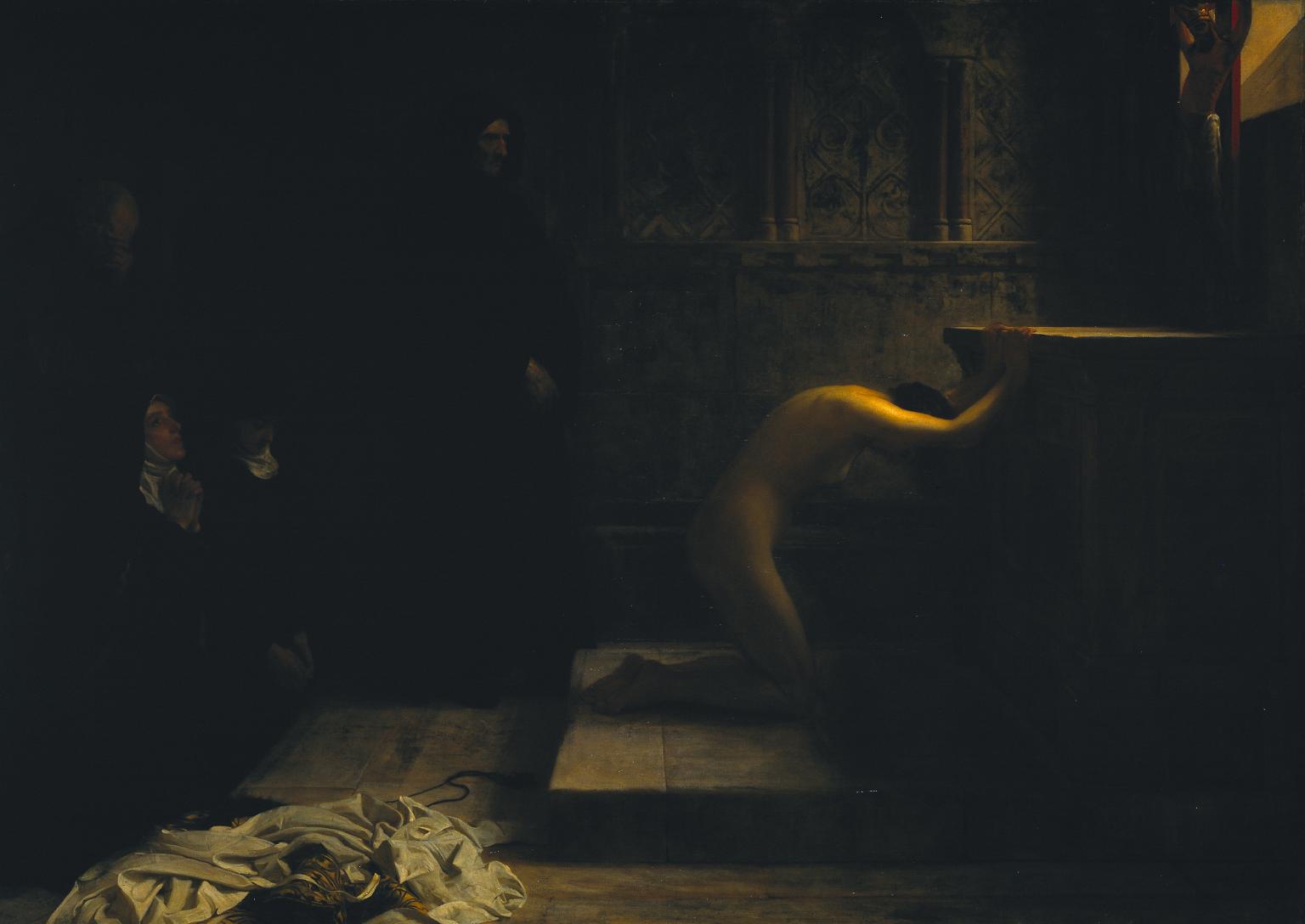
But it was Calderon’s 1891 masterpiece — and the one that drew the sharpest public outcry — that most directly engaged the nude as a subject of serious art. St. Elizabeth of Hungary’s Great Act of Renunciation depicts the 13th-century Hungarian queen and saint kneeling naked before an altar, watched by solemn monks and nuns.
The painting was based on Charles Kingsley’s play The Saint’s Tragedy (1848), in which Elizabeth, after the death of her husband, renounces her worldly position and wealth with the line: “Naked and barefoot through the world to follow my naked Lord.”
The work was acquired by the Chantrey Bequest for the national collection (now at Tate Britain) for £1,200 — a substantial sum. But it immediately provoked outrage, particularly from Roman Catholic viewers who found the depiction of a revered saint in the nude deeply offensive. The controversy echoed the broader Victorian anxiety about the nude in art: was it academic and noble, or indecent?
The Naked Saint and Victorian Censorship
Calderon’s St. Elizabeth stands at an interesting crossroads in the history of nude art. The Victorian era was famously conflicted about the body — simultaneously obsessed with classical nudes in academic settings and deeply anxious about their moral implications.
What made Calderon’s painting different was the religious context. A mythological nymph could be dismissed as classical fancy. A Biblical Susanna could be framed as moral instruction. But a canonized saint — a real woman from not-so-distant history — shown utterly naked in an act of piety? That crossed a line for many viewers.
Yet the painting also had defenders who argued that the nudity was essential to the narrative. Elizabeth’s renunciation was of everything — her clothes, her status, her worldly identity. To clothe her would have been to miss the point entirely. As Calderon himself might have argued, the nude here wasn’t decorative or erotic — it was theological.
Calderon’s Legacy
Calderon died in London on April 30, 1898 — just three days short of his 65th birthday. In his final years as Keeper of the Royal Academy, he had worked tirelessly to ensure that future generations of British artists would study the nude figure from life, not just from plaster casts or books.
Today, Calderon is remembered as a significant figure in Victorian painting — an artist who bridged the Pre-Raphaelite movement’s intensity with a more classical academicism, and who was unafraid to provoke when the subject demanded it. His St. Elizabeth remains in the Tate collection: a reminder that the debate over the nude in art — what it means, when it’s appropriate, and who gets to decide — is as old as art itself.
Visit nudeartla.com to explore more art history, join the conversation about the nude in art, and discover LA’s vibrant nude art community.