On May 10, 1508, Michelangelo di Lodovico Buonarroti Simoni received 500 papal ducats from Pope Julius II and recorded in his own hand: “Today, 10 May 1508, I, Michelangelo sculptor, have received from His Holiness our Lord Pope Julius II five hundred papal chamber ducats … on account of the painting of the vault of the chapel of Pope Sixtus for which I began work today.”
Michelangelo, who considered himself a sculptor above all else, had reluctantly agreed to paint. What followed over the next four years would become the single most influential cycle of frescoes in the Western canon — and one of the most audacious celebrations of the nude human body ever set inside a house of worship.
The Pope Wanted Apostles. Michelangelo Gave Him 300 Figures.
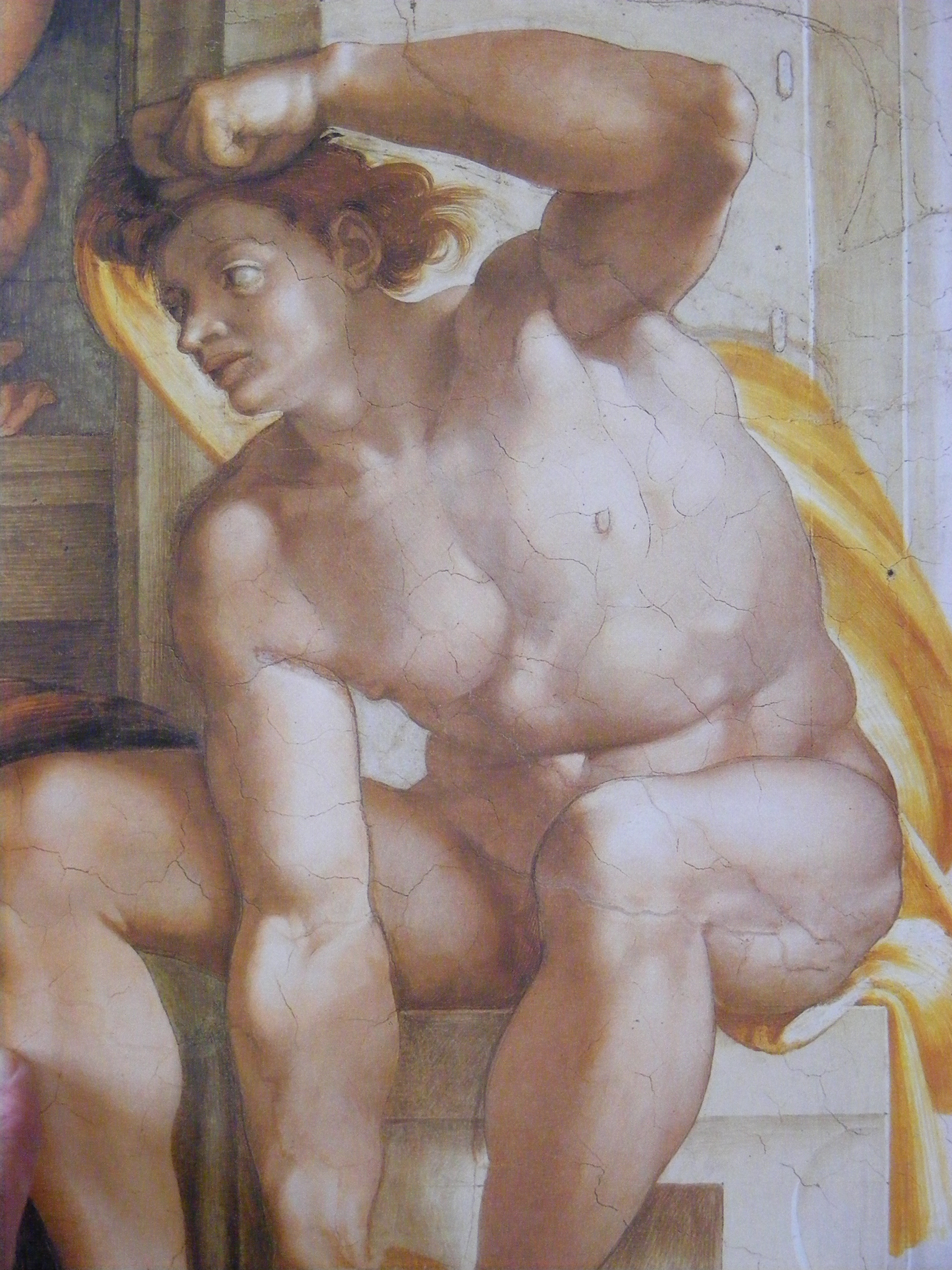
Pope Julius II’s original plan was modest: paint the Twelve Apostles on the chapel’s pendentives and fill the remaining space with ornamental geometry. Michelangelo negotiated for something far grander. His eventual scheme encompassed over 300 figures spanning nine central panels from the Book of Genesis, surrounded by prophets, sibyls, the ancestors of Christ, and — most provocatively — twenty nude male youths that art history would come to call the ignudi.
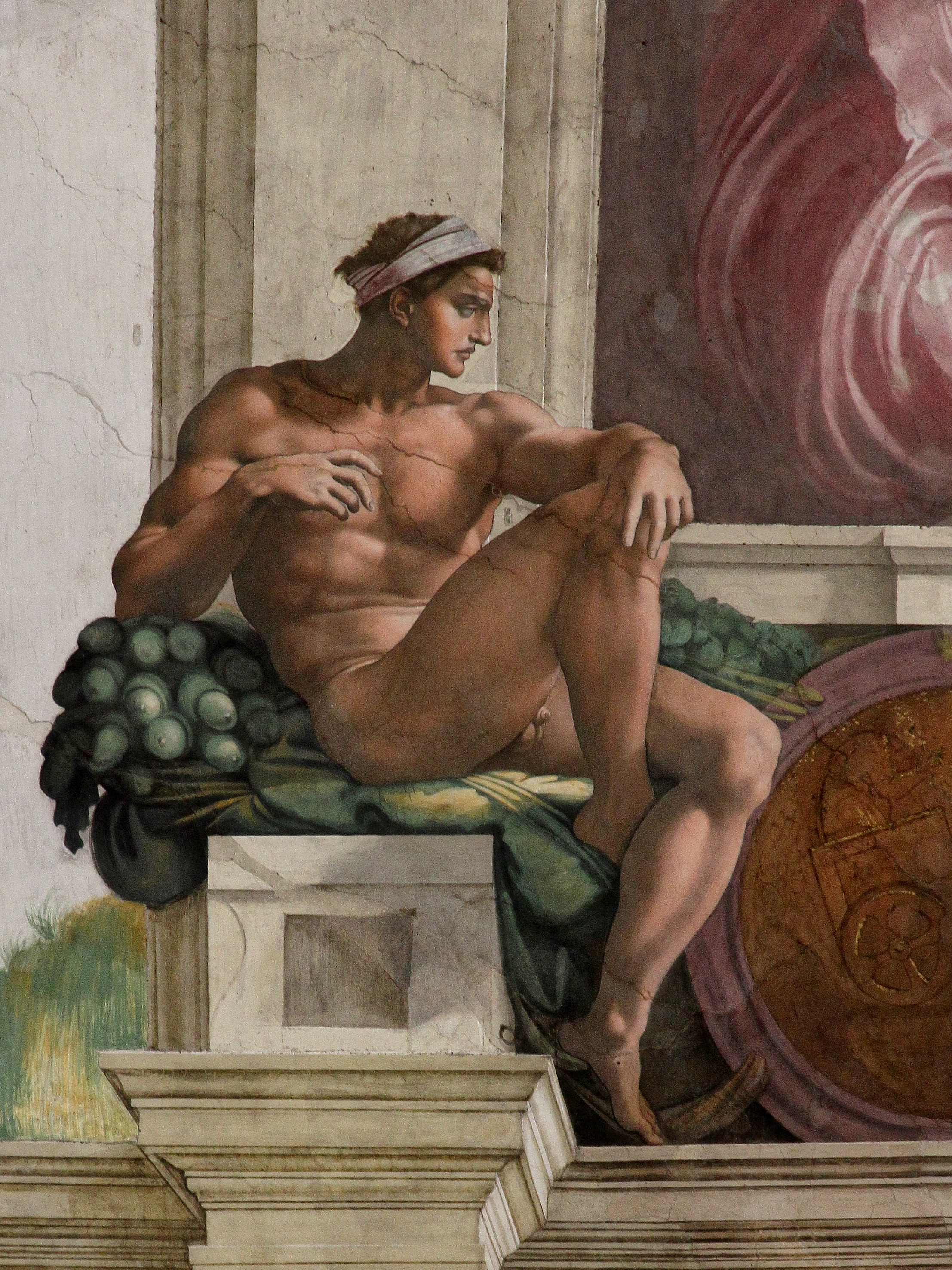
The ignudi (from the Italian ignudo, meaning “nude”) sit at the four corners of each of the five smaller Genesis panels, their muscular forms perched on fictive marble plinths as if they belong to a separate, higher plane of existence. They hold garlands of oak leaves and acorns — the heraldic emblem of the della Rovere family to which Pope Julius belonged — and frame bronze-colored medallions depicting scenes from the Old Testament.
Their precise meaning has been debated for five centuries. Art historian Kenneth Clark wrote that “their physical beauty is an image of divine perfection; their alert and vigorous movements an expression of divine energy.” The prevailing interpretation, rooted in Florentine Neoplatonism, sees them as representing humanity in its ideal, prelapsarian state — beings untouched by Original Sin, existing in a realm closer to God than the fallen prophets and sibyls below them.
The Nude Body as Theological Argument
What makes the Sistine Chapel ceiling so revolutionary is not simply that it contains nude figures — Renaissance art had been rediscovering the classical nude for decades — but that it places the glorified, athletic nude at the very center of Catholic theology. Michelangelo took the Neoplatonic idea that physical beauty was a reflection of divine perfection and literalized it on the ceiling of the pope’s own chapel.
Consider The Creation of Adam, perhaps the most famous image in the history of art. God reaches toward Adam, and Adam — entirely nude, reclining on a barren hillside — mirrors the Creator’s gesture. The nearly-touching fingers have been interpreted as representing the unattainability of divine perfection, but they also speak to something more profound: the belief that the human body, in its most essential form, carries within it the capacity for the divine. Adam’s body is not a shameful vessel. It is the recipient of the spark of life, made in the image of God.
This was a radical assertion in 1508, less than a decade before Martin Luther would nail his Ninety-five Theses to a church door in Wittenberg. The Catholic Church was still processing the humanist revolution of the fifteenth century — the rediscovery of classical texts, the celebration of human achievement, the conviction that the study of the human form was a study of God’s greatest creation. Michelangelo’s ceiling became the definitive visual expression of that synthesis.
The Ignudi: Why Are They There?
Art historians have proposed many theories about the ignudi. Some see them as representations of the angels who witnessed Creation, their nudity signifying their purity and proximity to the divine. Others interpret them through the lens of Renaissance humanism, as embodiments of the idealized human form that the classical world had perfected and that Christian art had largely abandoned during the Middle Ages.
What is certain is that Michelangelo lavished extraordinary attention on them. Each ignudo is posed differently — twisting, reaching, sitting, turning — forming a virtual anatomy lesson in contrapposto and foreshortening. They allowed Michelangelo to demonstrate his supreme mastery of the male nude in a way that the narrative panels themselves could not fully accommodate. They are, in a sense, the sculptor’s fingerprint on a fresco cycle: figures that could have been carved in marble, rendered in pigment on wet plaster.
The ignudi also serve a compositional purpose, creating a visual bridge between the sacred history unfolding in the central panels and the space of the chapel itself. They occupy a liminal zone between the fictional world of the frescoes and the real world of the worshipers below — nude, monumental, and utterly at home in the house of God.
The Body After the Ceiling
The influence of Michelangelo’s ceiling on subsequent depictions of the nude cannot be overstated. The ignudi were imitated by generations of artists — from Raphael’s School of Athens, where the figures on the lower level echo their poses, to the Mannerist painters who exaggerated their torsion and elongation. Michelangelo had established that the nude body was not merely a subject for classical sculpture or mythological painting; it was a legitimate vehicle for the most profound theological and philosophical ideas.
When Michelangelo returned to the Sistine Chapel two decades later to paint The Last Judgment on the altar wall, he pushed this idea even further, filling the composition with a swirling mass of nude figures — the saved ascending and the damned falling — all rendered with an intensity that would later provoke censorship during the Counter-Reformation. The loincloths added by Daniele da Volterra in 1565 (earning him the nickname “Il Braghettone,” or “the breeches painter”) represent one of history’s most famous acts of nudity censorship — a direct response to the very freedom Michelangelo had claimed on the ceiling.
Why This Matters Today
The debate Michelangelo ignited — about whether the nude body belongs in sacred spaces, about the relationship between physical beauty and spiritual truth, about the line between reverence and prurience — has never really ended. It echoes in every controversy over public art, every debate about nudity in museums and galleries, every legal battle over censorship and artistic freedom.
When Pope Julius II signed the contract with Michelangelo on May 10, 1508, he could not have known that he was commissioning not just a ceiling, but a template for how Western art would understand the human body for the next half millennium. Michelangelo gave us permission to see the nude not as shameful, but as sacred — as the site where the human and the divine most vividly intersect.
That is a legacy worth remembering, especially in a world that still struggles to distinguish between the naked and the nude.
For NALA, which has spent nearly a decade celebrating the nude in art, Michelangelo’s ceiling remains the ultimate proof of our conviction: that the human body, in all its forms, is worthy of reverence, contemplation, and art.