At the heart of Western art sits a subject so ancient, so persistent, and so contested that it has come to define entire movements, wreck reputations, and launch revolutions: the nude human body.
From the smooth marble gods of ancient Greece to the confrontational canvases of the 21st century, the nude has never simply been about undressing. It has been a mirror for every civilization’s beliefs about beauty, power, sexuality, and what it means to be human.
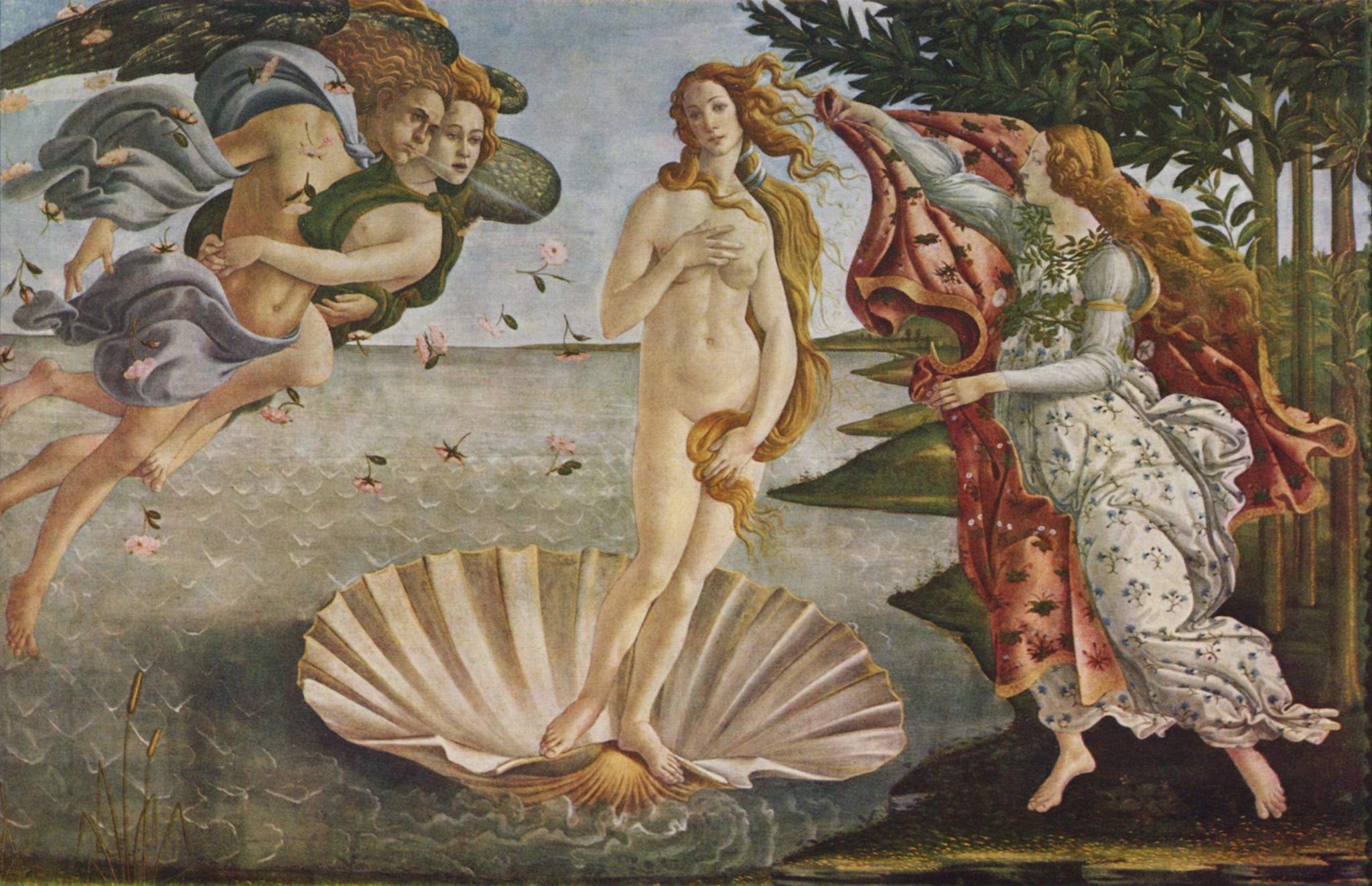 Sandro Botticelli, The Birth of Venus (1484-1486) — Uffizi Gallery, Florence. Public domain.
The Greeks: Inventing the Ideal
The story begins in ancient Greece, where sculptors transformed the human form into a vessel for philosophy. The Greek kouros—a free-standing nude male youth—was not a portrait of any individual. It was an ideal: perfectly proportioned, eternally youthful, balanced between motion and stillness.
This wasn’t just art. It was mathematics, geometry, and metaphysics made flesh. Pythagoreans believed numerical ratios governed the cosmos, so the ideal body became a microcosm of universal order. The contrapposto stance—a slight S-curve in the spine that Polykleitos codified around 450 BCE—gave marble the illusion of living breath.
The Venus de Milo, created around 130-100 BCE, represents the Greek ideal of female beauty: serene, modest, and proportioned according to strict mathematical ratios. Her missing arms have only increased her mystique, forcing viewers to complete the work in their imagination—an invitation to participate in the act of creation.
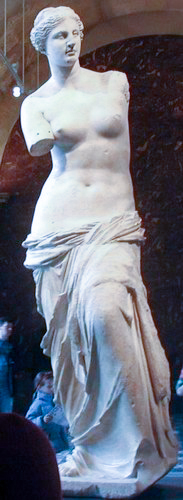 Venus de Milo, Louvre Museum (c. 130-100 BCE). Public domain.
The Romans copied Greek sculptures by the thousands, spreading the nude across their empire. But when Christianity rose, the nude body—once a symbol of divine harmony—became a source of shame. For over a thousand years, the naked form all but disappeared from Western art, hidden beneath the robes of saints and the drapery of biblical scenes.
The Renaissance: Rediscovering the Body
The Renaissance was, in many ways, the re-nudification of Western art. When Florentine humanists began unearthing Roman copies of Greek sculptures in the 15th century, they weren’t just discovering ancient art. They were recovering a whole way of thinking about the body as something sacred rather than sinful.
Sandro Botticelli’s The Birth of Venus (1484-1486) marked a watershed. For the first time since antiquity, a life-sized female nude stood at the center of a major commission—not as Eve, not as a sinner, but as a goddess born from the foam of the sea. Venus covers herself with a modest gesture, but the painting’s true subject is the celebration of the naked form as something beautiful, mythic, and worthy of contemplation.
Botticelli’s Venus stands at the threshold of a revolution. Within decades, Michelangelo would carve his David, Raphael would paint his Galatea, and Titian would produce the sensuous Venus of Urbino—each pushing the nude further toward naturalism, psychology, and eroticism.
By the Baroque period, artists like Caravaggio and Rubens had transformed the nude into a vehicle for drama, emotion, and physical excess. The body was no longer an ideal—it was a battlefield of light and shadow, flesh and spirit.
The 19th Century: Scandal and Liberation
No painting better captures the 19th century’s fraught relationship with the nude than Édouard Manet’s Olympia (1863). When it debuted at the Paris Salon of 1865, the painting caused a scandal that rippled across Europe. Not because the subject was nude—the Salon was full of nudes—but because Manet’s Olympia was unapologetic.
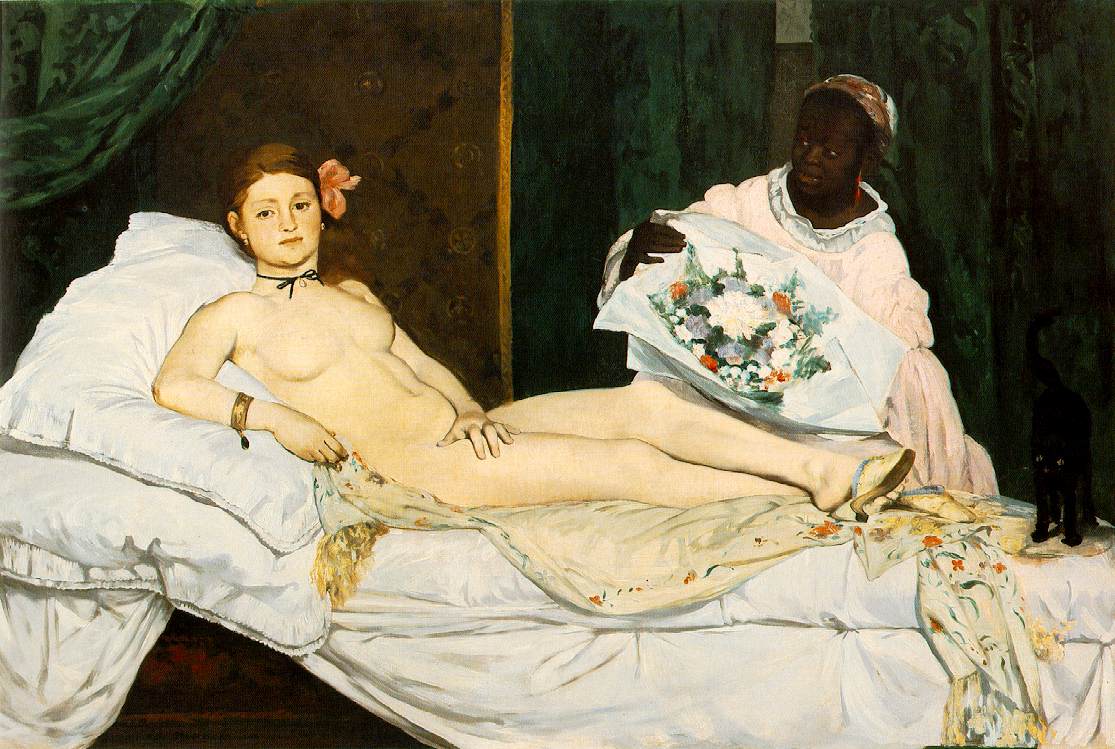 Édouard Manet, Olympia (1863) — Musée d’Orsay, Paris. Public domain.
She looks directly at the viewer with a calm, knowing gaze. Her hand presses firmly against her body, not in modesty but in self-possession. She is a sex worker who refuses to look away, and that refusal—that assertion of her own subjectivity—was what made the painting indecent in the eyes of its critics. Olympia wasn’t a goddess or a mythic figure; she was a real woman in a real room, and she had the audacity to stare back.
Manet’s painting marked a turning point. The nude was no longer required to be mythological or allegorical. It could be contemporary. It could be confrontational. It could ask difficult questions about class, gender, and power.
From that moment, the trajectory of the nude accelerated through Impressionism (Renoir’s bathers, Degas’s women at their toilette), Post-Impressionism (Gauguin’s Tahitian figures), and into the explosive innovations of the 20th century.
Modernism: Breaking the Body Apart
Pablo Picasso’s Les Demoiselles d’Avignon (1907) shattered the nude in a different way. Where Manet had challenged the viewer’s assumptions about who could be nude and how, Picasso challenged the very structure of representation. Five women’s bodies are fractured into geometric planes, their faces distorted by Iberian and African mask influences. The painting was so radical that even Picasso’s closest friends were horrified.
The 20th century saw the nude dispersed across every possible stylistic register. Egon Schiele twisted the body into expressions of psychological torment. Lucian Freud painted flesh with unforgiving honesty. Jenny Saville blew the female nude up to monumental scale, subverting centuries of the male gaze by reclaiming the form for a woman’s eye.
Why the Nude Still Matters
In an age of digital imagery, AI-generated bodies, and endless debates about representation, the nude in fine art remains as vital as it was in ancient Greece. The questions it raises—about who gets to depict whom, what beauty means, where the line between art and exploitation falls—are more urgent than ever.
The nude persists because it is the most direct conversation art can have with its audience. No armor, no costume, no props. Just a body, a gaze, and the space between them. That space is where art happens.
NALA — the National Association of Live Art — champions the tradition of the nude in fine art. Whether through figure drawing, gallery exhibitions, or educational programming, we believe the human body belongs in art, not in shadow. Get involved and help keep the nude alive in contemporary culture.