On this day in 1727, Thomas Gainsborough was baptized in Sudbury, Suffolk — the man who would become England’s greatest 18th-century painter and one of the founding members of the Royal Academy. Yet for all his mastery of portraiture and landscape, Gainsborough left behind only one known nude painting, and it was unfinished at his death.
That fact is extraordinary when you set it against the broader European tradition. Across the Channel, François Boucher was painting nymphs and Venuses by the dozen. Jean-Honoré Fragonard’s canvases practically glowed with erotic warmth. In France, the nude was the currency of high art — mythological, allegorical, decorative, and unapologetically sensual.
In England, it was different. And no single artist illustrates the British relationship with the nude quite like Gainsborough.
The Man Who Painted Everything but the Nude Body
Gainsborough was, by any measure, a giant. Alongside his great rival Sir Joshua Reynolds, he dominated British painting in the second half of the 18th century. He painted King George III and Queen Charlotte. He created the iconic The Blue Boy. His landscapes helped invent the British landscape school — John Constable would later say of Gainsborough’s work: “On looking at them, we have tears in our eyes, and know not what brings them.”
Yet the nude body is almost entirely absent from his output. This wasn’t a question of skill. Gainsborough’s portraits reveal an artist acutely attuned to the nuances of the human form, the drape of fabric over a shoulder, the turn of a wrist, the way light catches skin beneath silk. He could paint the body. He simply chose not to — or rather, the culture he worked in made it nearly impossible to do so as a matter of course.
This is the “British nude problem” of the 18th century. While French painters produced nudes for aristocratic patrons as a matter of routine, British patrons preferred portraits, landscapes, and conversation pieces. The Royal Academy promoted history painting as the highest genre, but the market demanded portraits. Gainsborough himself complained in a letter that he was “sick of Portraits” and longed to “walk off to some sweet Village, where I can paint Landskips.” He never once wrote that he wished he could paint more nudes.
Musidora: The Single Finished Nude
Musidora (c. 1780–1788) is Gainsborough’s only completed nude — and even that word “completed” requires qualification. The painting was still on his easel when he died.
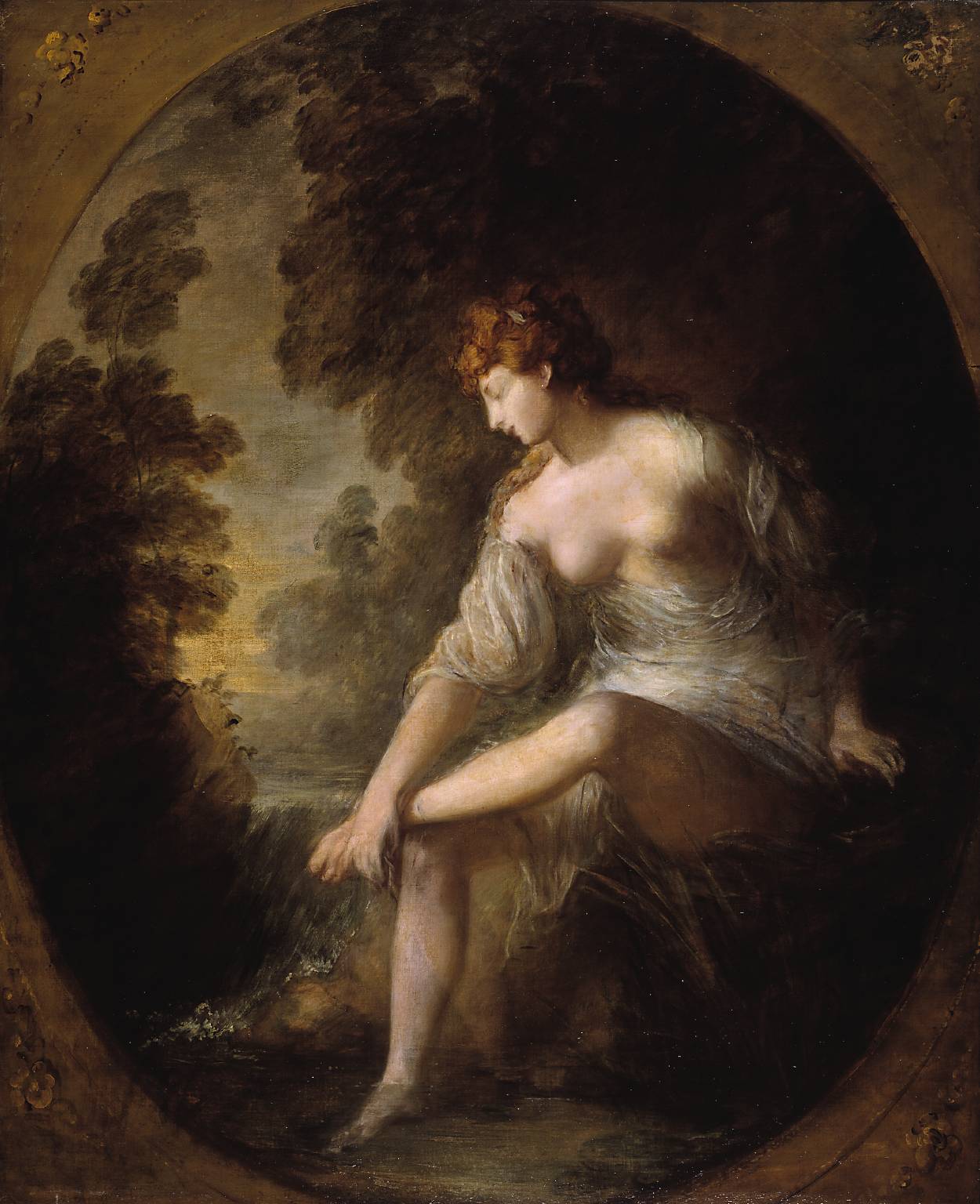
The subject comes from James Thomson’s 1727 poem Summer, part of his larger work The Seasons — the very same poem that gave the world “Rule, Britannia!” The poem describes Musidora, a virtuous maiden, bathing in a secluded pool. She believes she is alone, observed only by nature itself.
This framing is crucial. Musidora is not a goddess, not a mythological figure, not an allegory. She is a literary character caught in a private moment. The nudity is contextualized, almost accidental — a woman surprised in nature rather than a figure displayed for the viewer’s pleasure. Compare this to Boucher’s Venus Consoling Love (1751), where the goddess reclines openly, her nudity the entire point of the composition. Gainsborough’s approach is characteristically English: the nude is permissible so long as it arrives with a narrative excuse.
Painted for Thomas Macklin’s Poet’s Gallery — a project that paired contemporary British poetry with original paintings — Musidora was meant to illustrate English literature, not to celebrate the nude form. It now hangs in Tate Britain as part of the Vernon Gift of 1847, a quiet monument to what English art might have produced had the cultural winds blown differently.
Diana and Actaeon: The Mythological Exception
Even more revealing is Gainsborough’s Diana and Actaeon (c. 1784–1786), his only known essay into classical mythology. The subject is taken from Ovid’s Metamorphoses: the hunter Actaeon stumbles upon the goddess Diana bathing naked with her nymphs. Enraged, Diana transforms him into a stag, and he is torn apart by his own hounds.
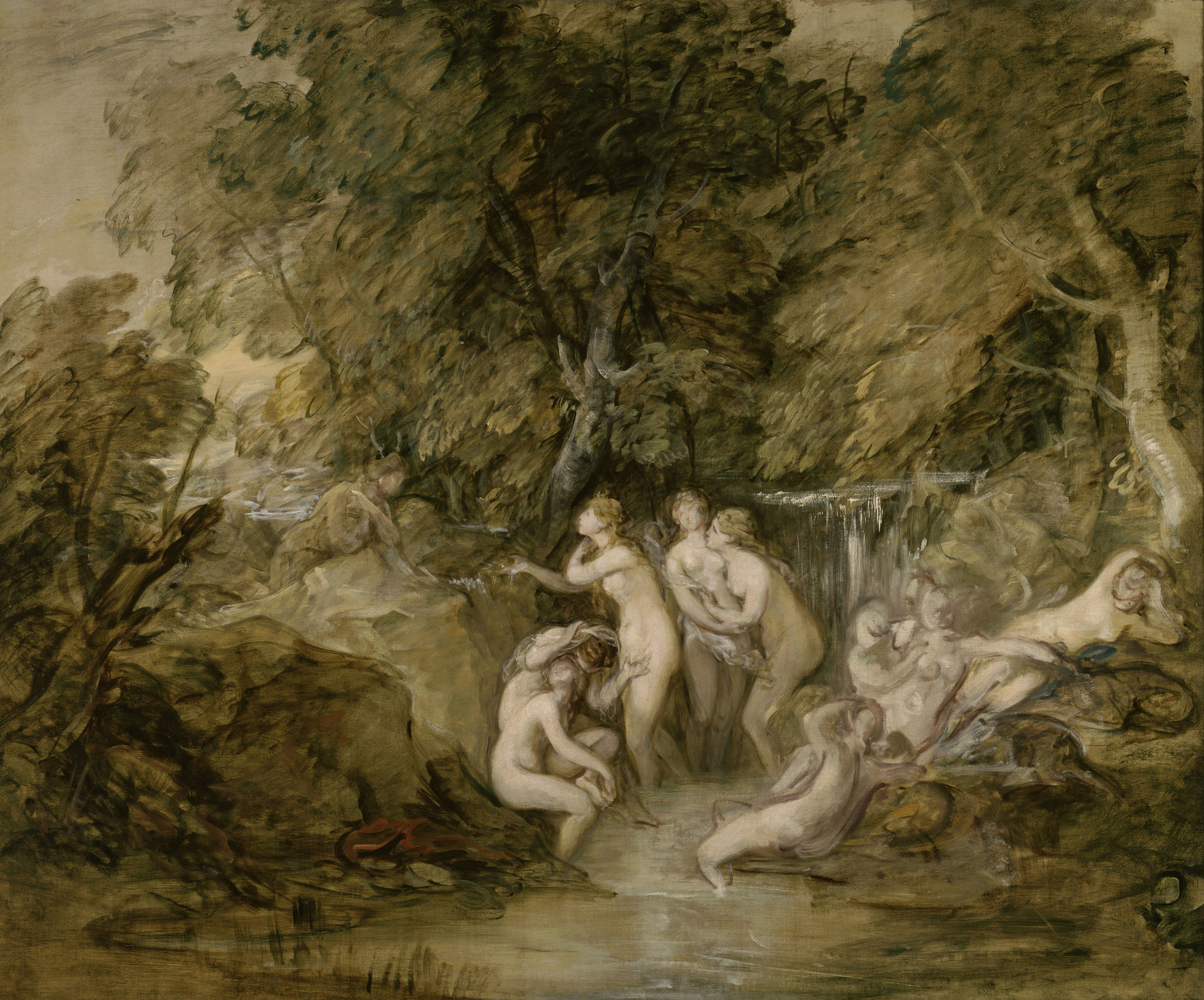
Again, Gainsborough handles the nude with notable restraint — or, more accurately, he submerges it. The painting is dominated by a dense, almost impenetrable woodland. The figures of Diana and her nymphs are partially obscured by trees and shadow. The violation of seeing the goddess naked is the subject, but the bodies themselves are half-hidden, as though the painting itself is embarrassed by its own subject matter.
One contemporary critic observed that Diana and Actaeon is “not really a mythological subject — it’s a study of man in nature.” Gainsborough approached the story the same way he approached a landscape: as an investigation of atmosphere, light, and the relationship between figures and their environment. The nude bodies are not the point; they are part of the landscape.
The painting remained in Gainsborough’s studio at his death and was never formally exhibited during his lifetime. It now belongs to the Royal Collection.
What Gainsborough’s Nudes Tell Us About British Art
The story of Gainsborough and the nude is not a story of failure. He wasn’t a prude, and he wasn’t incapable. His portraits of women are among the most sensitive in Western art — the 1783 portrait of the Duchess of Devonshire, for instance, captures her vitality, intelligence, and physical presence with extraordinary delicacy. But the difference between a clothed duchess and a nude goddess was, in 18th-century England, a categorical divide that few artists could cross comfortably.
Britain never developed a native tradition of the nude in the way France or Italy did. The reasons are complex: the Protestant Reformation’s suspicion of religious imagery, the rise of a middle-class market that valued respectability, the lack of a strong aristocratic patronage system for mythological painting, and a cultural preference for the “natural” over the “classical.” Gainsborough embodied all of these forces. He was England’s greatest painter, and his avoidance of the nude was not a personal limitation but a cultural one.
Two centuries later, the British art world still grapples with this legacy. Lucian Freud and Francis Bacon would eventually shatter the restraint, but they arrived late to a conversation that continental Europe had been having for centuries. Gainsborough stands at the beginning of that conversation — the artist who showed what British painting could do, and, in the process, revealed what it could not yet say.
— NALA Editorial