The Origin of the World: Gustave Courbet’s 1866 Masterpiece and the 160-Year War Against Looking at Naked Bodies
\n\n\n\nThere is a painting hidden behind a green door in the Mus\u00e9e d’Orsay. No guard stands in front of it. No velvet rope keeps you at a distance. But for 120 years \u2014 a stretch that spans the Franco-Prussian War, two world wars, the invention of cinema, and the landing on the moon \u2014 this painting was kept from public view. It was owned by a succession of private collectors, each of whom understood that what they possessed was too powerful, too dangerous, too real to hang on a wall where anyone could see it.
\n\n\n\nThe painting is Gustave Courbet’s L’Origine du monde (The Origin of the World), completed in 1866. It depicts a woman’s torso, thighs, and exposed genitals \u2014 nothing more, nothing less. No mythological allegory. No biblical pretext. No classical fig leaf. Just a body, seen without excuse. And that, it turns out, was the most radical thing an artist could do.
\n\n\n\n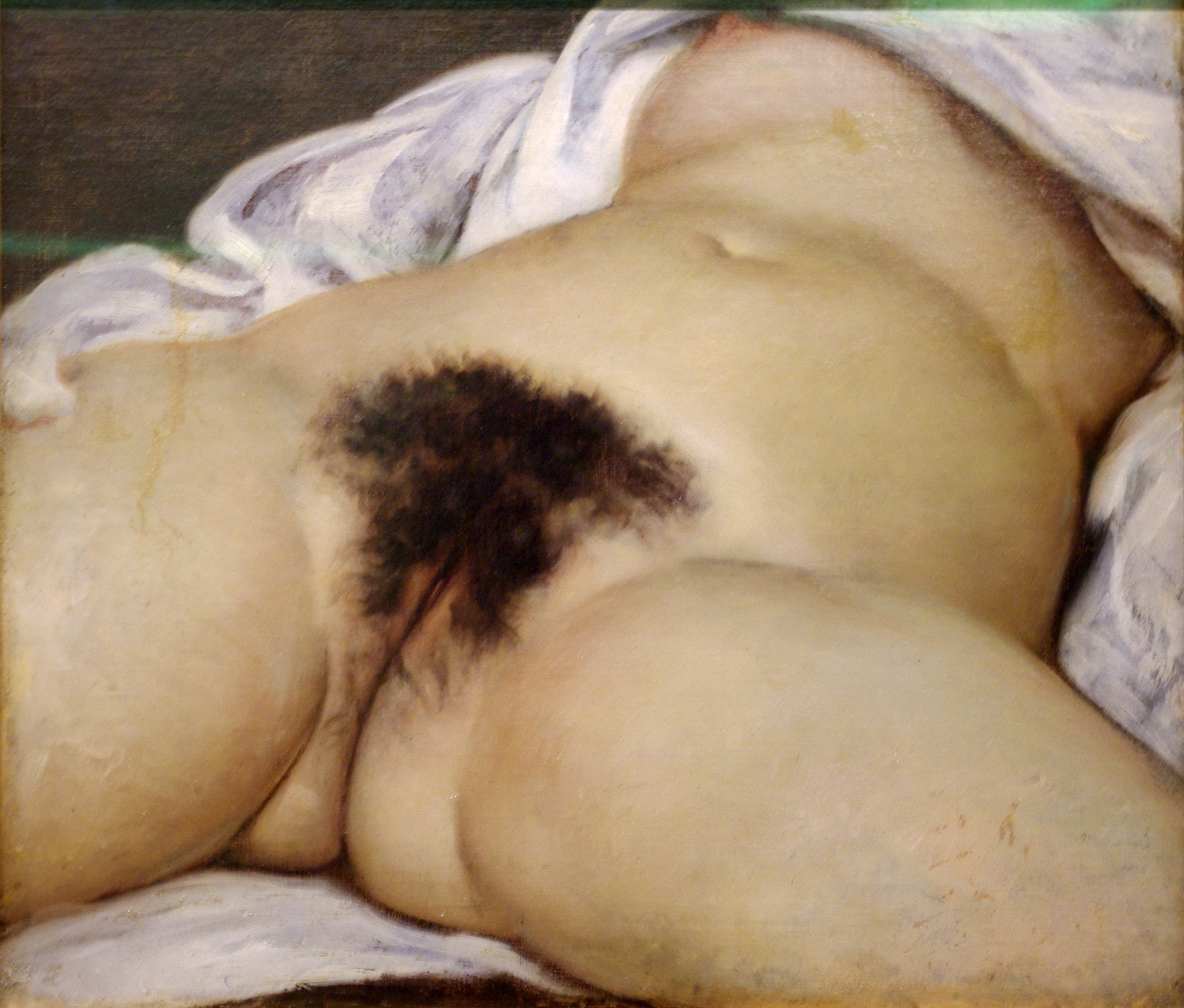
The Painting That Refused to Be Art
\n\n\n\nBy 1866, Courbet was already a provocateur. He had declared himself a Realist \u2014 not as a style, but as a\u5ba3\u8a00. His Burial at Ornans (1849) scandalized Paris by painting ordinary country people life-sized, as if they deserved the monumental scale reserved for history painting. His Sleep (1866, painted the same year as Origin) depicted two women entangled in post-coital sleep \u2014 and was immediately labeled pornography.
\n\n\n\nBut L’Origine du monde was different. It didn’t scandalize Paris because it was never shown in Paris. The painting was commissioned by Khalil-Bey, an Ottoman-Egyptian diplomat and collector who maintained a private collection of erotic art. He hired Courbet to paint something that would hang in his private apartments \u2014 a painting for looking, not for display.
\n\n\n\nAfter Khalil-Bey fled gambling debts in 1868, the painting disappeared. For over a century, art historians knew it only through references in letters. Some assumed it had been destroyed. Others believed it existed but had no proof. The most famous missing painting in Western art became a kind of ghost \u2014 discussed in whispers, reproduced in blurry black-and-white photographs passed between collectors like contraband.
\n\n\n\nThe Psychoanalyst’s Secret
\n\n\n\nIn 1955, the painting resurfaced. Its owner was Jacques Lacan, the French psychoanalyst, who had purchased it at auction in 1954. Lacan hung it in his country house at Guitrancourt \u2014 but not where visitors might see it. He installed a sliding wooden panel over the canvas, painted by another artist with a bucolic landscape. To see L’Origine du monde, you had to know the panel was there. You had to slide it open yourself.
\n\n\n\nThis is the perfect metaphor for how the Western world has treated the female nude: acceptable when draped in allegory, dangerous when presented as itself. Lacan’s sliding panel is the history of art censorship in physical form \u2014 a mechanism designed to let you choose whether to see.
\n\n\n\n1866: The Year Courbet Painted Three Masterpieces of the Forbidden
\n\n\n\nRemarkably, 1866 saw Courbet produce not one but three of the most daring nudes of the 19th century. Alongside L’Origine du monde, he painted Woman with a Parrot and Le Sommeil (The Sleepers).
\n\n\n\n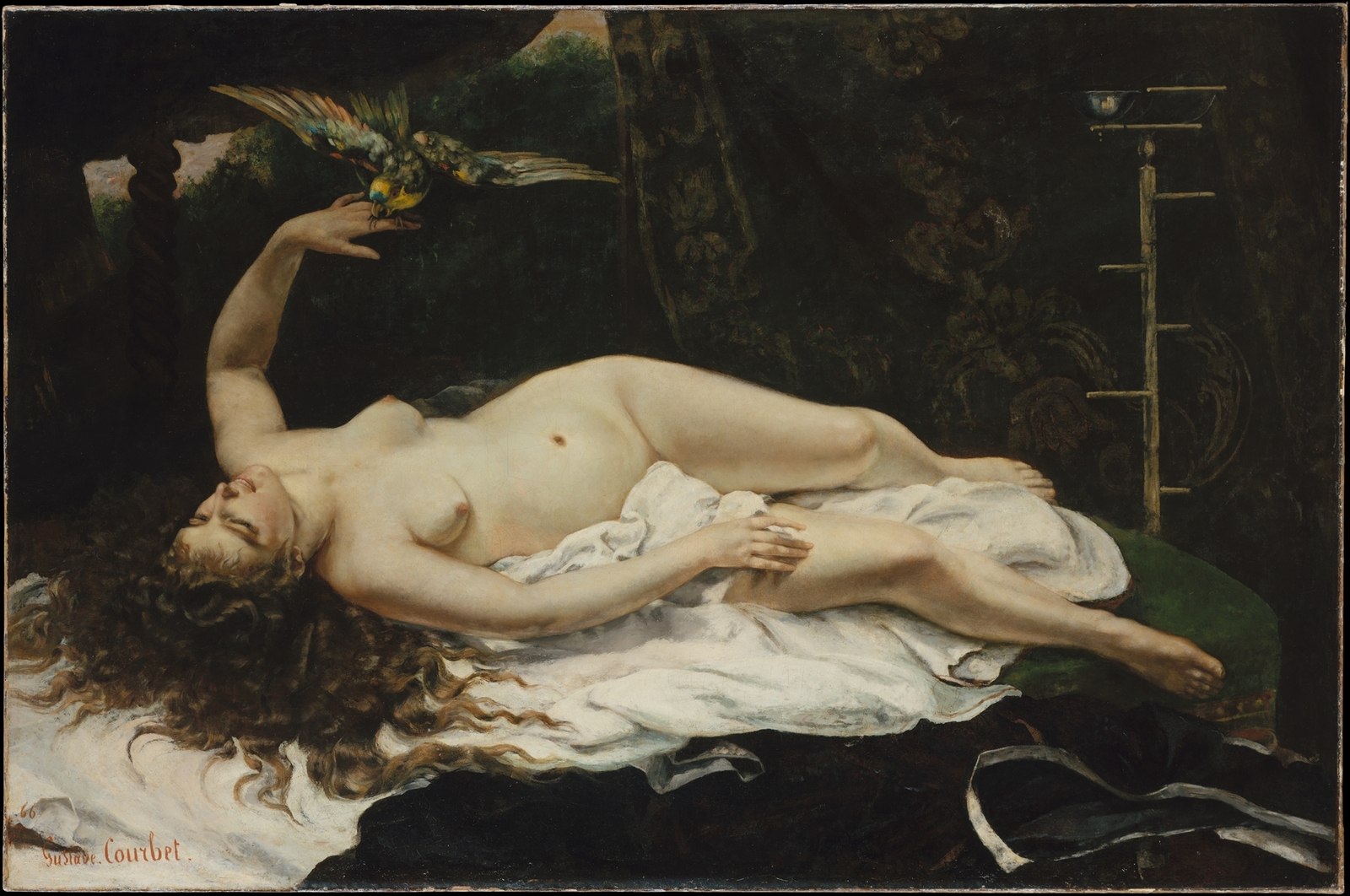
Woman with a Parrot shows a nude woman lying on her back, her hair cascading over the edge of a bed, a parrot perched on her raised hand. It was Courbet’s first nude accepted by the official Salon \u2014 but only because he added the parrot. The bird gave the painting a “subject” \u2014 a narrative pretext that made the nudity legible to the bourgeois jury. Without the parrot, it would have been just a woman, naked, with no story to justify her exposure. The parrot is the fig leaf of narrative.
\n\n\n\n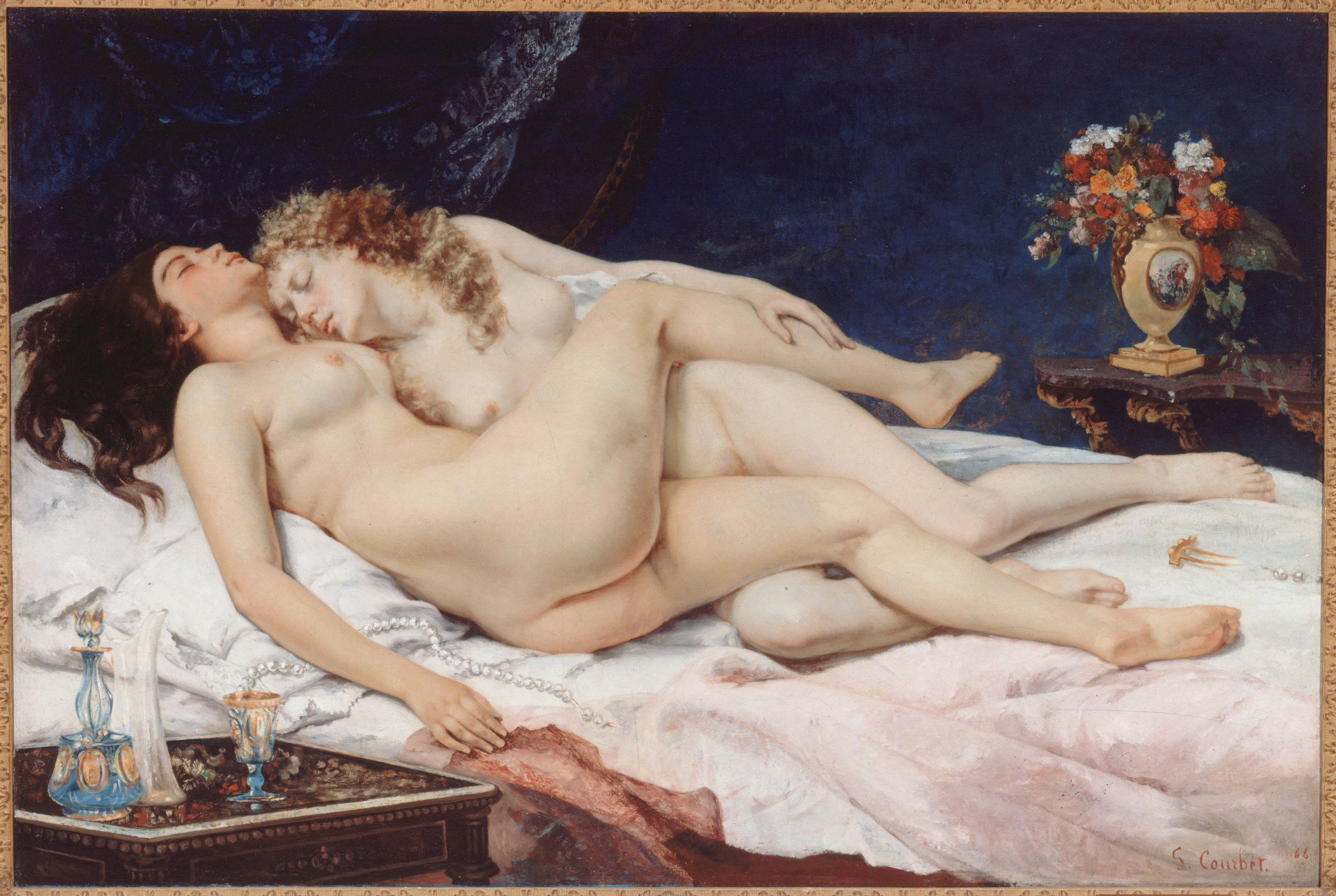
Le Sommeil was even more direct: two women asleep in bed, their bodies intertwined, the visible evidence of sexual intimacy rendered in rich, warm flesh tones. The Paris police vice squad raided the shop of the dealer who displayed it in the window. The painting was labeled obscene and removed. Today it hangs in the Petit Palais, steps from the Champs-\u00c9lys\u00e9es, and no one raids anything.
\n\n\n\nThe Most Censored Canvas in French History
\n\n\n\nL’Origine du monde didn’t enter the public museum system until 1995, when Lacan’s heirs donated it to the Mus\u00e9e d’Orsay in lieu of estate taxes. The museum spent years debating how to display it. Should it have its own room? A warning label? Limited hours?
\n\n\n\nToday it hangs in a dedicated space on the second floor, behind a glass panel \u2014 not locked away, but signaled as different. In 2014, a performance artist was arrested for lying beneath it and reenacting the pose. In 2024, the museum began requiring visitors under 18 to be accompanied by an adult to view it. The painting is 160 years old and still triggers institutional panic.
\n\n\n\nCompare this to the Venus of Urbino by Titian (1538), which shows a woman in a nearly identical pose \u2014 hand over genitals, gaze meeting the viewer. Titian’s Venus is art history. Courbet’s Origin is pornography. The difference? Titian gave his nude a mythological name. Courbet refused to lie.
\n\n\n\nWhat Courbet Understood That We Keep Forgetting
\n\n\n\nCourbet’s great insight was that the nude in Western art had always been a kind of respectable fiction. It was Venus, not a woman. It was Eve, not a body. It was allegory, not reality. The female nude was acceptable in museums precisely because she was never quite herself \u2014 always standing in for something else: beauty, truth, nature, sin.
\n\n\n\nCourbet stripped that fiction away. His Origin doesn’t represent anything but what it is. The title is both literal and ironic \u2014 yes, this is where we all come from, the origin of every human life. But it’s also a dare: can you look at this without adding a story?
\n\n\n\nMost people can’t. That’s why the painting still needs its green door, its glass panel, its parental advisory. That’s why Facebook and Instagram’s AI content moderators \u2014 trained on millions of labeled images \u2014 still flag cropped details of L’Origine du monde as prohibited content while letting The Birth of Venus circulate freely. The algorithm doesn’t know Courbet’s title. It only knows a naked body that refuses to be art history.
\n\n\n\nThe Line That Hasn’t Moved
\n\n\n\nWe like to think we’ve progressed. The Mapplethorpe trial is 35 years behind us. The NEA survived its defunding attempts. Museums compete to acquire sexually explicit contemporary works. But the same fundamental line persists \u2014 drawn not by law but by cultural comfort. The line says: a nude is art when it’s about something else, and obscene when it’s about itself.
\n\n\n\nCourbet’s Origin crossed that line in 1866 and hasn’t been recrossed. We’ve spent 160 years testing whether a painting of a woman’s body can be allowed to simply exist as itself. The answer, so far, is still no \u2014 or at least “yes, but behind a glass panel.”
\n\n\n\nThat tension \u2014 between what we can bear to see and what we’re willing to admit we see \u2014 is the real subject of Courbet’s masterpiece. It’s not a painting about a body. It’s a painting about looking. And we still haven’t figured out how to do it without flinching.
\n\n\n\nExplore more of the conversation about art, censorship, and the nude body in our Censorship & Culture archive. NALA is a 501(c)(3) nonprofit. Support our mission.
\n\n