Thomas Eakins Painted the Body Without Lies
On June 25, 1916, Thomas Eakins died in Philadelphia at the age of seventy-one. He was broke, bitter, and largely forgotten by the art world that had once celebrated him. But in the decades since, Eakins has been recognized as arguably America’s greatest painter of the human figure — and the story of why he fell from grace is, in essence, a story about the nude.
The Making of a Realist
Born in Philadelphia in 1844, Eakins trained at the Pennsylvania Academy of the Fine Arts before sailing to Paris in 1866 to study under Jean-Léon Gérôme at the École des Beaux-Arts. Unlike many American painters who brought back a watered-down European classicism, Eakins absorbed something far more radical: the belief that truth to the human body was the foundation of all great art.
He returned to Philadelphia in 1870 and immediately began producing the works that would define his career — portraits, surgical scenes, rowing pictures, and, most controversially, paintings of the unclothed human body that refused to prettify or idealize. Where his contemporaries were still painting allegorical nudes draped in mythological gauze, Eakins painted bodies that looked like bodies — specific, weighted, individual, and unapologetically real.
The Swimming Hole: An American Masterpiece
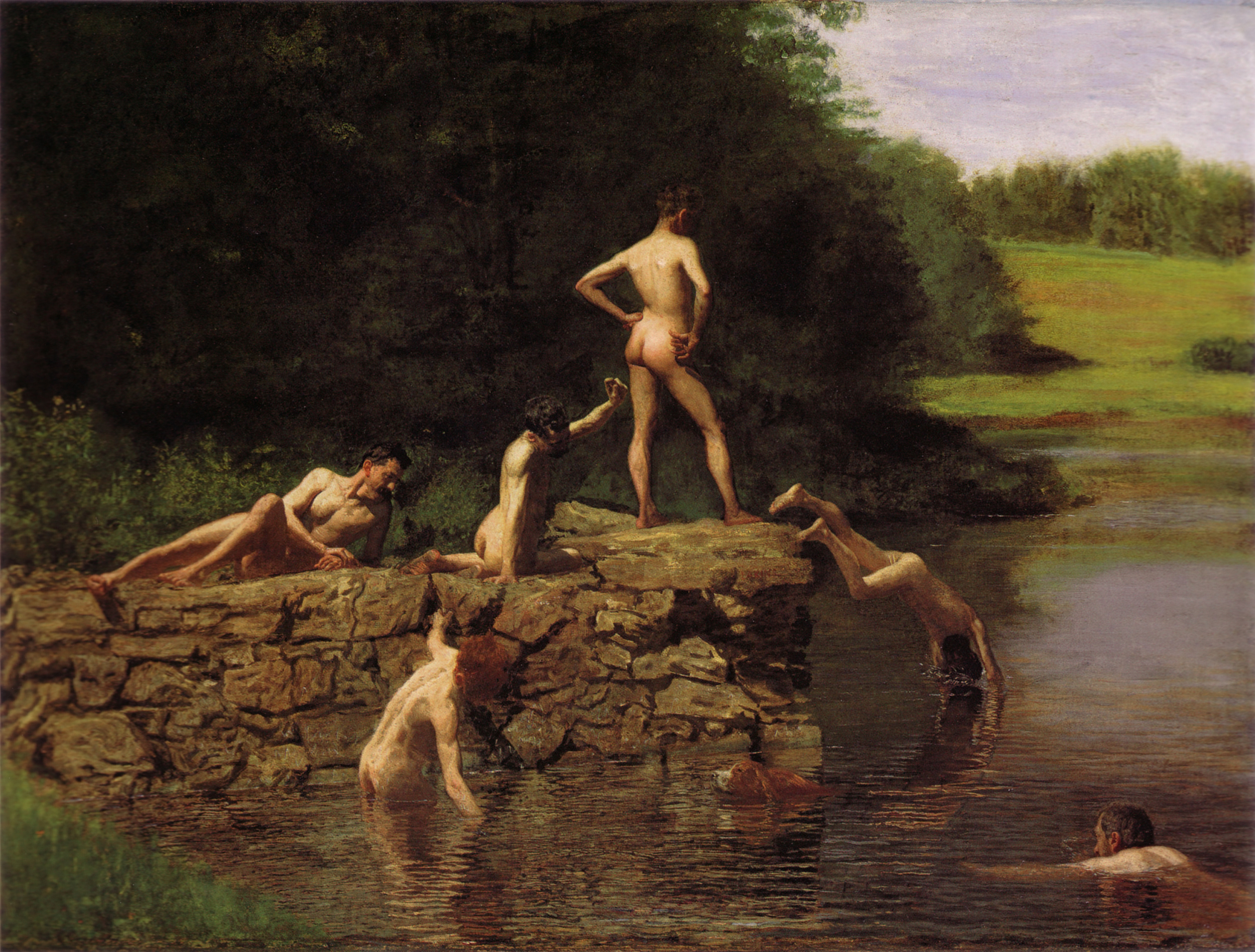
Painted in 1885, The Swimming Hole is Eakins’ most famous exploration of the male nude — and arguably the greatest American painting of the naked body ever made. It depicts six men at a swimming hole in Pennsylvania’s Mill Creek: one diving, one floating, one poised on the rocks, their bodies arranged in a frieze-like composition that recalls classical Greek sculpture while remaining utterly, unmistakably American.
What makes The Swimming Hole radical — even today — is its complete lack of self-consciousness. These men are not posing as gods or heroes. They are not allegorical figures. They are swimming. Eakins painted them not through imagination but from exhaustive preparation: photographic studies, anatomical drawings, wax maquettes. Every muscle, every shadow, every angle of a shoulder blade was observed and recorded before a single brushstroke touched the canvas.
The painting was considered too frank to exhibit publicly in 1885. It entered private collections and was largely unseen for decades. Today, it hangs at the Amon Carter Museum of American Art in Fort Worth, a benchmark of realism that paved the way for everything from Edward Hopper’s spare interiors to the unflinching figuration of contemporary painters like Jenny Saville.
The Scandal That Destroyed Him
In 1876, Eakins had been appointed a professor at the Pennsylvania Academy of the Fine Arts. Within a decade, he had transformed the school’s curriculum. He abolished the use of casts — students would draw from live models from day one, not from plaster copies of Greek statues. He insisted on studying anatomy by attending surgical dissections. He taught men and women in the same classroom. And most controversially, he removed the loincloth from the male model during a mixed-gender life-drawing class.
In 1886, the board of the Pennsylvania Academy demanded Eakins resign. He refused. They fired him. The reason? Conduct unbecoming a professor — which meant, in plain language, his insistence on teaching from the naked human body.
The scandal didn’t just cost him his job. It cost him commissions, reputation, and relationships. Students who defended him were expelled. His wife, Susan Macdowell Eakins — a former student and a fine painter in her own right — stood by him, but the social damage was permanent. Eakins spent the last three decades of his life outside the institutional mainstream, painting portraits and nudes for a dwindling circle of supporters.
The Nude as Study, Not Spectacle
Eakins’ approach to the nude was fundamentally different from that of his European contemporaries. Where French academic painters used the nude as a vehicle for mythological storytelling, and where Impressionists used it as an excuse to paint light on skin, Eakins treated the nude body as a subject worthy of study in itself.
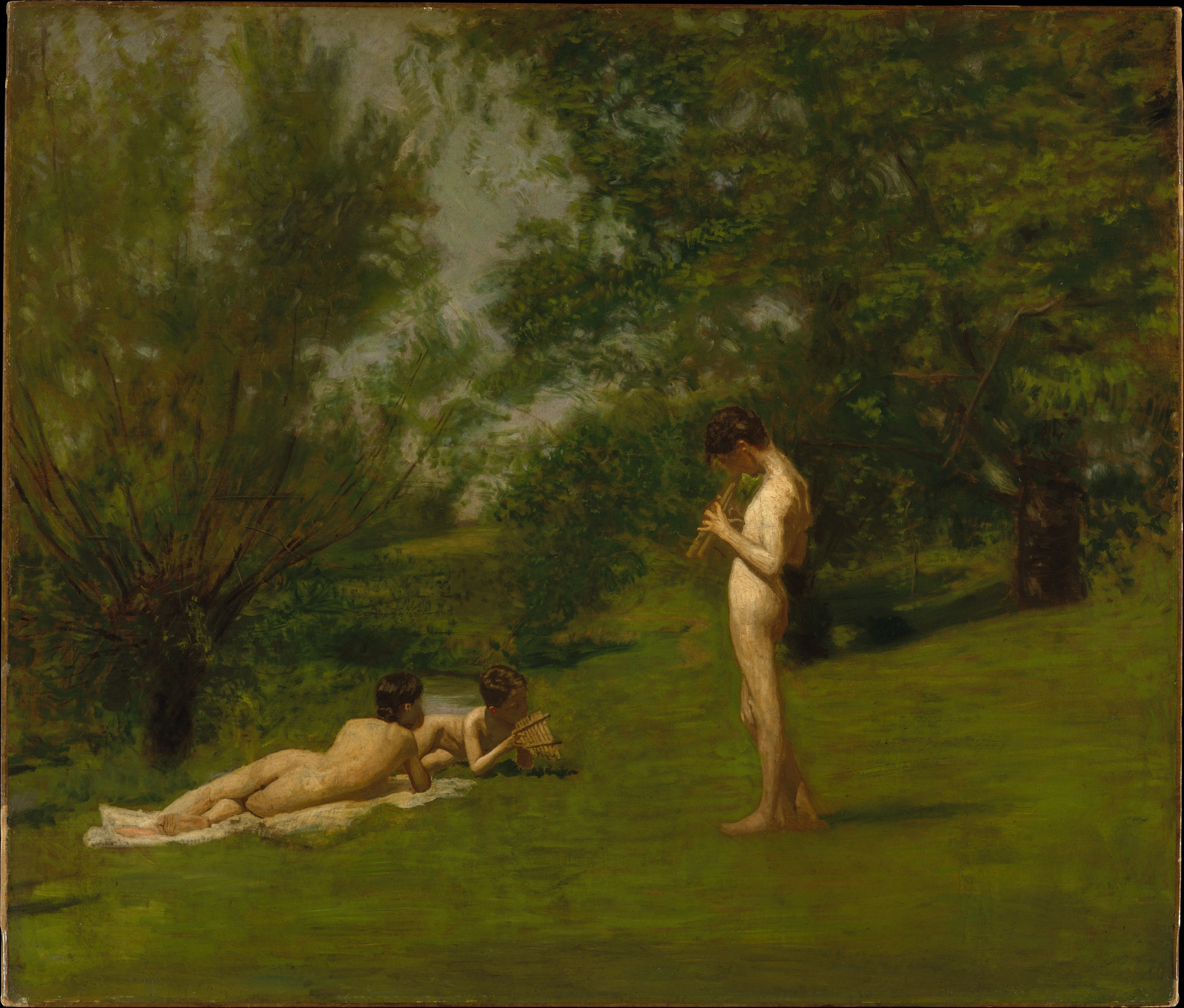
His 1883 painting Arcadia — which depicts nude female figures in a pastoral setting — is instructive here. Unlike the gauzy nymphs of Bouguereau or the eroticized odalisques of Ingres, Eakins’ figures are solid, grounded, and specific. You can feel the weight of the bodies. You can see the way the light falls on actual flesh, not an idealized fantasy of flesh. The classical title is almost an alibi — but the painting’s power comes from its refusal to hide behind mythology.
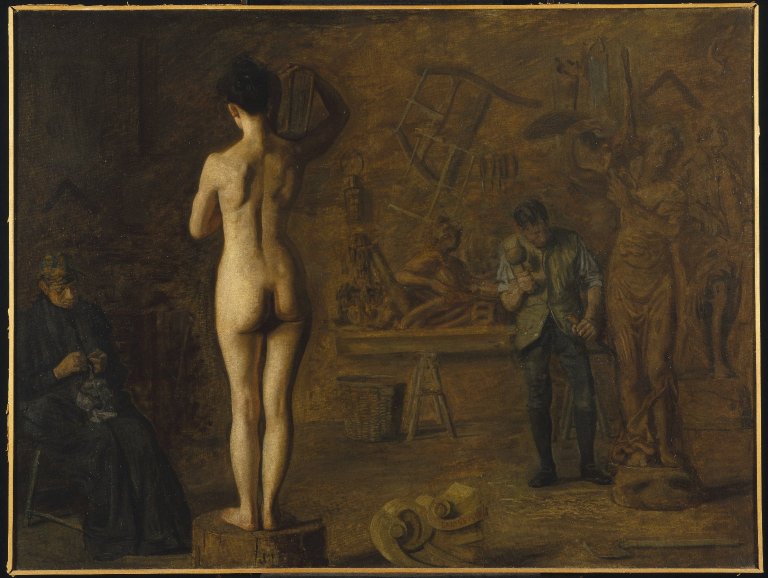
Even more revealing is Eakins’ William Rush Carving His Allegorical Figure of the Schuylkill River (1908). The painting depicts the 19th-century sculptor William Rush at work, chiseling a wooden allegorical figure while his nude model sits patiently nearby. It is a painting about the act of making nude art — a meditation on the relationship between artist, model, and the human form that emerges between them. Eakins painted several versions of this scene, returning to it across three decades, as if he were trying to work out something essential about his own practice.
Why Eakins Mattered, and Still Matters
Eakins’ contribution to American art is often framed in technical terms — his mastery of perspective, his anatomical precision, his pioneering use of photography. But his real legacy is moral. He insisted that the human body was not something to be coy about, not something to allegorize away, not something to hide behind classical drapery or mythological excuses. The body was real, and painting it truly was a form of honesty that bordered on spiritual discipline.
That honesty ruined his career, but it made his art immortal. The artists who came after — Thomas Hart Benton, George Bellows, the Ashcan School, and countless painters of the figure who followed — all worked in the light Eakins had lit. He normalized the idea that an American painter could take the human body seriously, without irony, without classical crutches, without apology.
When Eakins died on June 25, 1916, the New York Times gave him a brief, respectful obituary. He had been nominated to the National Academy of Design but had never been fully welcomed into the establishment that fired him. Today, The Swimming Hole and The Gross Clinic are recognized as peak achievements of 19th-century American painting. The scandal that destroyed his career is taught in every art history survey — not as a cautionary tale, but as proof that the fight to depict the human body honestly is never really over.
One hundred and ten years after his death, Thomas Eakins’ nudes still have the power to unsettle. Not because they are obscene — they are anything but — but because they ask us to look at bodies the way he did: without embarrassment, without myth, and without lies.