When Max Pechstein died on June 29, 1955, the obituaries were polite but cautious. He had once been one of the most celebrated painters in Germany \u2014 a founding member of Die Br\u00fccke, the Dresden-based artists’ collective that detonated German Expressionism in 1905. But his career had been interrupted by war, exile, and the Nazis, who confiscated 326 of his works and labeled him “degenerate.” By the time of his death at 73, Pechstein was a survivor more than a star. The art world had moved on to abstraction and Pop. His nudes \u2014 raw, electric, painted in colors nature never intended \u2014 seemed like artifacts from a lost century.
\n\n
Seventy-one years later, those nudes look less like artifacts and more like prophecy.
\n\n
The Body as Liberation, the Body as Protest
\n\n
To understand Pechstein’s nudes, you have to understand Die Br\u00fccke‘s founding premise: that bourgeois German society had become a machine for repression, and that the naked body \u2014 unashamed, unposed, uncommodified \u2014 was the antidote. Kirchner, Heckel, Schmidt-Rottluff, and Pechstein didn’t just paint nudes. They lived them. The Die Br\u00fccke artists spent summers at the Moritzburg lakes near Dresden, swimming naked, painting each other and their models outdoors, treating the body not as an object of contemplation but as an instrument of freedom.
\n\n
Pechstein was the group’s colorist. Where Kirchner’s nudes are jagged and anxious, Pechstein’s are lush. His 1919 watercolor Akte am Strand (Nudes on the Beach) shows four figures on a shoreline, their bodies rendered in hot oranges and cool blues \u2014 not anatomically precise but emotionally exact. The women aren’t posing for the viewer. They’re inhabiting their own world, one where being naked isn’t an invitation but a state of being.
\n\n
This was radical in Wilhelmine Germany. The Nacktkultur (nude culture) movement was already gaining traction \u2014 a back-to-nature health movement that promoted sunbathing and communal nudity as physical and moral hygiene. Pechstein took that earnest reformism and gave it teeth. His nudes aren’t hygienic. They’re alive.
\n\n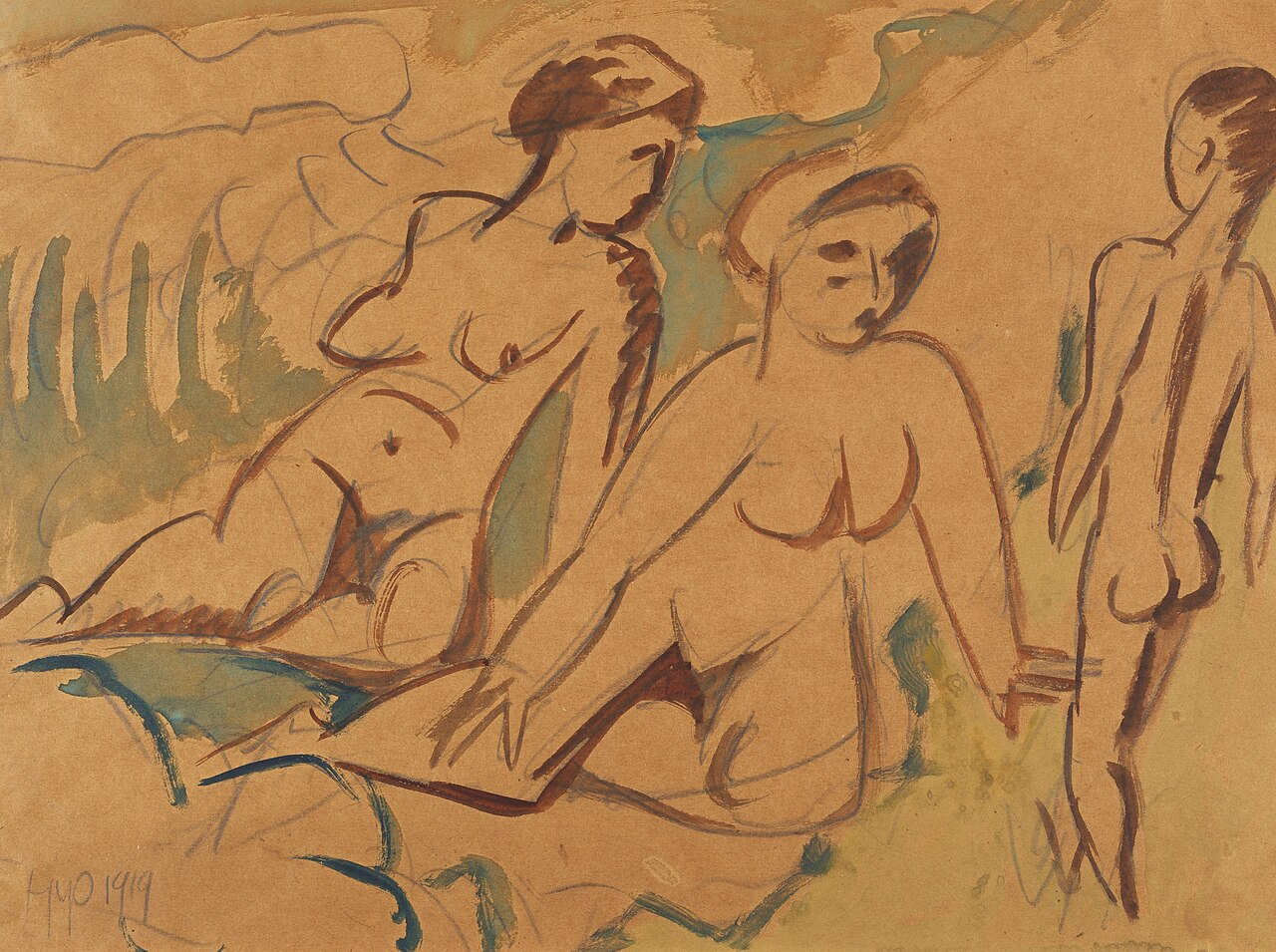 \n\n
\n\n
The Woodcut and the Body
\n\n
Pechstein’s 1911 woodcut Badende I (Bathers I) strips the nude down to its graphic essentials. Two figures, angular and simplified, share a frame that feels almost claustrophobic despite the open-air subject. The woodcut medium \u2014 which Die Br\u00fccke revived from D\u00fcrer and the German Renaissance \u2014 forces the body into stark contrasts of black and white. There’s no color to soften the impact. Just flesh carved into wood.
\n\n
This was the other half of Pechstein’s project: not just freeing the body from clothing, but freeing the image from illusion. The woodcut’s frank materiality \u2014 you can see the grain, the gouge marks, the labor \u2014 insisted that looking at a body was an act, not a passive transaction. The viewer was implicated.
\n\n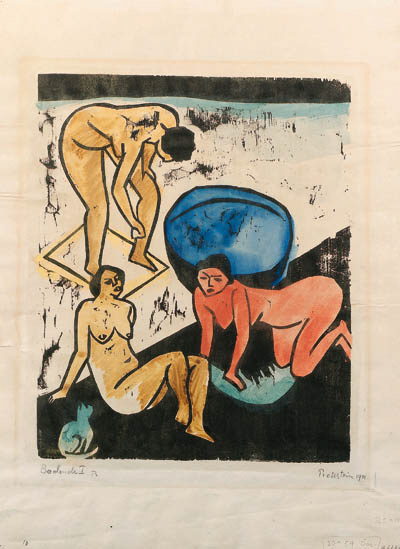 \n\n
\n\n
The South Seas and the Limits of the Gaze
\n\n
In 1914, Pechstein traveled to the Palau Islands in the South Pacific, following a path Gauguin had taken before him. His Palau works \u2014 watercolors of islanders fishing, swimming, resting \u2014 are among the most beautiful and most complicated of his career. The colors intensify. The forms become simpler, more sculptural. But the same questions that dog Gauguin’s Tahitian paintings apply here: was Pechstein painting real people, or was he painting his own fantasy of prelapsarian innocence?
\n\n
His 1912 watercolor Sitzende und kauernde nackte Frauen (Seated and Crouching Nude Women), painted before the Palau trip, offers a partial answer. The two figures \u2014 one seated, one crouching at her feet \u2014 are rendered in fast, confident strokes. Their bodies are simplified but specific. The crouching woman’s back curves with real weight. These aren’t archetypes. They’re individuals caught in a private moment.
\n\n
Pechstein was never as psychologically penetrating as Kirchner, nor as spiritually ambitious as Nolde. His gift was for presence \u2014 the sense that the body you’re looking at is actually there, breathing, taking up space.
\n\n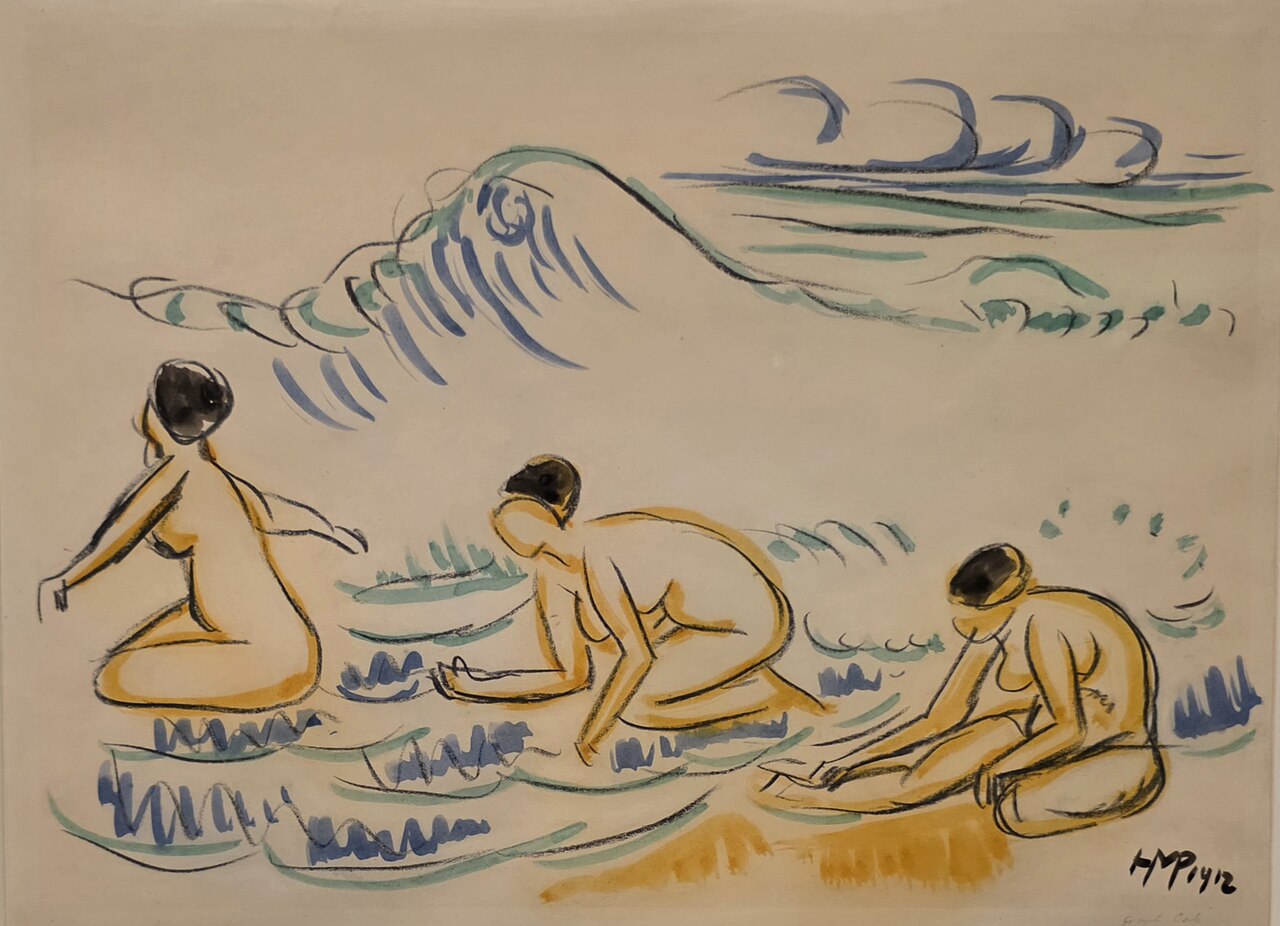 \n\n
\n\n
Degenerate and Unkillable
\n\n
The Nazis destroyed what they could. In 1937, Pechstein’s work appeared in the infamous Entartete Kunst (Degenerate Art) exhibition alongside Kirchner, Nolde, Beckmann, and the rest of the German avant-garde. The exhibition’s organizers hung his paintings crooked, scribbled mocking commentary on the walls, and invited the public to sneer. By 1944, Pechstein’s Berlin apartment \u2014 and much of his remaining work \u2014 had been destroyed by Allied bombing.
\n\n
He kept painting anyway. After the war, he taught at the Berlin Academy and continued producing nudes, landscapes, and still lifes until his death. The late works are quieter \u2014 less electric, more elegiac \u2014 but they never abandoned the body. He had staked everything on the idea that the nude could mean something more than decoration, and he never backed down from that conviction.
\n\n
Why Pechstein Matters Now
\n\n
Pechstein entered the public domain this year \u2014 January 1, 2026 \u2014 freeing his entire body of work from copyright restrictions. For the first time in seventy years, his paintings, prints, and watercolors can be reproduced, studied, and shared without permission or payment. That’s a cultural event, not just a legal one.
\n\n
But Pechstein matters for a deeper reason. In a century that industrialized death \u2014 two world wars, the Holocaust, the atomic bomb \u2014 he insisted on painting life. Not idealized life. Not sanitized life. Life as it registers in the body: warm, vulnerable, ungovernable. The Nazis called that degenerate. History has been kinder. And his nudes, after everything, are still here \u2014 still breathing, still taking up space, still impossible to ignore.