Walk into any museum with classical sculpture and you will see it everywhere: the weight shifted onto one leg, the hip dropping, the shoulders tilting in counterbalance, the spine tracing a gentle S-curve through the torso. This is contrapposto \u2014 the Italian word for “counterpoise” \u2014 and it is, quite simply, the moment Western art learned how to make stone breathe.
\n\n\n\nBefore contrapposto, the human figure stood rigid and frontal. The Archaic kouros \u2014 the standing nude youth carved across the Greek world from roughly 600 to 480 BCE \u2014 was a descendant of Egyptian sculpture: left foot forward, arms pinned to the sides, weight distributed evenly on both legs, the body a symmetrical block. These figures are impressive. They are not alive.
\n\n\n\n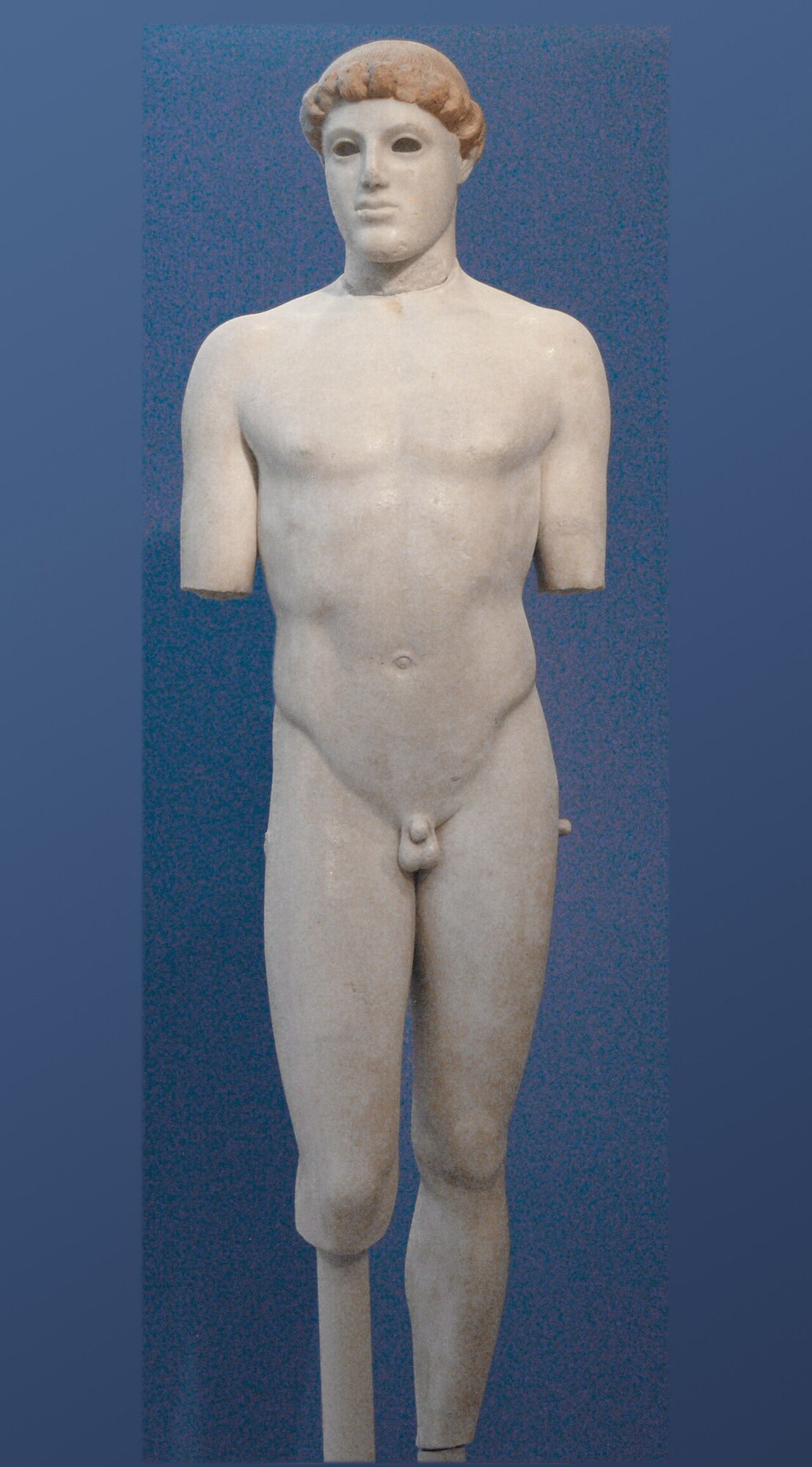
Then, sometime around 480 BCE, everything changed. An unknown sculptor \u2014 possibly a young Kritios, whose name the work now carries \u2014 carved a marble youth that did something no Greek statue had done before. The weight settled onto the left leg. The right knee bent slightly, the right hip dipped, the left shoulder rose in answer. The head turned a few degrees to the right. The body was no longer a diagram. It was a person standing there, at ease, inhabiting space.
\n\n\n\nThe Kritios Boy, excavated from the rubble of the Persian sack of the Acropolis, is the earliest surviving sculpture to employ contrapposto. It is not an exaggeration to call this the most important formal innovation in the history of the nude in Western art. Everything that follows \u2014 the Parthenon marbles, the Hellenistic baroque, the Roman copies, the Renaissance rebirth \u2014 depends on this single insight: that the human body in repose is never symmetrical.
\n\n\n\nThe Canon: Polykleitos and the Mathematics of the Living Body
\n\n\n\nA generation after the Kritios Boy, the sculptor Polykleitos of Argos systematized contrapposto into a complete theory of the ideal human form. His lost treatise, the Canon, established proportional relationships for every part of the body \u2014 head to height, torso to legs, hand to forearm. And his Doryphoros (Spear Bearer), created around 440 BCE, became the definitive demonstration.
\n\n\n\n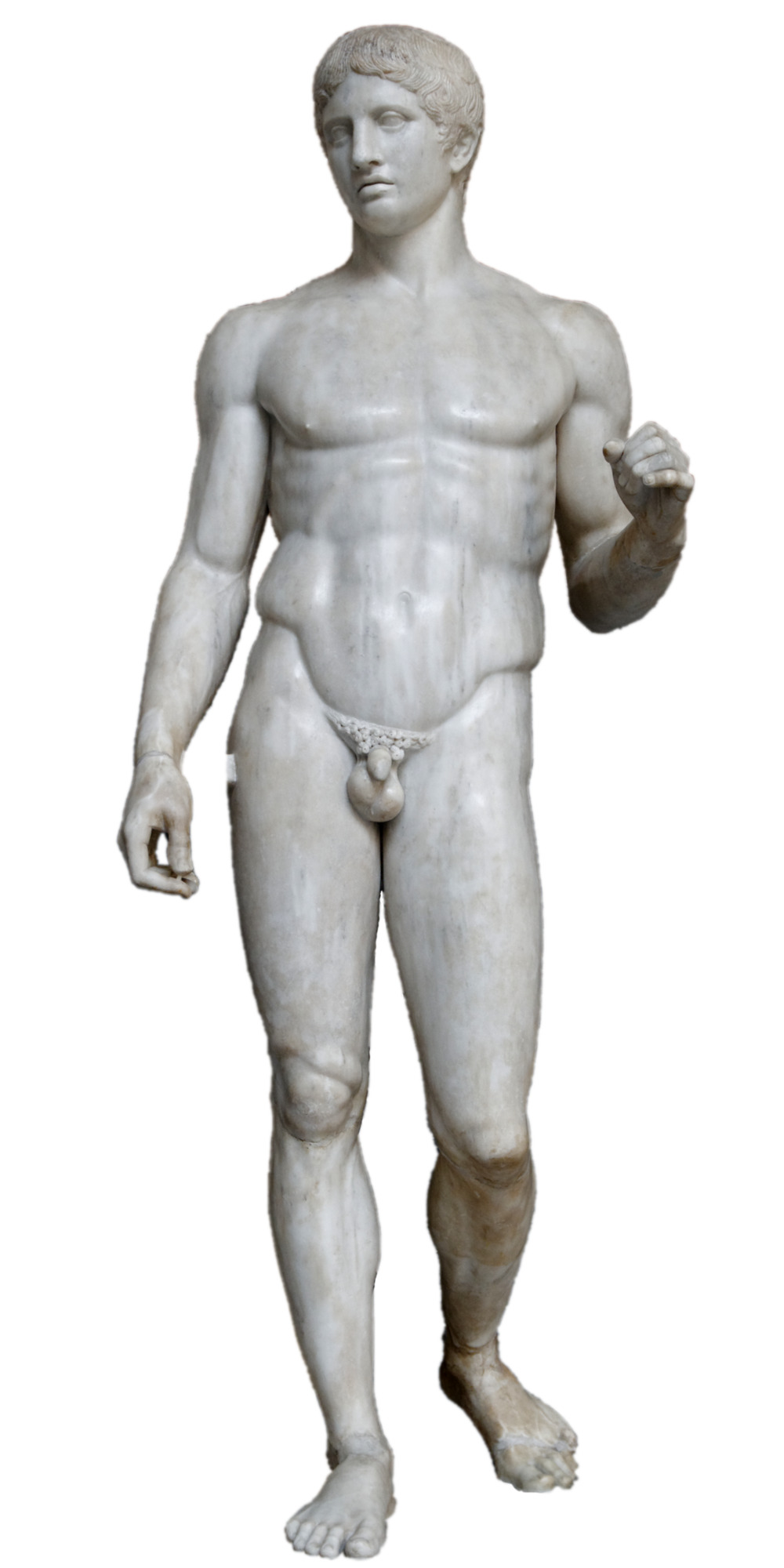
Look at the Doryphoros and you see contrapposto at full maturity. The standing leg and the spear-bearing arm are engaged \u2014 taut, active. The relaxed leg and the dangling arm are at rest. This crossed diagonal \u2014 what the Greeks called chiasmus, from the letter chi (X) \u2014 creates a dynamic equilibrium that makes the figure feel suspended between motion and stillness. The body is balanced, but it is the balance of a living thing, not a building.
\n\n\n\nPolykleitos was not just making beautiful statues. He was arguing something philosophical: that the nude body, properly understood through mathematics and observation, could embody an ideal \u2014 to kallos, the beautiful \u2014 that was simultaneously physical and moral. The nude became the vehicle for Greek humanism itself.
\n\n\n\nThe Resurrection: Donatello’s David and the Return of the Nude
\n\n\n\nWhen the Roman Empire collapsed, contrapposto went into hibernation. Medieval art flattened the body into symbolic frontality \u2014 the human figure as emblem, not presence. It took more than a thousand years and the revolutionary ambition of early Renaissance Florence to bring it back.
\n\n\n\n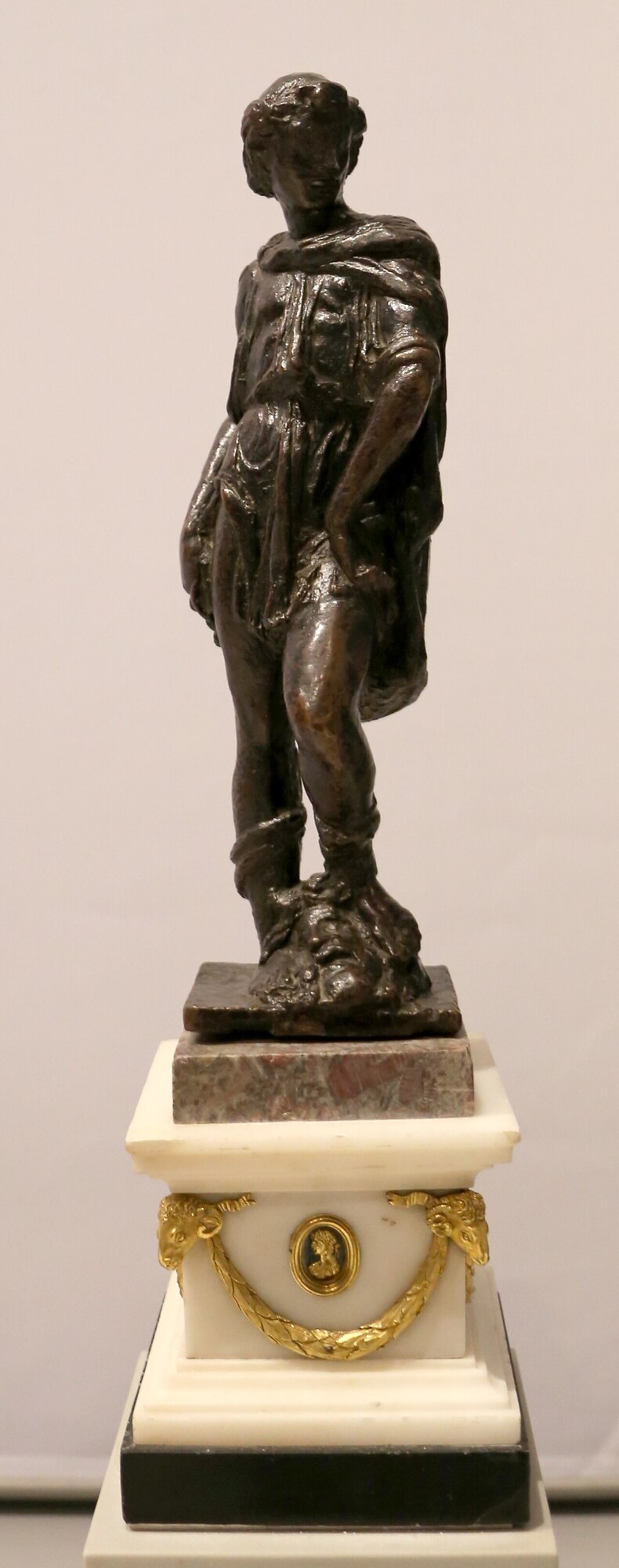
Donatello’s bronze David \u2014 cast around the 1440s for the Medici \u2014 was the first free-standing nude sculpture created since antiquity. And the pose is pure contrapposto: weight on the right leg, left foot resting on Goliath’s severed head, the adolescent body relaxed and unashamed. Donatello had studied Roman copies of Greek originals in Florence and Rome. He understood exactly what contrapposto meant: not just a technical trick, but a declaration that the body could be beautiful on its own terms, without armor, without drapery, without excuse.
\n\n\n\nFrom Donatello’s workshop, the knowledge passed to Verrocchio, to Leonardo, to Michelangelo \u2014 whose own David (1504) would take contrapposto to a scale and intensity the Greeks never attempted. The chain was unbroken. Every figure painter from Raphael to Rubens to Ingres to Lucian Freud stands in this lineage.
\n\n\n\nWhy It Still Matters
\n\n\n\nContrapposto is not merely an art-historical footnote. It remains the default vocabulary for representing the standing human body \u2014 in sculpture, in painting, in photography, in fashion illustration, in every figure-drawing class on the planet. When a model shifts their weight in the life room, they are re-enacting a pose invented in an Athenian workshop twenty-five centuries ago.
\n\n\n\nMore than that, contrapposto encodes a specific idea about what the body means. A symmetrical, frontal figure \u2014 the kouros, the Byzantine Christ Pantocrator \u2014 declares authority, permanence, the eternal. A contrapposto figure declares presence. It says: I am here, in this moment, alive. It is the posture of someone who is comfortable in their own skin \u2014 and that, when you think about it, is the entire project of the nude in Western art.
\n\n\n\nThe Greeks called it nothing special \u2014 it was simply how they saw bodies stand. But that is precisely the point. The most radical artistic innovation in the history of the nude was also the most natural. It was the day sculptors stopped imposing geometry on the body and started watching it instead.
\n\n