Max Klinger died on July 5, 1920 \u2014 106 years ago today \u2014 in Grossjena, a small town near Naumburg, Germany. He was sixty-three. By then he had produced one of the strangest and most psychologically charged bodies of work in the history of Western art: dozens of print cycles that treated the nude human figure not as an exercise in classical beauty, but as a mirror held up to the unconscious.
\n\nIf you know Klinger’s name at all, you probably know him as a German Symbolist \u2014 the painter of The Judgement of Paris, the sculptor of the monumental Beethoven in Leipzig, the man who gave Brahms a visual language in his Brahms Fantasies. But Klinger’s real contribution, the thing that makes his work still crackle with electricity a century after his death, is something stranger. He was one of the first artists to systematically treat the nude body as a vehicle for dream logic.
\n\n\n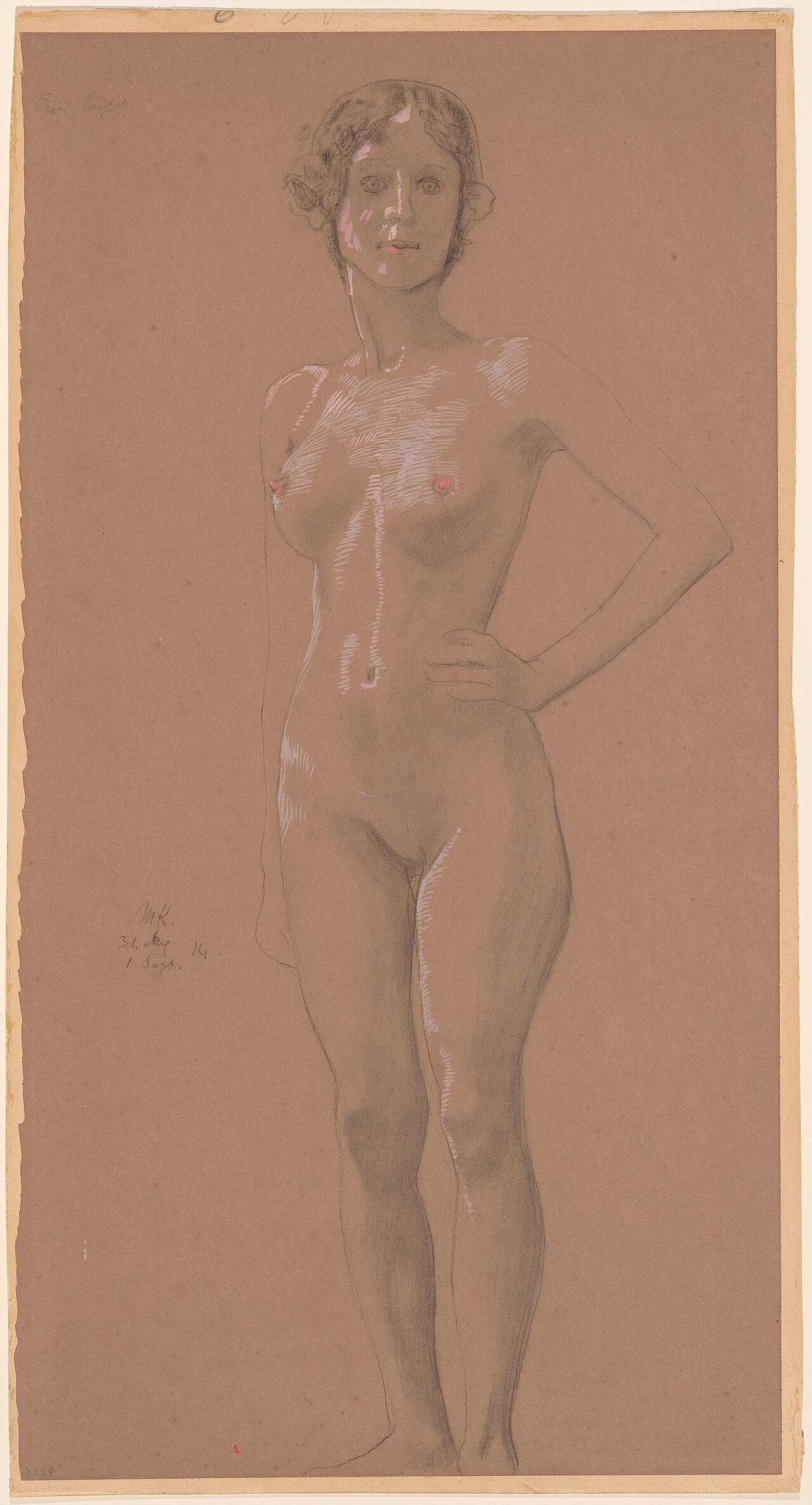
The Print Cycle as a New Medium
\n\nBefore Klinger, the nude in Western art followed a well-worn script. The academic tradition treated it as an exercise in anatomy and ideal proportion \u2014 the body as architecture. The Romantics injected drama and passion but kept the narrative legible. Even the Realists, who stripped the nude of its mythological costume, still presented the body as a fact in the world: here is a woman bathing, here is Olympia staring back.
\n\nKlinger broke this contract. His great innovation was the print cycle \u2014 a sequence of etchings, aquatints, and engravings that functioned like a visual novel. Each cycle tells a story, but not the kind with a clear beginning, middle, and end. These are stories that happen inside a mind: dreams, obsessions, nightmares. And the nude body, stripped of context and placed in impossible spaces, carries all the psychological weight.
\n\nHis first major cycle, Paraphrase on the Finding of a Glove (1881), opens with a perfectly ordinary event \u2014 the artist picks up a woman’s glove at a skating rink. What follows is a descent into obsession. The glove grows monstrous. It appears in nightmares. The artist’s psyche projects onto it fantasies of rescue, possession, and annihilation. There are nudes in this cycle \u2014 dream-figures, half-formed, emerging from darkness \u2014 but they obey no laws of anatomy or decorum. They are products of a mind unmoored.
\n\nThis was 1881. Freud’s The Interpretation of Dreams wouldn’t appear until 1899. Klinger got there first, in pictures.
\n\nThe Body as Psychological Territory
\n\nThe cycles that followed deepened the project. A Life (1884) traces a woman’s existence from innocence through shame to death \u2014 the nude appears at moments of vulnerability, not titillation. A Love (1887) maps a relationship across its emotional registers. Eve and the Future (1880) reimagines the Genesis story as a meditation on female beauty and male anxiety, with Eve placed in an indeterminate space that looks more like a dreamscape than Eden.
\n\nWhat unites these works is Klinger’s refusal to let the nude body be merely beautiful. His nudes are awkward, exposed, sometimes frankly unattractive by the standards of the academy. They crouch, they cower, they float. They exist in black voids or surreal landscapes that seem to emanate from the figure’s own emotional state. The background is mood. The lighting is psyche.
\n\nThis is a fundamentally different use of the nude than anything that came before. Titian’s Venuses inhabit real beds and real architecture. Rubens’s nudes revel in their own flesh. Ingres’s odalisques invite the viewer into a specific, if fictional, space. Klinger’s nudes exist in nowhere. They have been extracted from the world and placed in the theater of the mind.
\n\n\n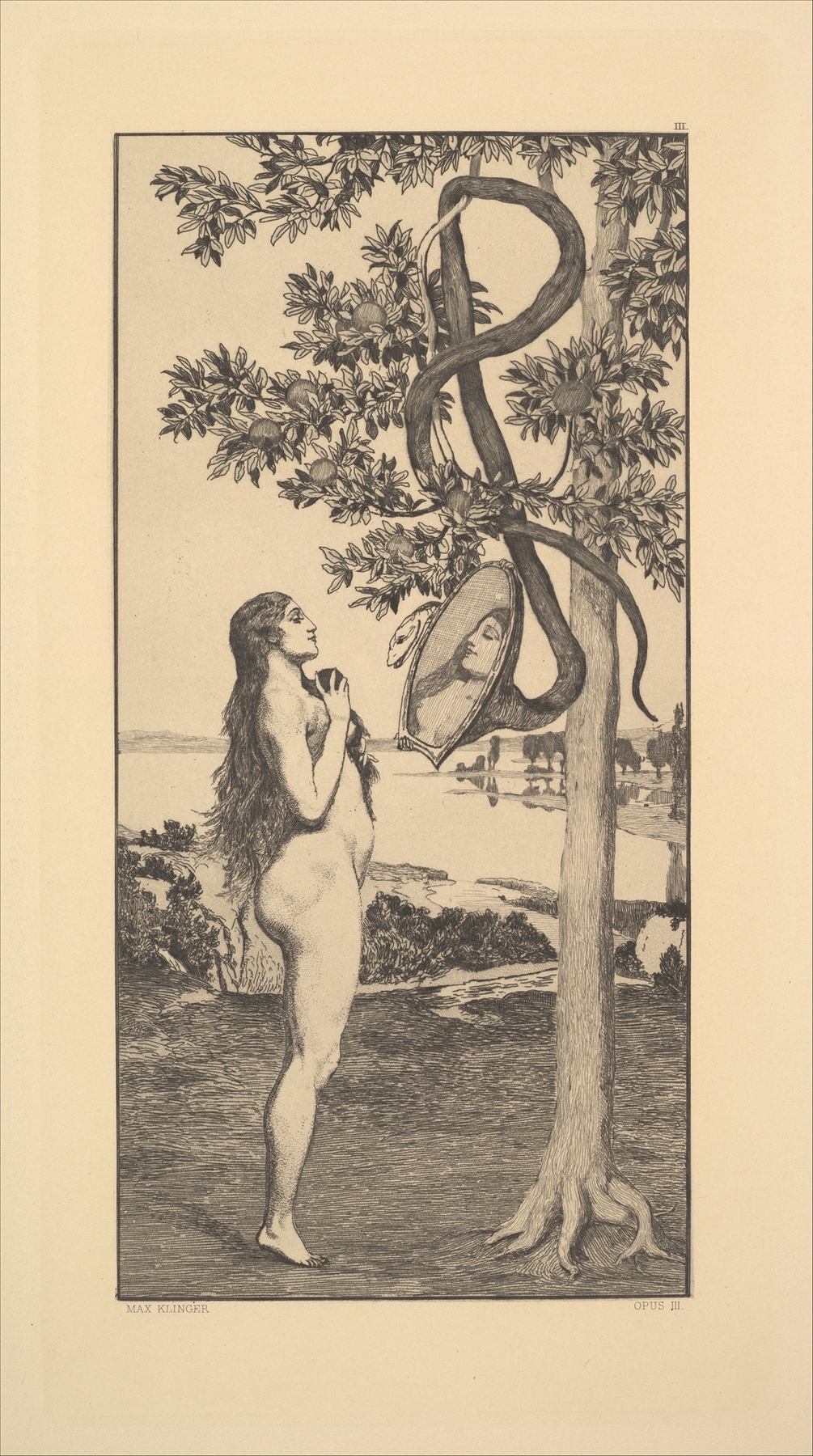
The Technique of Darkness
\n\nKlinger’s printmaking technique deserves attention because it’s inseparable from the content. He worked in etching and aquatint, building images through acid-bitten lines and tonal washes that could produce velvety blacks unlike anything in painting. His figures emerge from the darkness, half-seen, their bodies defined as much by what’s hidden as what’s revealed. The nude in a Klinger print doesn’t stand before you \u2014 it materializes out of shadow, as if you’re watching a thought form.
\n\nThis technical mastery gave him a freedom that oil painting, with its weight and its history, could not. Prints are multiples. They travel. They can be sequenced. They can be held in the hand and studied in private \u2014 which matters, because Klinger’s nudes are not public spectacles. They are intimate, sometimes uncomfortable, meant to be encountered alone.
\n\nWhy He Still Matters
\n\nKlinger’s influence radiated in multiple directions. Edvard Munch saw his prints in Berlin and absorbed the lesson that the figure could carry psychological states directly, without narrative mediation. Giorgio de Chirico’s empty plazas and mannequin-figures owe a debt to Klinger’s dislocated spaces. The Surrealists claimed him as a forefather, and for good reason \u2014 Klinger showed that art could map the territory Freud was just beginning to chart.
\n\nBut the deepest reason to revisit Klinger today has less to do with art-historical genealogy and more to do with what his nudes refuse to do. They refuse to perform. They refuse to decorate. They refuse to reassure. In an age when the nude body is flattened into content \u2014 Instagram-ready, algorithm-optimized, stripped of interiority \u2014 Klinger’s figures remind us that the body has always been, and remains, a site of psychological complexity that no image can fully resolve.
\n\nThe nude, in Klinger’s hands, is not an answer. It is a question. A hundred and six years after his death, that question is still worth asking.
\n\n\n\n
Max Klinger (1857\u20131920) was a German Symbolist painter, sculptor, and printmaker. His graphic cycles \u2014 including Paraphrase on the Finding of a Glove, A Life, A Love, and Eve and the Future \u2014 are held in major museum collections including the Metropolitan Museum of Art, the National Gallery of Art, and the Museum der bildenden K\u00fcnste in Leipzig. All of Klinger’s works entered the public domain in 1991.
\n