Vincent van Gogh died on July 29, 1890 — 136 years ago today. He was 37. The mythology is familiar: the tortured genius, the severed ear, the paintings that sold for millions only after he was gone. The sunflowers. The starry night. The wheat field with crows.
But if you only know Van Gogh through his landscapes and still lifes, you’re missing something fundamental. Van Gogh was obsessed with the human body — not as an academic exercise in idealized proportion, but as a carrier of emotional truth. His nudes are some of the most honest, unflinching, and quietly radical figure studies in Western art.
The Body Before the Color
Long before the saturated yellows and cobalt blues of his mature style, Van Gogh was drawing figures. In 1880, at 27, he committed himself to art with the intensity of a convert. He drew peasants. He drew miners. He drew bodies bent by labor and poverty — not idealized forms but bodies that told the truth about what it cost to live in them.
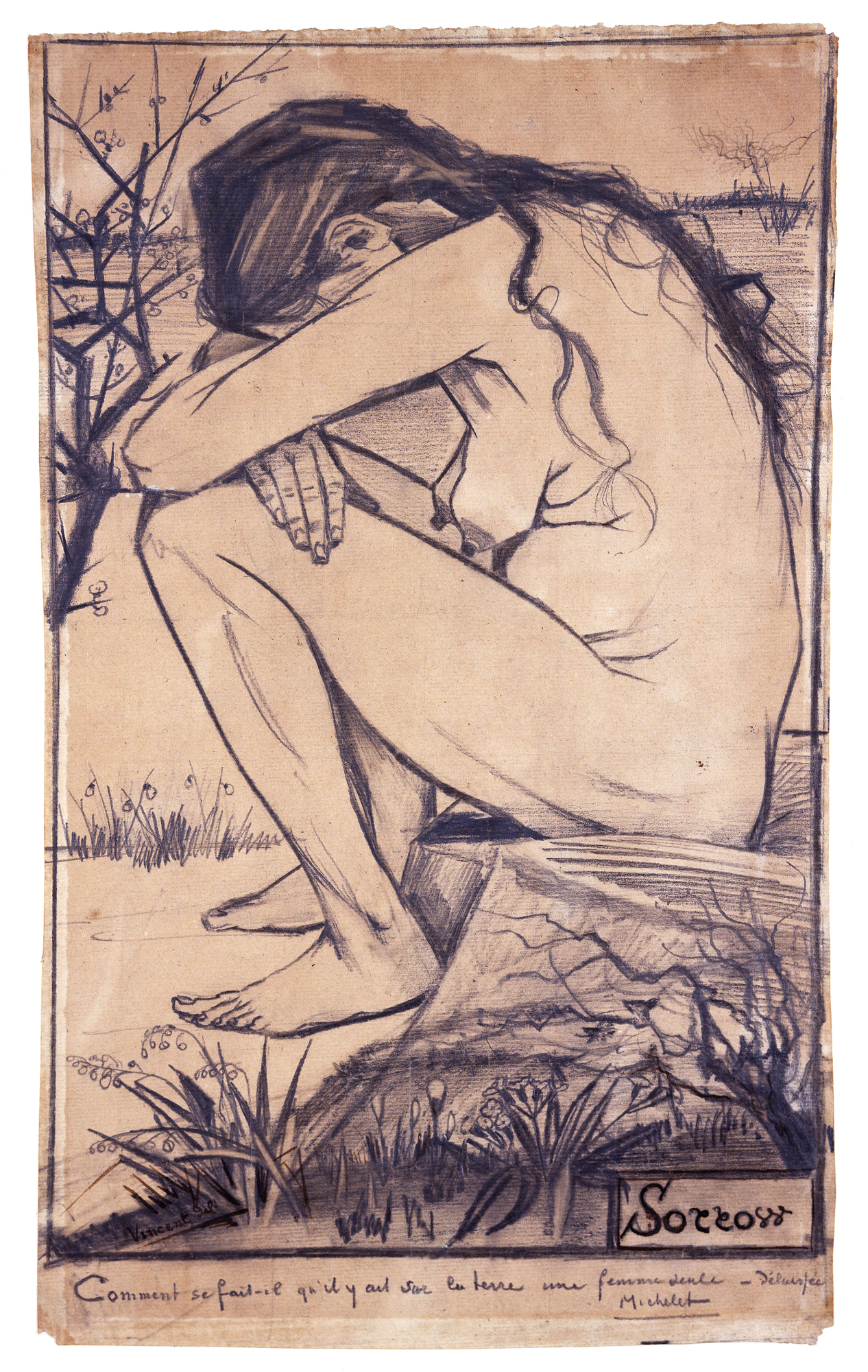
In 1882, living in The Hague, Van Gogh made one of the most moving figure drawings in the history of art. He called it Sorrow. The subject was Clasina Maria Hoornik — “Sien” — a pregnant seamstress and occasional prostitute with whom Van Gogh lived for nearly two years. In the drawing, she sits naked on a low block, her head bowed into her folded arms, her body collapsed into itself. Breasts hang heavy. Her pregnant belly presses against her thighs. Her hair falls forward and hides her face.
This is not the nude of the academy. This is not Titian’s Venus or Ingres’s odalisque. This is a real woman carrying real suffering, rendered with a tenderness that makes the drawing almost unbearable to look at. Van Gogh wrote to his brother Theo that he wanted the drawing to express “something of the struggle of life.” He was not interested in the nude as a formal problem. He was interested in the nude as a human problem — the exposed body as the exposed self.
Antwerp and the Academy: Learning the Rules to Break Them
In late 1885, Van Gogh enrolled at the Royal Academy of Fine Arts in Antwerp. He was 32. The Academy was a bastion of classical tradition — students drew from plaster casts of Greek and Roman sculptures, studied anatomy, and learned to render the nude according to centuries-old conventions of proportion and idealized beauty.
Van Gogh lasted about three months. He clashed with his teachers. He refused to draw the way they demanded. When assigned to draw a cast of the Venus de Milo, he produced a version with the exaggerated hips and thick torso of a Flemish peasant woman. The drawing instructor was not amused. Van Gogh wrote to Theo: “They tell me to draw like David or Ingres. I cannot. I will not. The body I see is not the body they see.”
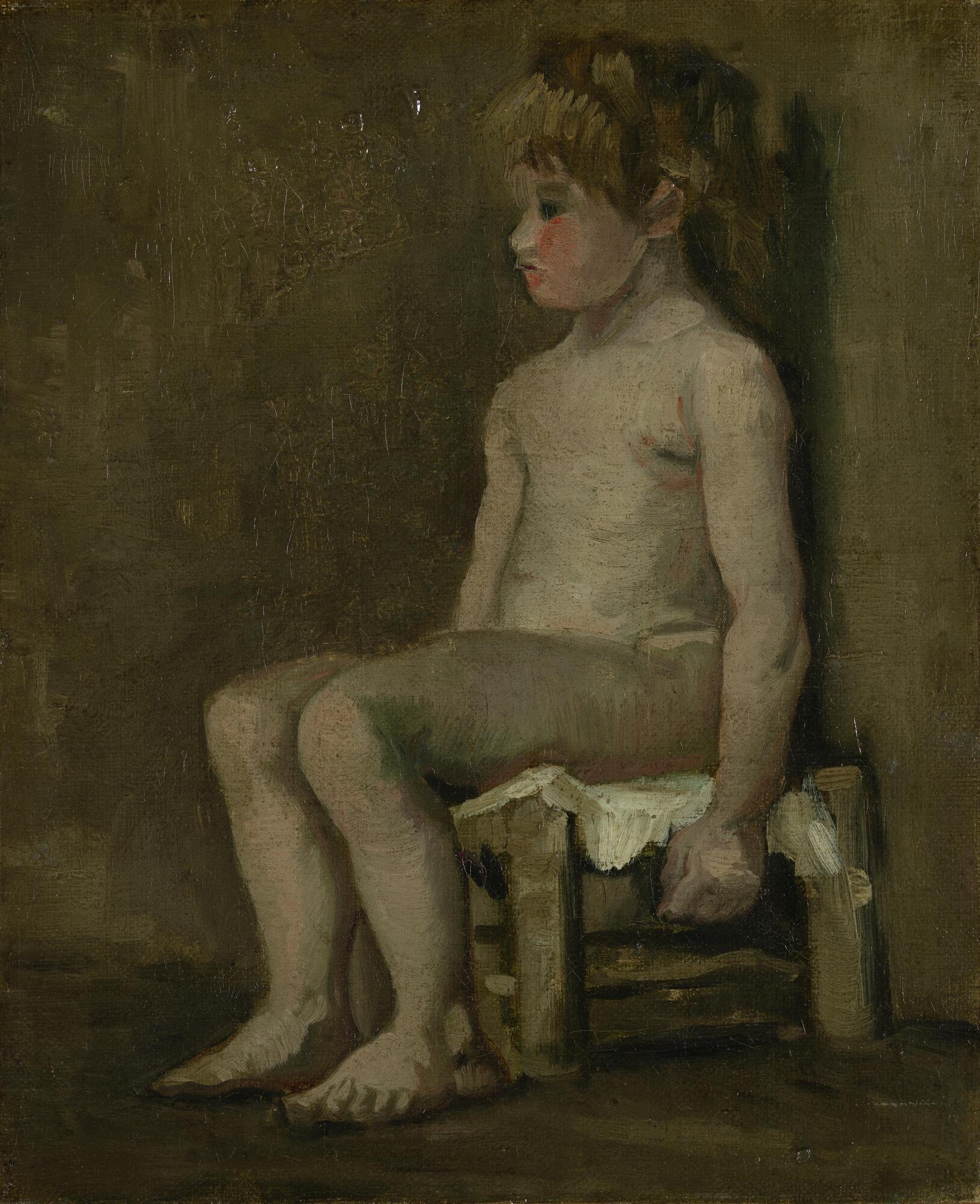
What emerged from the Antwerp period was a series of nude studies — mostly of female models from the life class — that are startling in their departure from academic norms. The Seated Nude Girl (1886, now at the Van Gogh Museum) shows a young model in a cramped, awkward pose. Her proportions are not classical. Her skin is rendered in earthy browns and dull grays. There is nothing idealized here — and that is precisely the point.
Paris: Flesh Becomes Color
In early 1886, Van Gogh moved to Paris and everything changed. He encountered Impressionism, Neo-Impressionism, Japanese prints, and a circle of avant-garde painters who were dismantling every rule he had been taught. His palette exploded. The muddy browns of the Dutch period gave way to pure, luminous color.
And then he applied this new chromatic language to the nude.
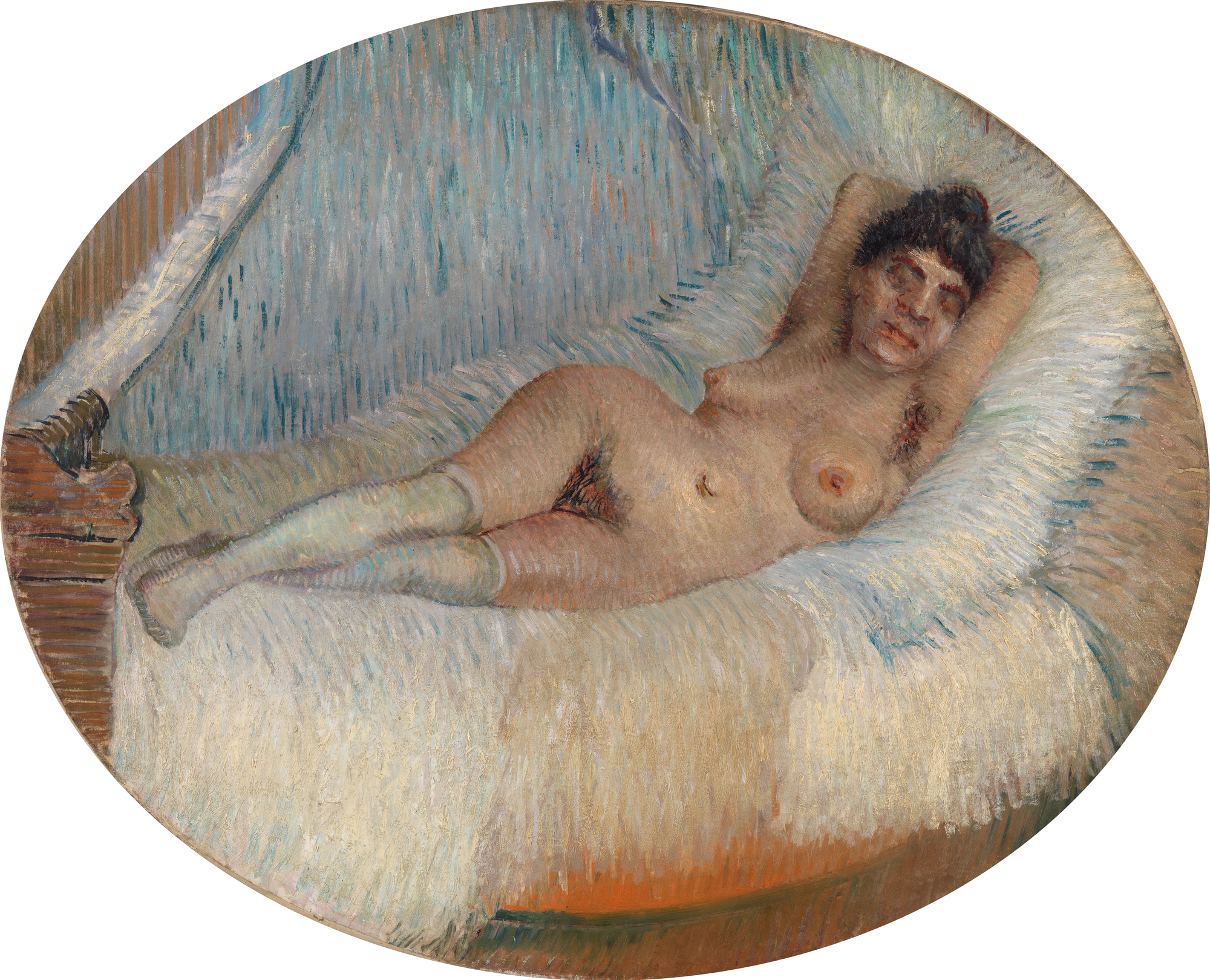
The Reclining Nude of 1887 (now at the Barnes Foundation) is a revelation. A woman lies on a bed, seen from above, her body filling the canvas. Her flesh is rendered not in naturalistic skin tones but in streaks of green, yellow, pink, and blue — the same brushwork that would soon animate the Sunflowers. Van Gogh was not painting a body; he was painting the experience of a body — its warmth, its weight, its vulnerability.
This is the breakthrough. The nude is not a thing to be looked at but a field of sensation to be felt. The body becomes a landscape — not in the metaphorical sense, but literally: Van Gogh applies the same swirling energy to flesh that he would later apply to wheat fields and cypresses. The boundary between the body and the world dissolves.
The Body Without a Viewer
What distinguishes Van Gogh’s nudes from those of his predecessors is not technique but intent. A Titian Venus looks back at you. She knows she is seen. An Ingres odalisque turns toward the viewer with an invitation that is part submission, part seduction. The nude, in the Western tradition, is almost always a performance — the body arranged for an audience.
Van Gogh’s nudes refuse this arrangement. Sien in Sorrow does not look at you. She does not even know you are there. The reclining nude of 1887 is seen from above, as if through a window — she is asleep or lost in thought, not posing. The seated nude girl in Antwerp looks away, her expression unreadable. These are bodies caught in their own private existence, not offered up for yours.
This is a radical ethical position, not just an aesthetic one. Van Gogh treats the nude body with a respect that borders on reverence — not the reverence of idealization, which turns the body into an abstraction, but the reverence of witness. He sees the body not as a symbol or an object but as a person — someone who exists whether or not anyone is looking.
What We Lost on July 29, 1890
Van Gogh’s death at 37 — from a gunshot wound, self-inflicted in a wheat field outside Auvers-sur-Oise — is one of art history’s great what-ifs. He had been painting seriously for barely a decade. His most famous works — The Starry Night, the Sunflowers, Irises — were all produced in the final two years of his life. He was accelerating, not slowing down.
What kind of nudes would Van Gogh have painted at 45, at 55, at 65? We can only guess. His late figure paintings — like the portraits of Dr. Gachet and the Roulin family — hint at a synthesis that never fully arrived: the emotional intensity of the early drawings combined with the chromatic mastery of the mature style. He was building toward something, and July 29, 1890 cut the arc short.
But what he left behind is enough. Van Gogh taught us that the nude body does not need to be beautiful to be powerful. It does not need to be idealized to be meaningful. It only needs to be true — true to the person inside it, true to the feeling it carries, true to the life that shaped it. In a tradition built on centuries of looking at bodies as objects, Van Gogh dared to look at them as people. That is a more radical act than any severed ear or starry night.
Vincent van Gogh (March 30, 1853 – July 29, 1890). He painted the body the way he painted everything else — not as it appeared, but as it felt. And 136 years later, we are still learning how to look that way.