In 1642, in the city where he had spent most of his life, Guido Reni died at the age of sixty-six. For more than a century the painters of Europe had called him il Divino, the Divine, and the name was not flattery. It described what he did to the human body. Reni painted it the way no one else would: as a flawless, calm, nearly weightless ideal.
The Divine Body
Reni came of age in the same Bologna that produced the Carracci, but he took the family’s classical draftsmanship somewhere softer. Where Caravaggio, his great Roman rival, pushed the body toward grit and shadow and the sweat of real flesh, Reni pulled it in the opposite direction. He aimed for grazia, the quality of effortless grace. His figures look lit from within, their skin smooth as porcelain, their gestures slow and unhurried. This was a deliberate philosophy. For Reni, beauty was a spiritual value, the visible trace of something divine. To make the body lovely was to make it holy.
Saint Sebastian and the Eternal Male Nude
No painting shows that conviction more clearly than his Saint Sebastian. Reni returned to the subject again and again, and the most famous version, in Rome’s Capitoline Museums, dates from around 1615. It became one of the most copied images of the male nude in Western art. Sebastian stands bound, his torso pierced by arrows, yet his face is lifted and serene, almost ecstatic. The picture carries an impossible composure in place of agony. Later viewers understood exactly what Reni had made. Oscar Wilde revered it and held it up as his ideal of beauty. The painting endures because it holds two things at once: it celebrates the body and points beyond it.
Myth in Motion
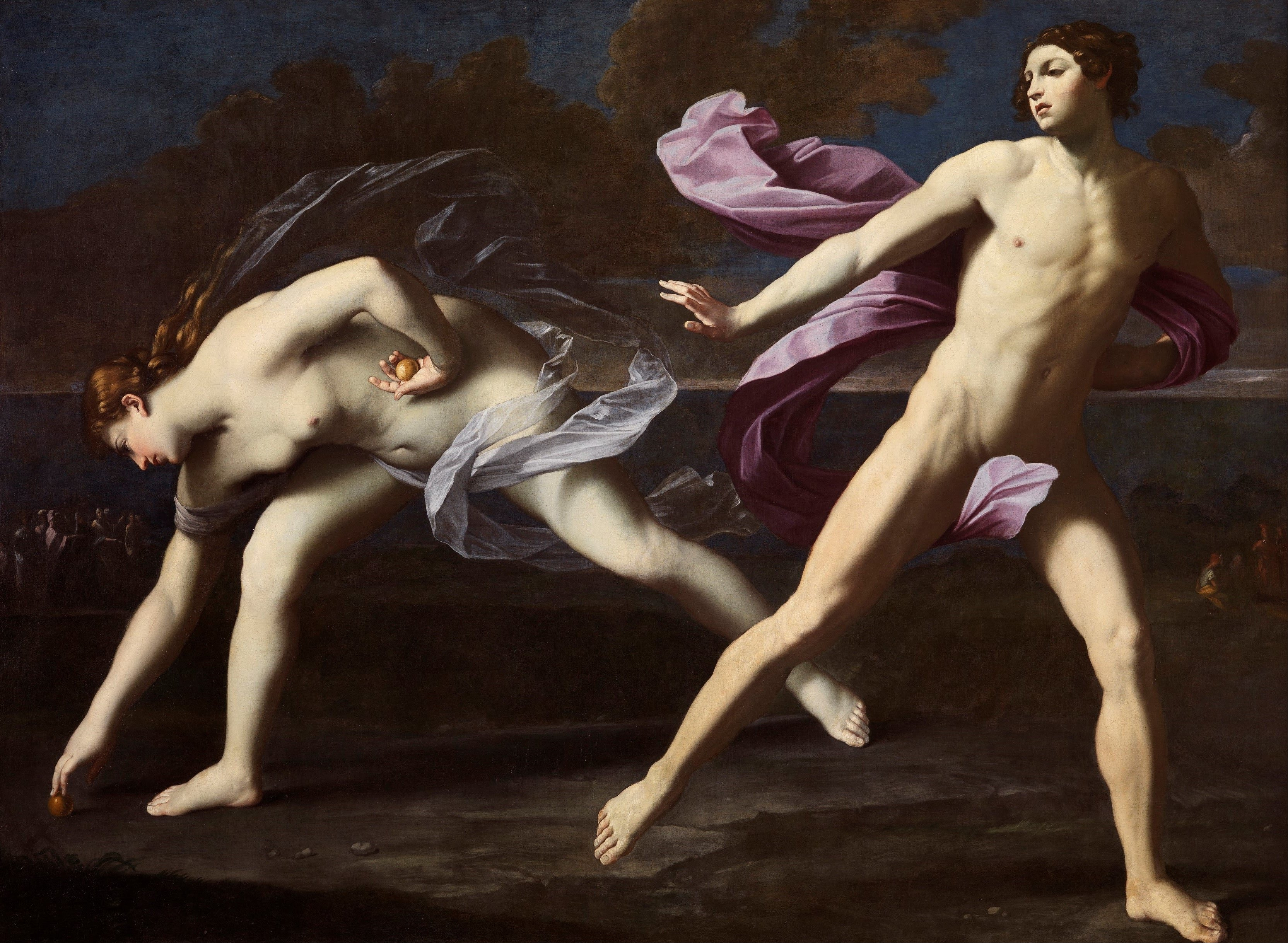
Reni brought the same poise to classical myth. His Atalanta and Hippomenes, painted around 1612, freezes two bodies mid-race, their limbs arranged with the balance of a dance. His Abduction of Deianira and his many Susannas do the same work: the nude becomes a study in ideal form, bodies caught at the exact moment when motion turns into music.
The Rise, the Fall, the Reassessment
For a long time that restraint cost him. In the 1840s the English critic John Ruskin decided Reni was empty, sentimental, a painter of pretty surfaces, and the verdict stuck for a century. The reassessment since then has been gentler and more accurate. What Ruskin read as emptiness was discipline. Reni stripped the body down to its essential harmony and refused to clutter it with anything that would not last.
Why Reni’s Body Still Matters
That discipline is why his nudes still feel timeless while so much of his era looks dated. Centuries later, the body remains a battleground of anxiety, commerce, and self-criticism. Reni offers a different register. His figures do not confess, do not advertise, do not perform their pain. They stand, calm and unreachable, as if beauty were the most ordinary thing in the world. That unreachability is the whole point. The ideal body asks to be contemplated.
Three hundred and eighty-four years after his death, Guido Reni’s bodies still float a little above the ground. They ask nothing of us. They only remind us, with perfect serenity, that grace is a thing the body can carry.