Scholars have never fully settled whether Francesco Albani was born on the 17th of March or the 17th of August in 1578. What no one disputes is what he did with the eight decades that followed. Albani took the naked human figure, the most loaded subject in Baroque painting, and made it feel weightless. His nudes drift through sunlit groves, calm and unashamed, and they ask the viewer for nothing except a little attention.
The story of the Baroque nude is usually told as a story of drama. Caravaggio flooded it with shadow. Bernini twisted it into motion. Rubens let it overflow with flesh and appetite. Albani, working in the same century, chose a quieter path. He painted the body at rest, in a world where nakedness was a season.
A painter shaped by the Carracci
Albani grew up in Bologna at the moment the city was building itself into a rival to Rome and Florence. The engine of that ambition was the academy run by Ludovico Carracci and his cousins Agostino and Annibale, where students learned to draw the human figure from the live model before they learned anything else. Albani entered that orbit as a teenager and absorbed its central lesson: the body is the foundation of painting.
Around 1600 he moved to Rome and joined the workshop of Annibale Carracci, assisting on the great fresco cycles of the Palazzo Farnese alongside Guido Reni and Domenichino. The gallery there, with its muscular nudes reimagining the loves of the gods, became the classroom that shaped a generation. Albani took the classical figure he learned there and softened it, trading muscle for grace and shadow for light.
The Anacreon of painters
His contemporaries gave him a nickname that has stuck for four centuries: the Anacreon of painters, after the Greek poet of wine, love, and ease. The comparison is exact. Albani’s finest work lives in a small format and a tender register, goddesses at their baths, Venus tended by her handmaidens, Diana and her nymphs surprised at a forest pool. These are cabinet pictures, made for the private rooms of collectors, and their intimacy is the point.
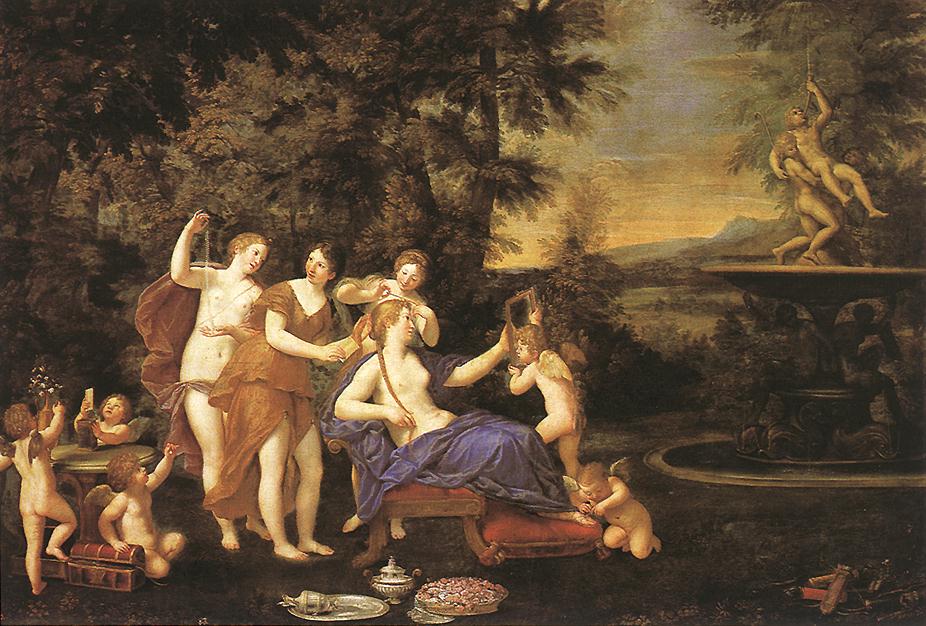
In Venus Attended by Nymphs and Cupids, the goddess of love reclines at the center of a gathering that feels like a picnic. Nymphs braid hair, cupids scatter, and no one covers up. In Albani’s world there is nothing to hide, because nudity is the natural state of beings who live outside time and trouble.
The Toilet of Venus and the question of the gaze
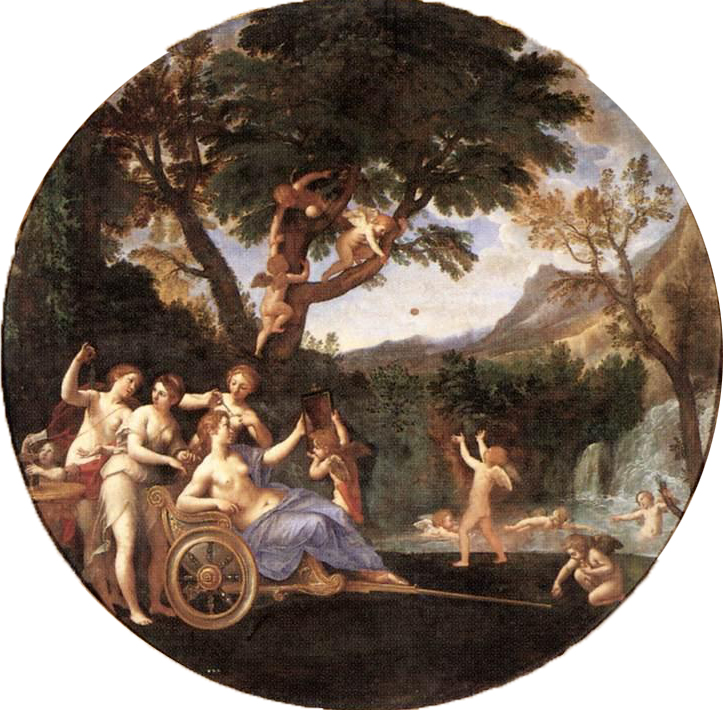
His Venus at her Toilet shows the goddess at her mirror, half turned toward a reflection the viewer cannot see. The subject reaches back through Titian’s Venus of Urbino and forward toward the rococo of Boucher and Fragonard. Where Titian’s Venus meets the viewer’s eye head-on, Albani’s looks away, absorbed in her own image. The painting is about a woman at ease with her body, an ease it extends to anyone who stands before it.
Diana and Actaeon, the softest telling of a brutal myth
His Diana and Actaeon carries the same gentleness into a myth that ends in violence. Actaeon the hunter stumbles on Diana bathing with her nymphs and is punished for the trespass, transformed into a stag and torn apart by his own hounds. Albani shows the moment of discovery, the goddess and her attendants recoiling at the water’s edge, and yet there is no rage in the picture, no blood, no menace. He painted the single instant before cruelty enters the story, the instant when a body is first seen.
Why the gentle nude still matters
Albani’s influence flowed into the next century. The idyllic landscape, the amorous goddess, the nude at ease in nature, all passed through his pictures on their way to the French rococo, where Boucher and Fragonard carried the genre to its most luxurious extreme. He died in Bologna in 1660, having spent his whole life inside the school that made him.
Four centuries later, his quiet approach still has something to teach a culture that treats the naked body as either a provocation or a problem. Albani proposed a third option. He painted the body the way the Greek poets sang of it, as ordinary grace. His nudes ask nothing of us except that we slow down long enough to look.
To support the celebration of the body in art, visit the Get Involved page at Nude Art LA.