On August 19, 1839, in a packed chamber of the Institut de France in Paris, the French government did something almost without precedent in the history of invention. It stood up and gave a technology away. The daguerreotype, the first practical process for fixing a permanent image of light, was announced to the world in full technical detail, free of charge. France had purchased the secret from Louis Daguerre and Isidore Niépce, then handed it to humanity as, in the words of the astronomer François Arago, a gift to the world.
We now mark that day as World Photography Day. For art, the gift was seismic, and nowhere more than in the way we look at the naked body.
Before 1839, every image of the human figure passed through an artist’s hand, an artist’s eye, an artist’s decisions. Painting and sculpture filtered the body through memory, training, and convention. The camera promised something else: the body itself, caught in light, with no hand in between. That promise was never fully kept, but the pursuit of it changed the nude forever.
The first photograph of a person
The earliest surviving photograph to contain a human being is a street scene. Daguerre made his view of the Boulevard du Temple in 1838, a year before the announcement, and the long exposure erased the moving traffic and crowds. Only two figures remain, a man and the bootblack polishing his shoes, still enough to be fixed in silver. It is a quiet, almost accidental record of the body entering the photographic age.
The body appears in months, staged and half-exposed
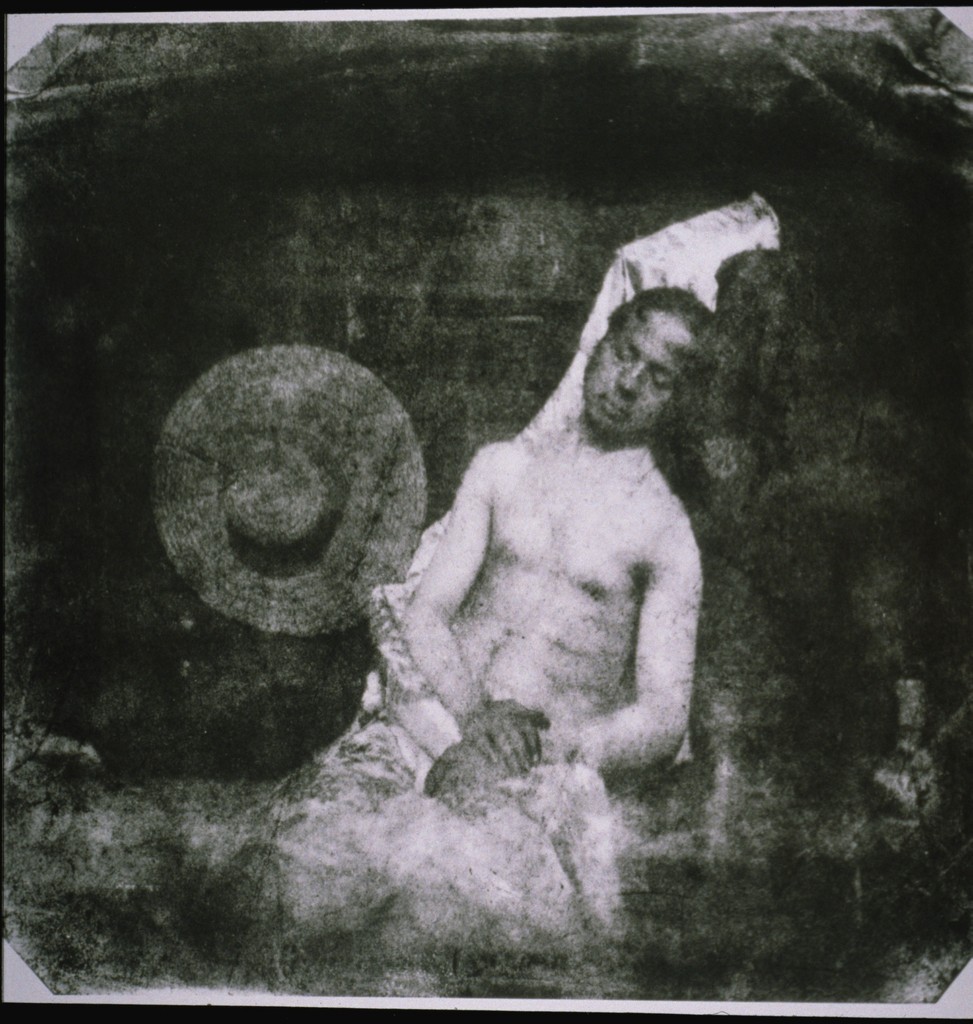
Photography and the nude met almost immediately. In 1840, Hippolyte Bayard, a rival inventor who had been passed over when the state embraced Daguerre, staged one of the earliest photographic fictions ever made. He posed for his Self-Portrait as a Drowned Man with his shirt off, half-draped, eyes closed, arranged as if washed up and lifeless, and captioned the print with a bitter joke about a man the government let drown.
The image was one of the first uses of the human body as a subject for the camera: staged, exposed, and freighted with meaning the image alone could not supply. From its opening act, the photograph was already trading in the body’s ambiguity.
The camera walks into the studio and becomes the model
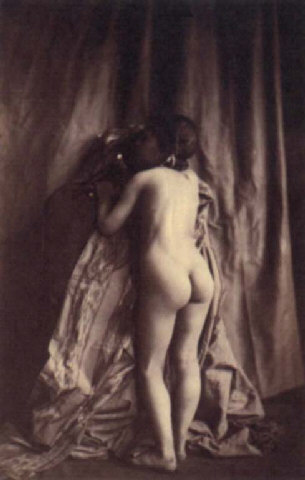
By the 1850s, the camera had entered the studio as a working tool. Photographers began producing académies, photographic figure studies of nude and semi-nude models, sold to painters and students as substitutes for the live model and the plaster cast. The most celebrated of these collaborations paired Eugène Delacroix with the photographer Eugène Durieu, who in 1854 made a series of nude studies at Delacroix’s direction, poses the painter then worked from directly.
In the eyes of their makers, these photographs were working reference. They still did something revolutionary: they fixed a model’s body in a fraction of a second, in real light, with a precision no drawing could match, and put that record into circulation. The nude, once the rarest and most guarded subject of the academy, became reproducible.
Photography’s truth, and what it did to painting
The camera’s mechanical truth posed a blunt question to painting. If a machine could record the body exactly, what was painting for? The answer shaped a century of art. Painters who had spent their careers chasing naturalism began to abandon it. The Impressionists carried the body into actual light and air. The modernists after them dismantled it altogether, treating the figure as something to reconstruct, flatten, fragment, and reimagine.
The nude did not disappear in that turn. It was released from its obligation to look true. Photography absorbed the burden of documentation, and painting was free to think.
Who gets to see, and who gets to make
The democratization cut two ways. A photograph of the body could travel where a painting could not, into homes, into print, into the hands of people who would never enter a salon or a life room. That widened the audience for the nude and, in time, widened its makers, since photography demanded far less privilege than a studio apprenticeship. It also widened the argument over who controls the image of the body, an argument that has only grown louder in the century and a half since.
We tend to date the modern nude to a painting or a scandal. The deeper rupture came on August 19, 1839, when the means of recording the body was handed to everyone. The photograph promised the body unfiltered and delivered instead the body as a question: whose eye, whose frame, whose permission. Every nude photograph since, from the académies of the 1850s to the feeds of today, is still answering it.