Aubrey Beardsley was born on August 21, 1872, in Brighton, England, and died at twenty-five, leaving behind a body of work that turned the nude from an academic ideal into something electric, erotic, and unmistakably modern. In roughly six years of professional life he illustrated Oscar Wilde’s Salomé, produced a scandalous Lysistrata, and gave an entire decade its visual signature. On his 154th birthday, the question he raised has never gone away: what happens to the naked body when it becomes a line, an ornament, a provocation, instead of a virtue?
Beardsley never trained as a painter and rarely worked from the live model. He drew from memory, from Japanese woodblock prints, from the sinuous curves of Art Nouveau, and from a private imagination steeped in the decadent literature of the 1890s. The result was a nude that owed almost nothing to the classical tradition. His bodies are elongated, elastic, androgynous, and alive with a kind of knowing wickedness. Where the academic nude asked the viewer to admire proportion, Beardsley’s figures ask the viewer to acknowledge desire.
The body as ornament
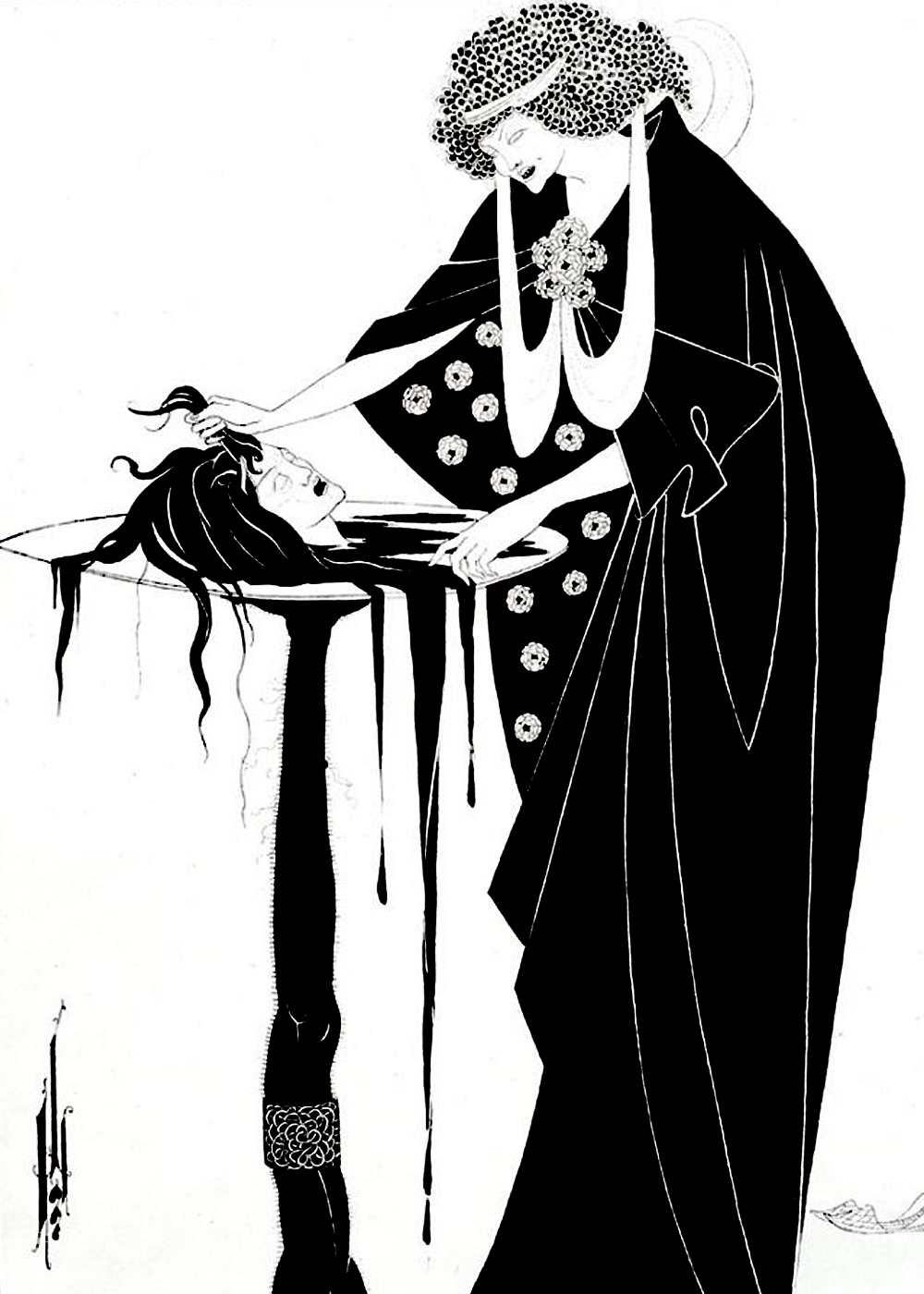
In 1893 Beardsley produced a single drawing, J’ai baisé ta bouche, Iokanaan, for the first English edition of Wilde’s Salomé, and the commission became the defining project of his short career. The Salomé illustrations reduced the biblical story to a study in erotic obsession, rendered in flat black masses and a white line so precise it seems carved rather than drawn. Salomé herself drifts through the pages half-clad, a figure of suspended, theatrical desire. In The Climax she floats upward, holding the severed head of John the Baptist, her robe and hair streaming like smoke. It is one of the most famous images of the fin de siècle, and there is not a classical proportion in it.
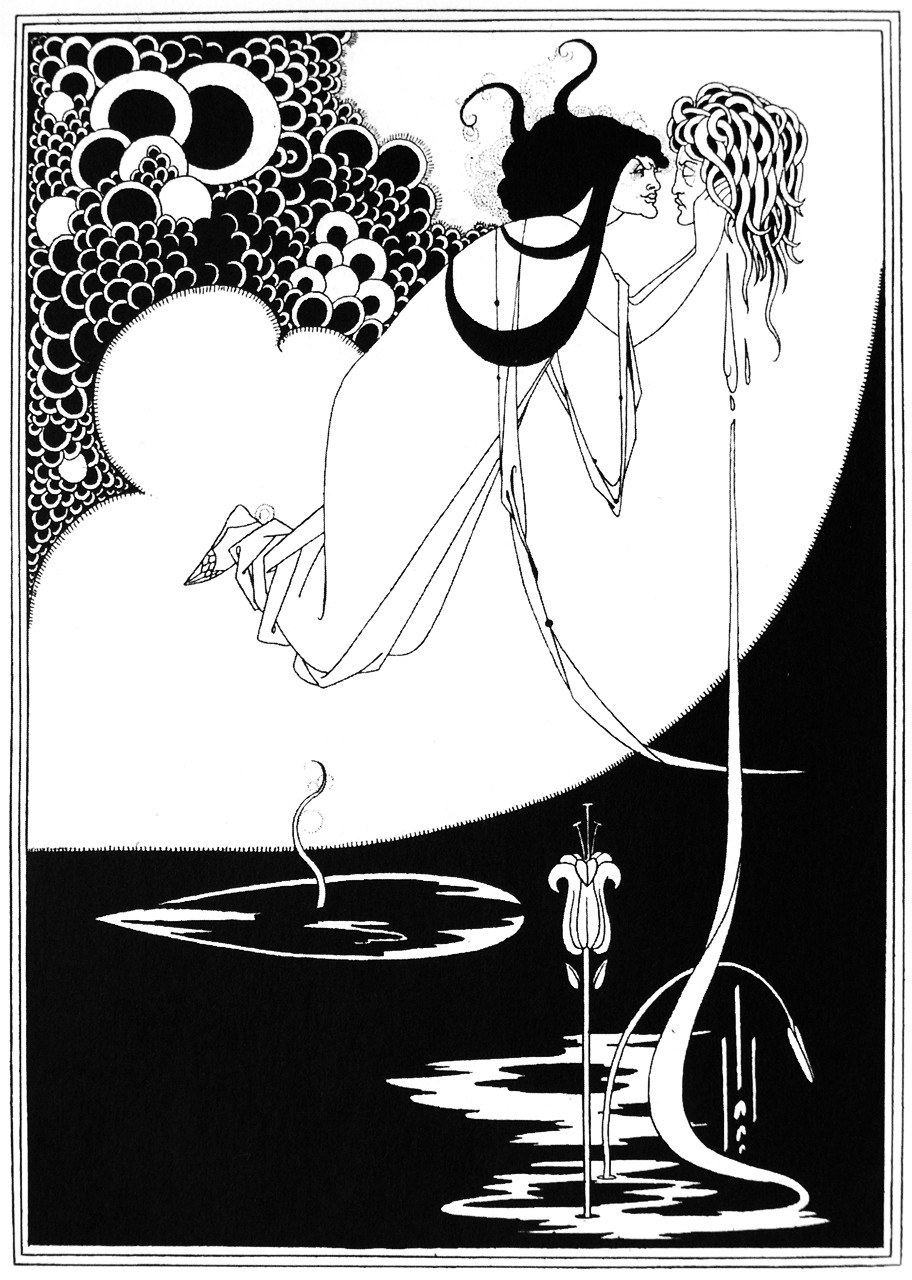
Beardsley understood that the erotic charge of the nude lives in what is withheld as much as in what is shown. His figures are framed, cropped, and patterned so aggressively that the body dissolves into decoration. A breast becomes a curve in a larger arabesque. A hand becomes a black shape against white paper. The nude, in his work, is inseparable from the ornament that surrounds it, and that was precisely the point: Beardsley collapsed the distance between fine art and decoration, between the sacred story and the private fantasy. The art world of his moment did not know whether to crown him or condemn him.
Lysistrata and the naked truth
If Salomé made him famous, the Lysistrata illustrations of 1896 made him notorious. Commissioned for a private, deluxe edition of Aristophanes’ comedy, the eight drawings are Beardsley at his most explicit: nude Greek men and women drawn with a frankness that shocked even his decadent admirers. The publisher insisted on censorship, and some plates were altered before printing. Beardsley, characteristically, was unbothered. The drawings, he said, were simply what the text demanded.
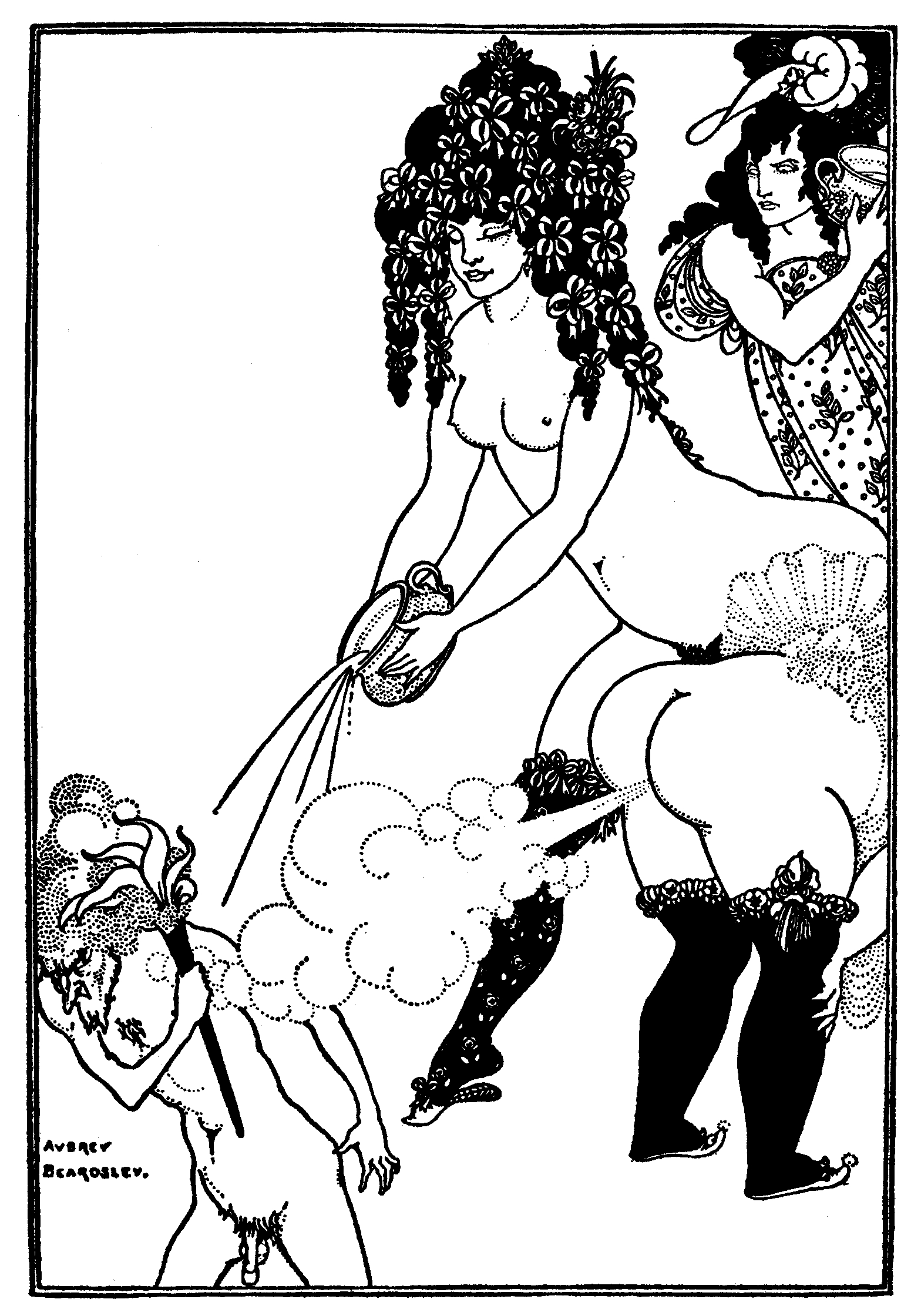
The Lysistrata nudes matter because they are comic and unashamed. They treat the naked body the way Aristophanes treated it: as the raw material of human appetite, funny and grotesque, and entirely without the polite alibi of mythology. Beardsley had no interest in Venus. He was interested in people, and in the absurdity of their bodies. That willingness to look at the nude without flinching separates him from the academic tradition he mocked and from the sentimental erotica that surrounded him.
The censorship he invited
Beardsley courted scandal as deliberately as any artist of his era. His work for The Yellow Book, the short-lived but influential quarterly of the 1890s, made him the visual voice of a movement that conservative critics branded as degenerate. When Wilde was arrested in 1895, the association nearly destroyed him: Beardsley was dismissed from The Yellow Book and, for a time, struggled to sell his work at all. The scandal was never about his nudes alone, but the nudes always sat at its center. A body drawn with desire, without shame, and without apology threatened a culture that preferred its nakedness safely inside a myth.
The ending of the story is as strange as anything Beardsley drew. In the final weeks of his life, dying of tuberculosis in Menton on the French Riviera, he wrote to his publisher asking that his improper drawings be destroyed. The request was ignored, and the work survived. Had it been honored, some of the most important nudes of the 1890s would exist only as rumor. The irony is fitting for an artist who spent his whole career proving that the forbidden image has a stubborn habit of outliving the people who try to suppress it.
A legacy drawn in black and white
Beardsley died on March 16, 1898, at twenty-five, having worked as a professional for less than a decade. His influence outran his lifespan many times over. Art Nouveau, the poster, the modern illustrated book, and much of the graphic sensibility of the twentieth century trace a line back to his ink. His treatment of the nude, at once decorative and confrontational, anticipated a century of artists who would insist that the naked body belongs to the present, not to a sanitized classical past.
A century and a half after his birth, Beardsley’s nudes still feel startling, because they refuse to let the viewer stand outside them. They are too knowing, too composed, too pleased with their own wickedness to be safely admired. That refusal is his gift to the history of the body in art. The nude, he showed, does not need an alibi. It only needs a line.