
The French Revolution ended a great deal: the monarchy, the old aristocracy, and an entire way of picturing the body. Jean-Honoré Fragonard died on August 22, 1806, having outlived the world his paintings celebrated by more than a decade. The courtly France that commissioned his pleasure-soaked scenes had vanished. What survived, what still halts viewers in front of a single canvas, is his gift for painting the nude as pure, fleeting joy.
Fragonard was born in Grasse in 1732 and trained under Boucher and Chardin. He won the Prix de Rome, spent years in Italy absorbing the grand tradition, then turned his back on it. Where the Academy demanded history painting, allegory, and the idealized body, Fragonard painted moments: a girl on a swing, a stolen kiss, a bolt sliding shut. His nudes belong to that same world of seized pleasure.
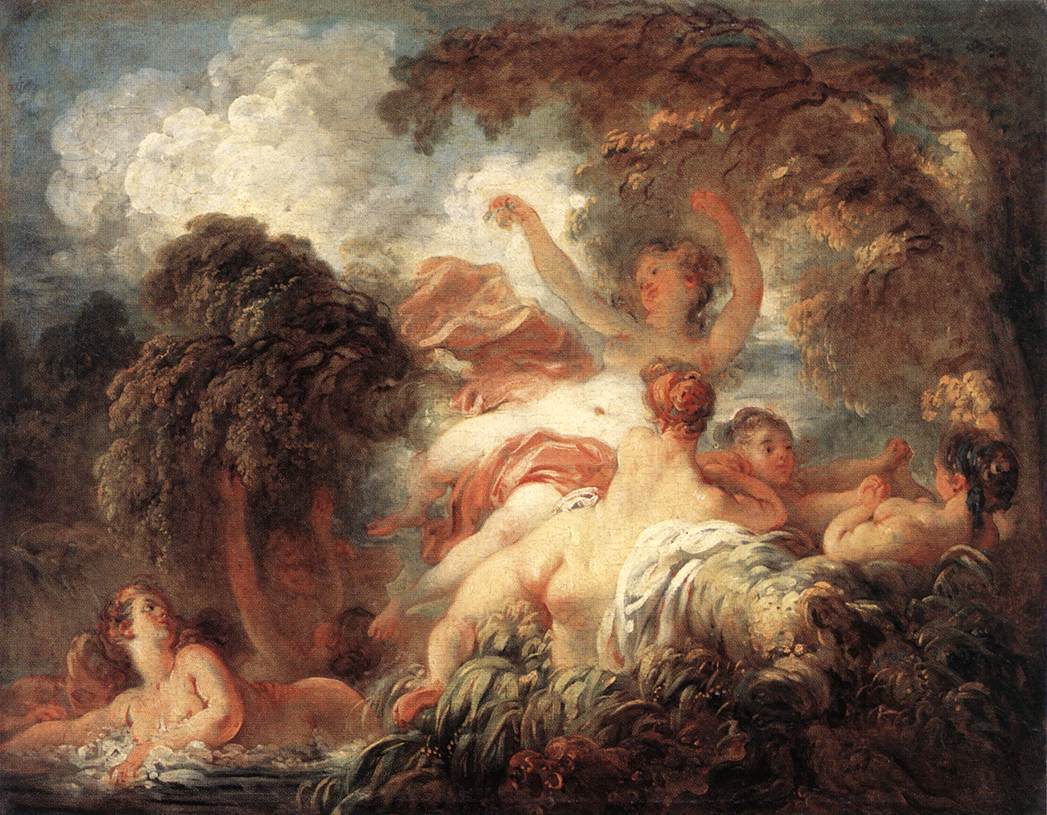
The Bathers (Les Baigneuses), painted around 1765 to 1770 and now in the Louvre, is the clearest statement of his approach. A cluster of nude women splash and tumble through a sunlit glade. Their bodies break from the classical frieze: they frolic, reach, laugh, and collapse into the grass. Fragonard’s brush moves fast, almost sketching, so the figures seem to still be in motion. The paint itself carries the energy. You sense the warmth of the afternoon and the delight of skin meeting water and air.
This marks a deliberate break from the academic nude. A century of French painters had rendered the naked body as a stately, marble-perfect emblem of virtue or mythology. Fragonard’s bathers are fleshy, unposed, and alive, women caught mid-laugh and enjoying their own bodies in private. The scandal, if there was one, lay in the honesty: pleasure treated as a legitimate subject for serious painting.
Fragonard painted the nude during the final, feverish years of the Rococo, when the French aristocracy wanted art that felt like a party. His nudes deliver exactly that. In his work the body becomes a site of delight rather than duty. Set his bathers beside the weighty, moralized nudes the Neoclassicists would champion, and you see what the Revolution rejected: the notion that a body could be enjoyed for its own sake.
The pleasure he painted so well did not last. When the Revolution came in 1789, Fragonard’s patrons scattered or lost their heads. He retreated, took a modest post, and died in relative obscurity in 1806 at the age of seventy-four. For decades critics dismissed him as a frivolous relic of a decadent age. The body in art was supposed to be serious, instructive, uplifting. Fragonard’s body was none of those things.
The reassessment came later, and it is now settled. His loose, bravura brushwork and his capture of light in motion directly anticipated Impressionism. He also legitimized a kind of nude that persists today: the nude as lived experience, caught on the wing. When a photographer frames a candid moment of unguarded skin, or a painter lets the figure dissolve into gesture and light, the lineage runs through Fragonard.
Two hundred and twenty years after his death, the bathers are still splashing. Some art asks you to admire the body. Fragonard asks you to enjoy it, briefly, before the moment passes. He understood that the moment always does.