Henri Rousseau painted jungles he never saw, in a country he never left, from a mind that had never been taught. He was Le Douanier, the customs officer, a retired toll collector who took up painting seriously in his early forties and worked until his death on September 2, 1910, at sixty-six. The critics laughed. Pablo Picasso, Guillaume Apollinaire, and a generation of avant-garde artists saw a seer. His nudes, The Dream, The Snake Charmer, and Eve, are where the two Rousseaus meet: the naive painter and the radical visionary who recast the naked body as a creature of the imagination.
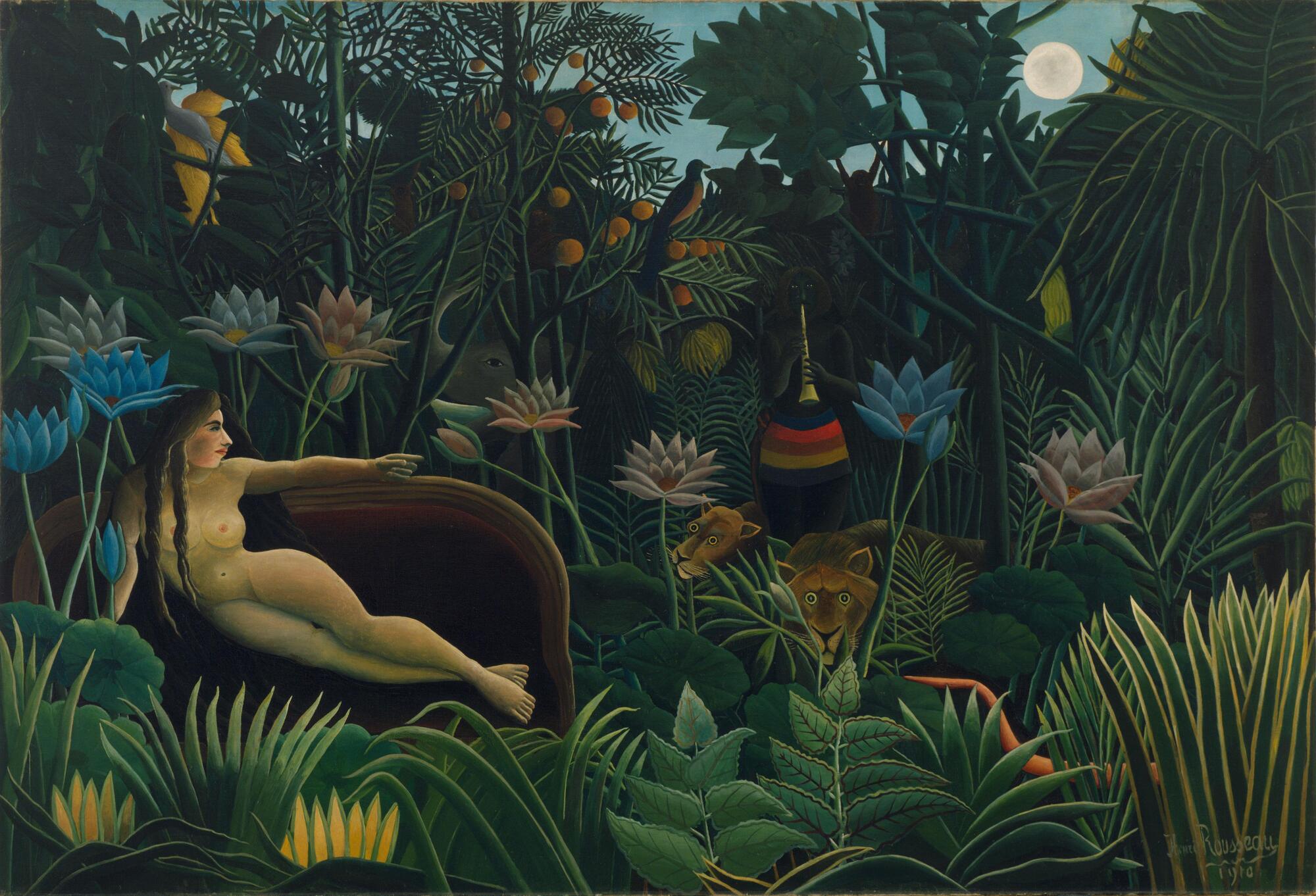
In The Dream (1910), a nude woman reclines on a red sofa in the middle of a jungle. Around her, giant lotus flowers, birds, monkeys, and a dark flute-player rise from the foliage. The painting reads as a direct transcript of a dream, down to the impossible calm of the scene. The woman is naked and unselfconscious. She makes no gesture of modesty, no appeal to Venus, no nod to any allegory. She is a body at rest inside a vision. Rousseau completed it months before he died and called it his masterpiece.
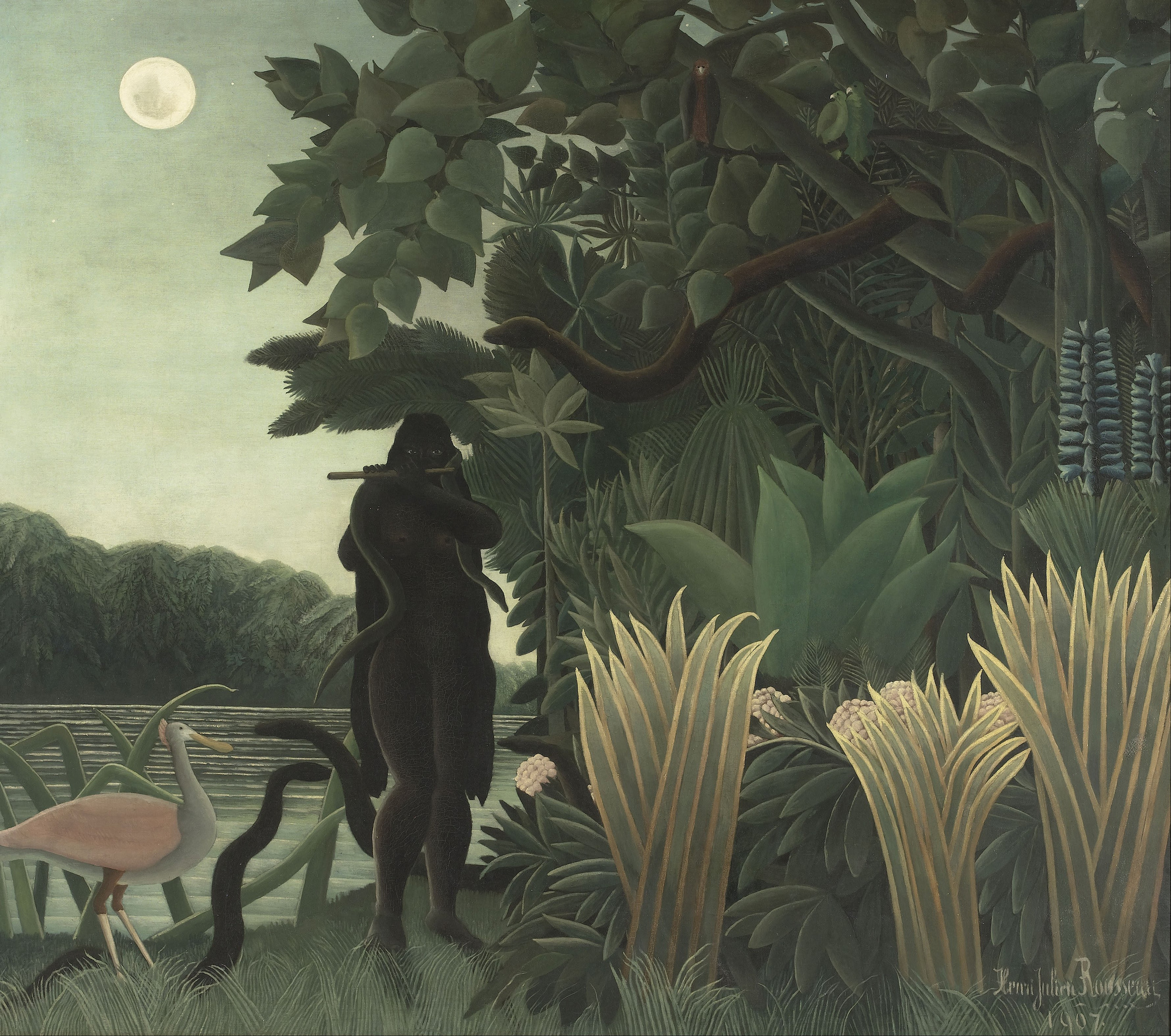
The Snake Charmer (1907) goes further. A nude figure, sometimes read as a modern Eve, stands at the edge of a moonlit river, flute to her lips, while serpents rise from the reeds to hear her play. The naked body becomes incantation. In a century that still leaned on classical myth to justify the nude, Rousseau stripped away the excuse. His Eve is a creature of the jungle, a musician, a body in communion with nature. The snake, the oldest symbol of sin, becomes her audience.
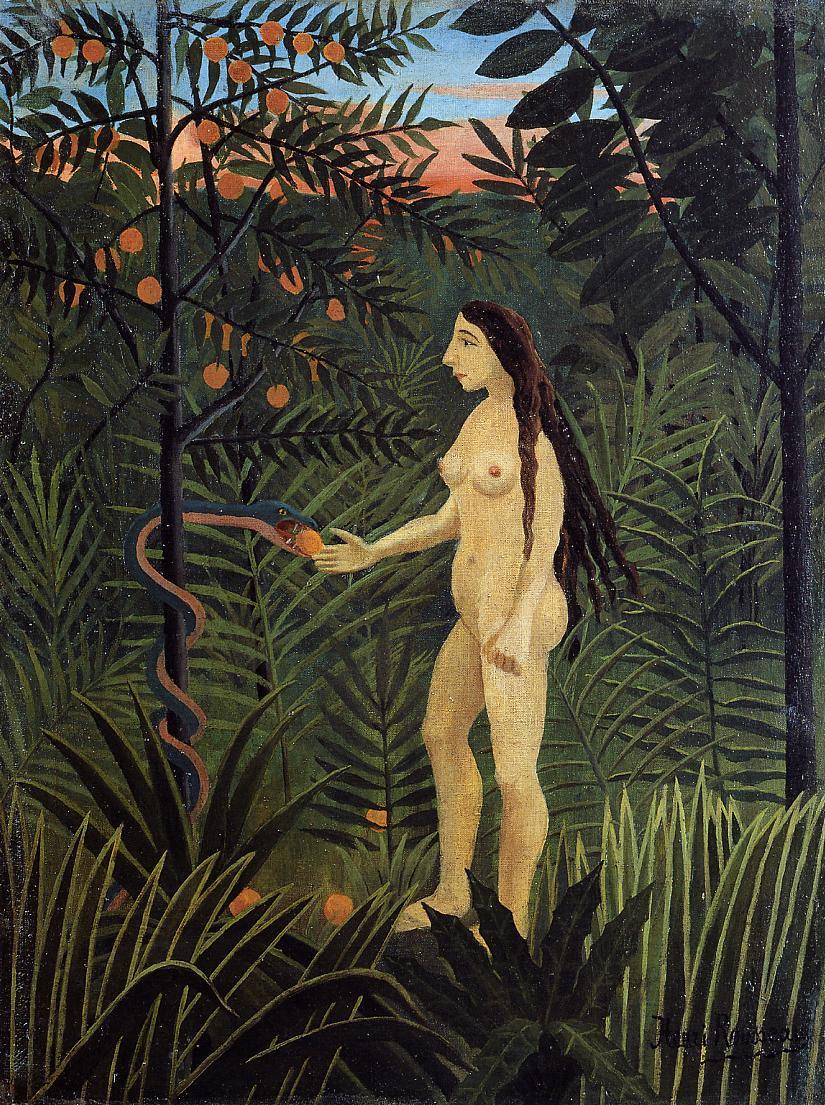
His Eve (c. 1905-1907) completes the arc. Painted for the Kunsthalle Hamburg, it shows the first woman in Eden reaching toward the forbidden fruit while a serpent coils at her side. There is no shame in her posture, no fig leaf of guilt. Rousseau painted Eden as a botanical garden and Eve as its native inhabitant, naked in the way an animal is naked, which is to say without the concept. That is the radical gesture at the heart of his work: the nude reclaimed from sin and returned to innocence.
For four centuries, Western art justified the nude through one of three alibis: myth, religion, or academic idealization. The body was Venus, or a saint, or a lesson in proportion. Rousseau discarded all three. His nudes are dreamed. They carry no idealization, no punishment, no anatomy lesson. The woman on the sofa in The Dream belongs to the dream itself. In that shift, Rousseau anticipated the Surrealists, who saw the jungle as the unconscious and the body as its most legible symbol, and he anticipated a modern understanding in which the nude is a state of mind as much as a state of undress.
Rousseau died in poverty and was buried in a shared grave at Bagneux cemetery. Apollinaire wrote his epitaph, and the art world that had mocked him began to catch up. Picasso hung a Rousseau in his studio. The Surrealists claimed him as an ancestor. The reason endures a century on: Rousseau did the one thing the academy had forgotten how to do. He made the naked body strange again, and in making it strange, he made it innocent. That is what a dream does.