The story comes from the Book of Daniel. Susanna, a married woman of spotless reputation, bathes alone in her garden. Two elders, respected judges, hide in the hedges and watch. They demand sex. She refuses. They accuse her of adultery to save themselves, and the false charge nearly sends her to her death before the young prophet Daniel cross-examines them and exposes the lie.
It is a story about justice, virtue, and false witness. For five centuries, European painters used it for a narrower purpose. It was the perfect excuse for a nude. The naked body was the real subject; the moral lesson was the alibi.
The Spectacle: Tintoretto
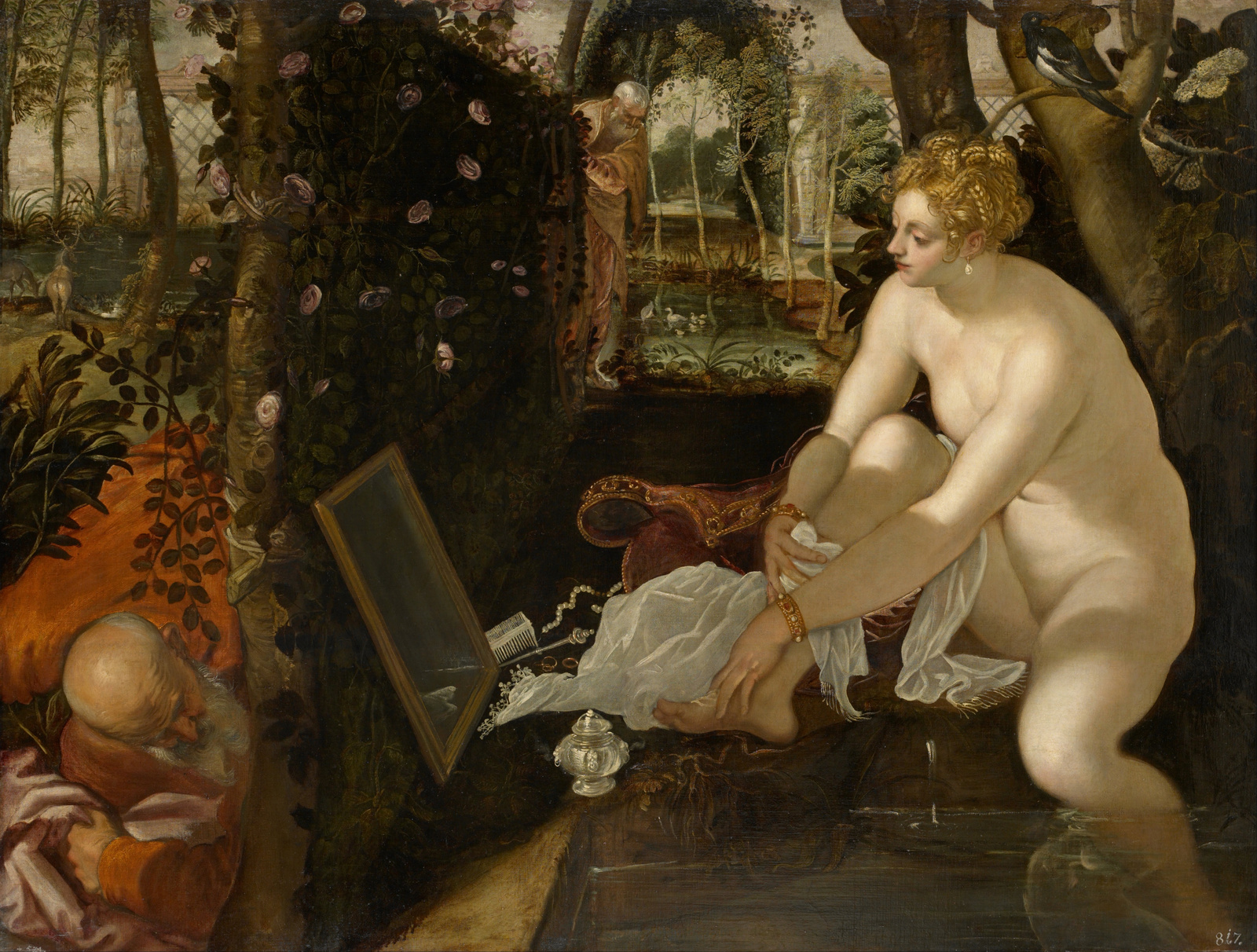
Jacopo Tintoretto’s version, painted around 1555, is the subject at its most knowing. Susanna sits beside a mirror, absorbed in her own reflection, arranging her hair. The two elders crouch behind a trellis of roses, watching. She is displayed for the viewer’s pleasure, framed by her garden like a jewel, unaware of the men at her back. The mirror is the key detail. It makes her complicit in her own display. She performs her body for herself, and the painting quietly folds the viewer in as a third elder.
This is the male gaze made structural: she is looked at, and she does not know it, and the looking itself is the point. Tintoretto did not invent this. He perfected a formula that dozens of painters would repeat, because it sold and because it flattered the buyer.
The Witness: Rembrandt
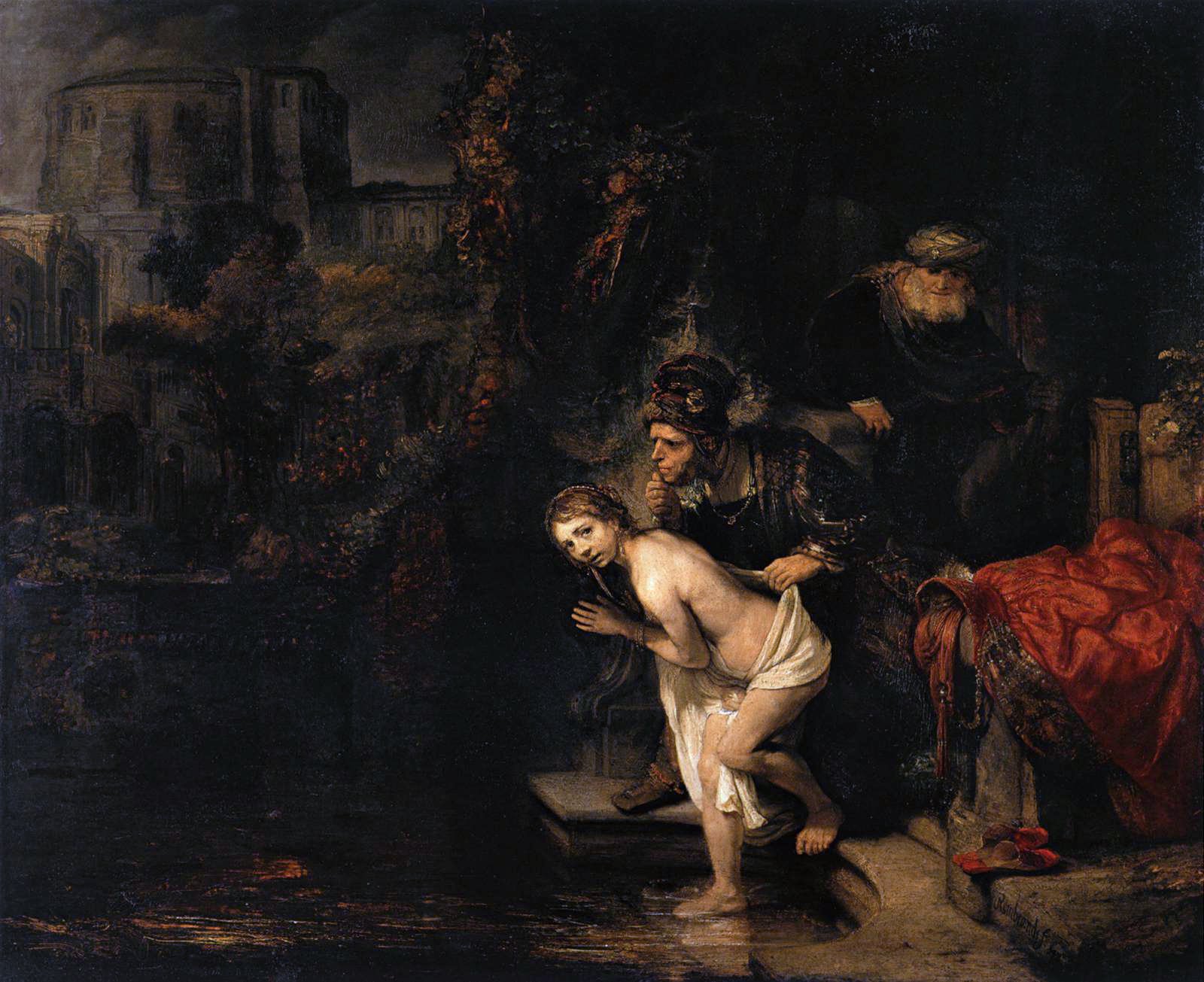
Rembrandt’s Susanna, painted in 1647, breaks the formula. His Susanna has been caught. She startles, clutches a cloth to her chest, and turns to look directly out of the picture, toward us. The elders are still there, but the painting’s center of gravity has moved. The moment becomes one of violation, and she is appealing to whoever is watching.
Rembrandt painted women with an unusual moral seriousness, and here he refuses the easy voyeurism. The viewer stops being a third elder and becomes a witness, with all the responsibility that implies. We are no longer invited to enjoy the sight; we are asked what we will do about it.
The Reversal: Artemisia Gentileschi
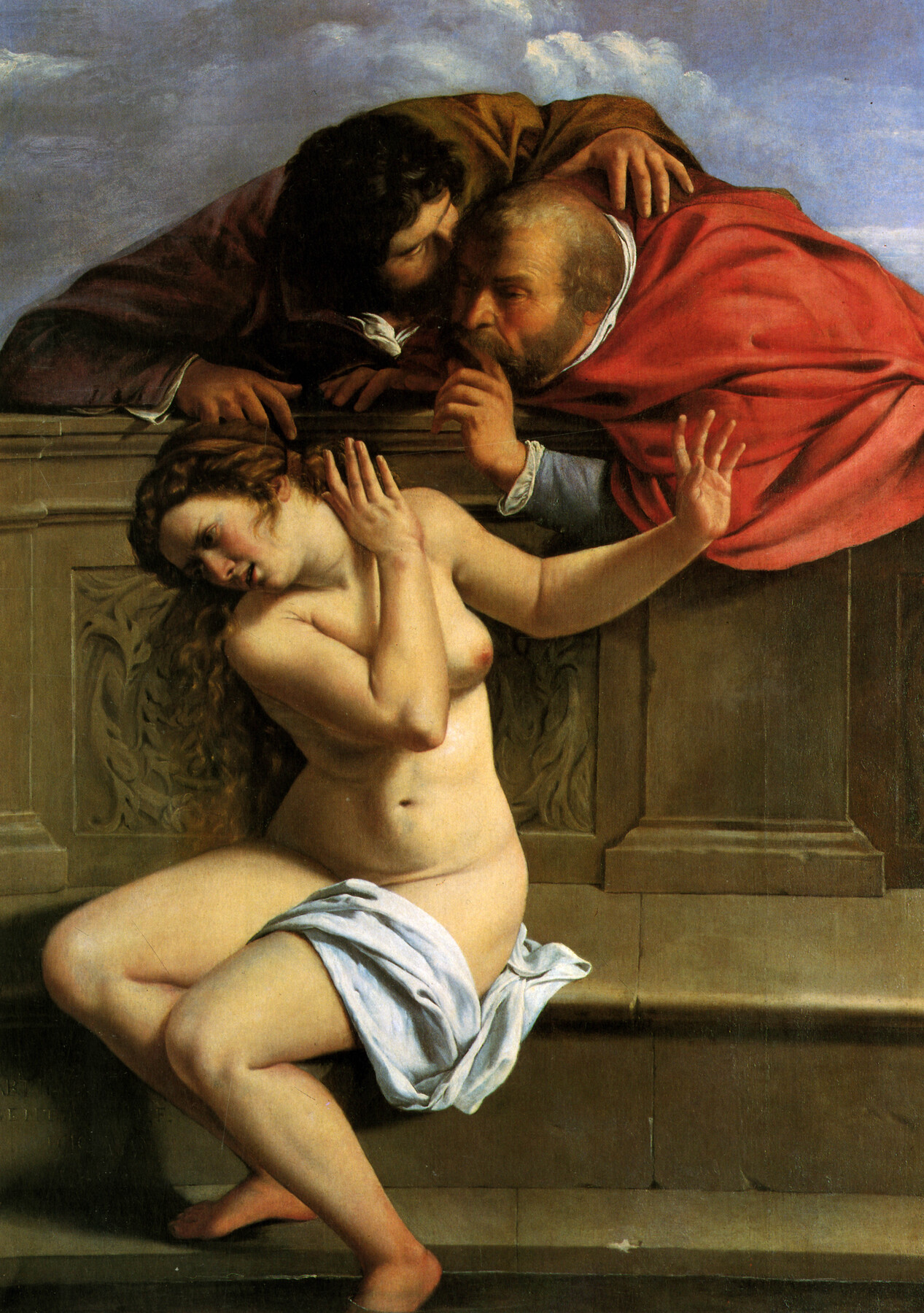
Artemisia Gentileschi painted her Susanna and the Elders in 1610, at the age of seventeen. It is her earliest known signed work. Her Susanna is in anguish, her body twisted away from the two men who loom over her, one whispering into her ear, both with their hands on her. Her arms rise to push them back. There is no mirror, no garden of pleasure, no complicity. The story is told from the woman’s body, and the painting’s sympathy rests entirely with her.
The painting carries a gravity that biography only deepens. A year later, Artemisia was raped by the painter Agostino Tassi, her father’s colleague. She testified against him in a trial where she was tortured, thumbscrews tightened around her fingers, to test the truth of her account. The records survive in her own voice, and they read like a premonition of the painting she had already made. She understood the mechanics of coercion before she had a name for what happened to her.
Who Controls the Image
Susanna and the Elders is the clearest proof of a claim the whole history of the nude keeps making. The naked body in Western art was never neutral. It was a technology for organizing looking: men look, women are looked at. The Susanna subject reveals this because it is a story about looking and power that painters converted into an excuse for display, over and over, for five centuries.
Artemisia’s corrective took three hundred years to be seen for what it was. Today her version hangs as the definitive one, the image people reach for when they want to explain the difference between a nude that is looked at and a nude that is a person. The Guerrilla Girls’ 1989 question, “Do women have to be naked to get into the Met. Museum?”, is the direct descendant of her 1610 painting.
The same fight is still running. Who controls the image of the naked body. Who decides whether it is art or exploitation. Who is looking, who is being looked at, and who gets to tell the story. Susanna’s arc, from spectacle to subject, is the arc the conversation about the nude is still trying to finish.
Explore the collection and see how the body in art keeps asking the same question.