Ovid told the story in the Metamorphoses two thousand years ago, and it has never stopped troubling painters. Actaeon, a hunter, wanders into a grove and comes upon the goddess Diana bathing with her nymphs. She flings a handful of water into his face. He staggers back, antlers splitting his skull, his hands hardening into hooves, his voice gone. His own hounds, dozens of them, catch his scent and tear him apart.
That one story handed Western art one of its most repeated subjects, and its most honest confession. Here, for once, the naked body is not offered to the viewer. Here the gaze is a crime, and the punishment is total.
Almost every other nude in the Western tradition is painted to be looked at. Venus turns toward the viewer and invites the eye. The odalisque reclines for an audience she pretends not to notice. The bather arranges herself for a window the viewer happens to be standing at. These pictures take consent for granted, because the body is mythological, or enslaved, or asleep.
Diana is the exception. She is the one nude in the canon who refuses the arrangement. When Actaeon looks, she does not pose, and she does not perform. She reacts, with a fury that ends in his death. The myth names the viewer as the guilty party, something the tradition almost never allows.
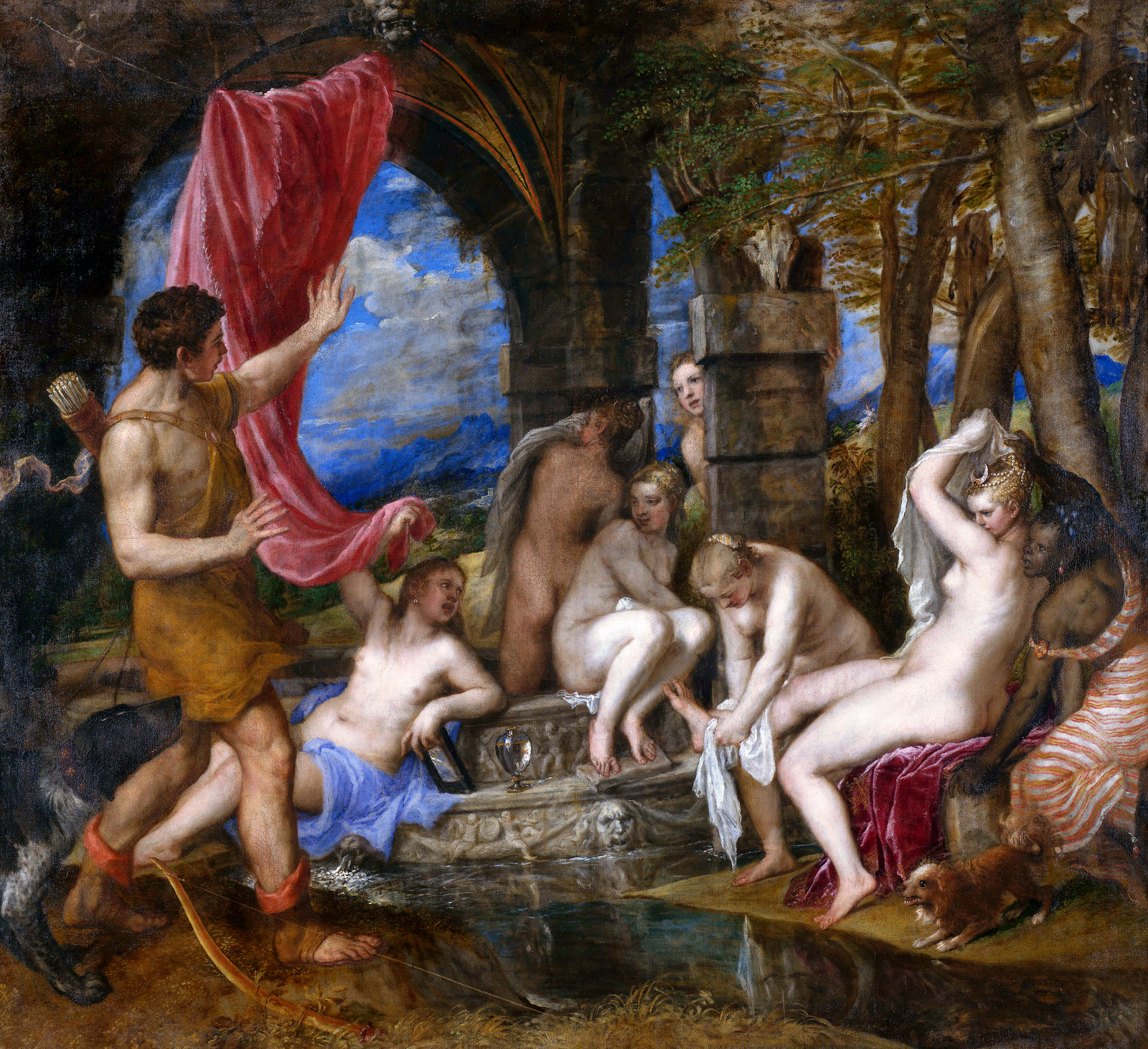
Titian painted the transgression at its flashpoint. In Diana and Actaeon (1556-59) he caught the split second of the violation: the goddess twisting away in fury, a nymph crouching to cover herself, Actaeon’s hand raised in a gesture that reads as both surprise and self-defense. A stag’s skull already hangs from a pillar at the upper right, the punishment announced before it has begun. The painting was one of six mythological poesie Titian made for Philip II of Spain, and it turns the nude into a drama of power rather than a display of flesh.
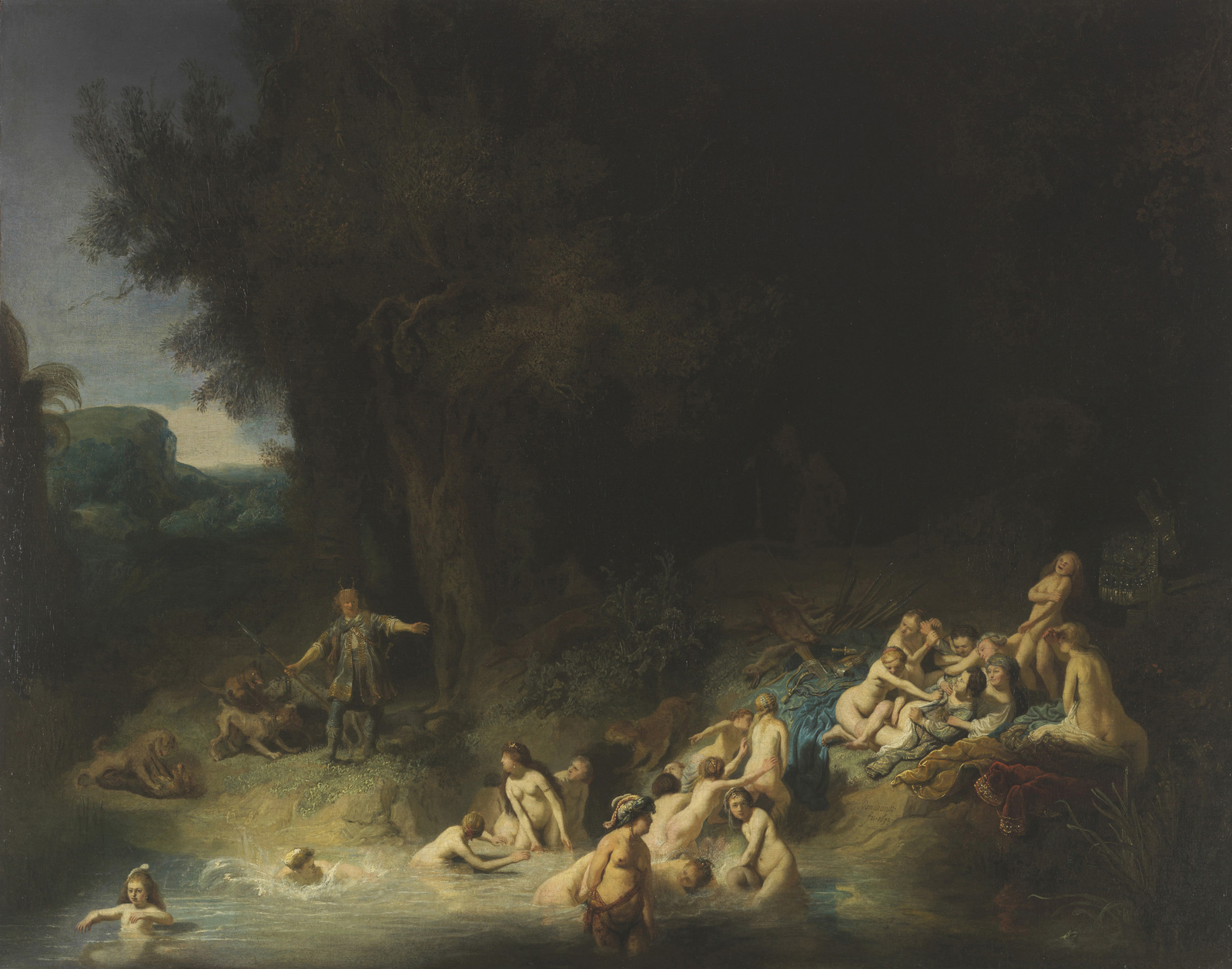
Rembrandt, working decades later, painted the private body itself. In Diana Bathing with her Nymphs (c. 1634) the goddess sits unguarded in the water, her body soft and ordinary, while the disaster of Actaeon plays out small in the distance. The intimacy is the point. This is a body that was never meant to be seen, and Rembrandt lets the viewer feel like an intruder throughout.
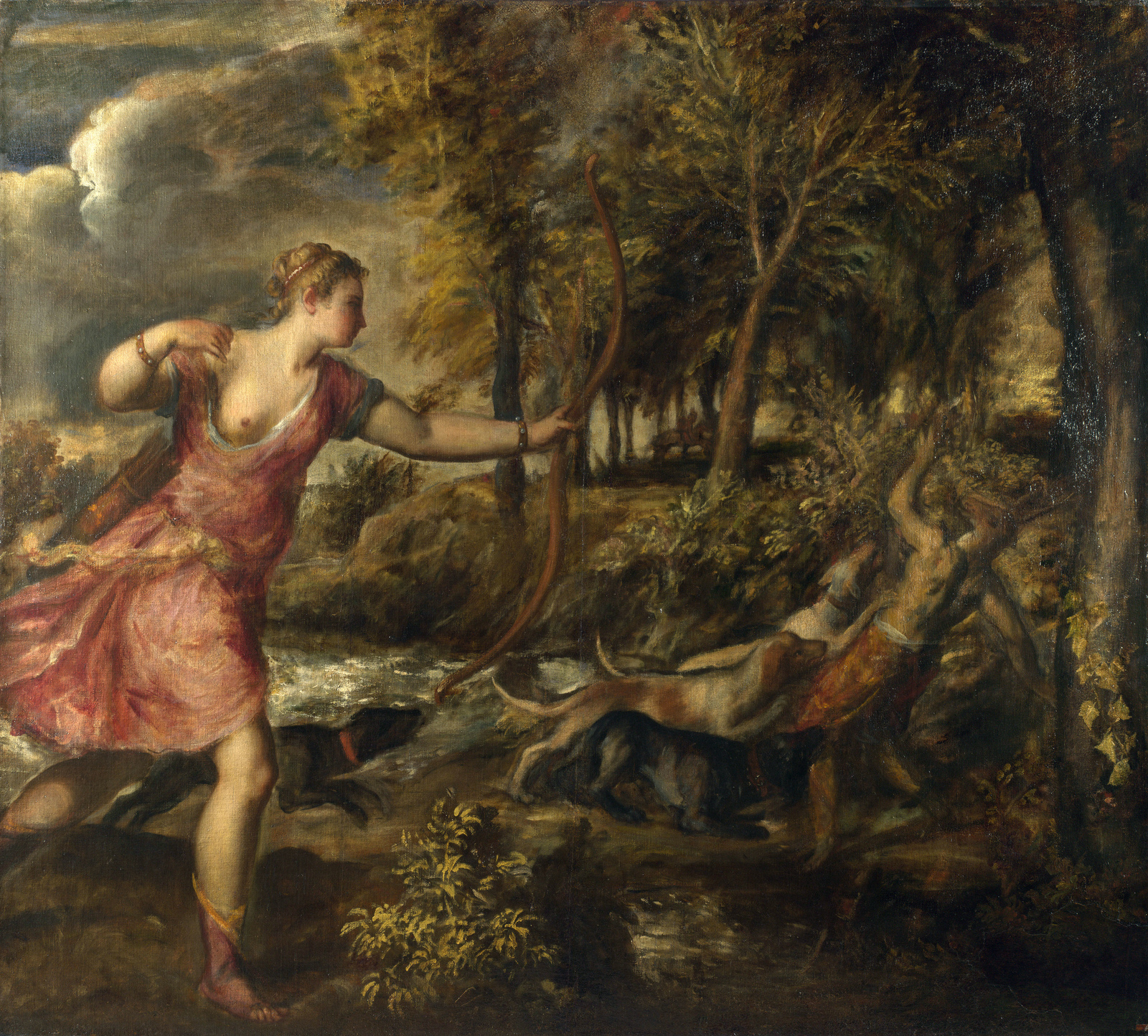
Titian closed the story years later in The Death of Actaeon (c. 1559-75). The goddess watches, composed, while Actaeon, half man and half stag, falls under his own hounds. He cannot speak, which is its own punishment: the viewer who looks without leave is the one who loses language, the one who can no longer explain himself.
The myth carries a hard lesson about power, and it points in a direction art history took centuries to name. In this story the naked female body is the instrument of judgment. Laura Mulvey coined the term “male gaze” in 1975 to describe a cinema built around a male viewer, but Ovid already knew the argument. The act of looking is not neutral, and the person who looks without being invited bears the consequences.
Set Diana beside her half-sister Venus and the contrast sharpens. In Titian’s Venus of Urbino (1538) the goddess looks back at the viewer, and her look is an invitation. In Diana and Actaeon the goddess looks back, and her look is a sentence. Both paintings meet the viewer with a naked woman’s gaze, and the two gazes could not mean more differently.
The story keeps resurfacing wherever the nude becomes a battleground. In 1914 the suffragette Mary Richardson took a meat cleaver to Velázquez’s Rokeby Venus at the National Gallery, a protest against the re-arrest of Emmeline Pankhurst. It was Actaeon’s punishment reversed: the looked-at body striking back at the people who looked. Modern content moderation, with its algorithms flagging the classical statue and the painted breast alike, runs the same ancient anxiety through code. Somebody is always deciding who may look, and who pays for it.
Two thousand years after Ovid, the story still lands because it refuses the easy bargain the rest of the tradition makes. It says the naked body is not yours to take with your eyes. It says looking has a price. It says the viewer is the one who should be afraid. That is why the myth endures: it is the one nude in Western art that warns instead of inviting.