
Edgar Degas died in Paris on September 27, 1917, at the age of 83. By then his eyesight had failed so badly that he had given up painting years earlier and spent his last days wandering the streets he had once drawn. He left behind the most radical body of nude pictures produced in the nineteenth century, work that still asks the central question of our own age: what does a naked body look like when nobody is performing for the viewer?
Degas spent the first half of his career painting what the Academy told him to paint. He copied the Old Masters in the Louvre. He sketched historical scenes with heroic, half-dressed figures. The nude, in that tradition, was a costume. A woman in a painting by Ingres or Bouguereau stood naked for the same reason a statue of Venus stood naked: nudity was the uniform of allegory, myth, and ideal beauty. The body existed to be looked at, and the woman in the picture knew it.
Sometime in the 1880s Degas stopped painting that body. He turned instead to a subject the Academy considered beneath art: women in the private act of washing themselves. In pastel after pastel he drew a woman crouched in a shallow tub, or drying her back with a towel, or dragging a comb through wet hair, or stooping to sponge her leg. These are the pictures he showed at the eighth and final Impressionist exhibition in 1886, a “suite of nudes of women bathing, washing, drying themselves, rubbing themselves down, combing their hair, or having it combed.”
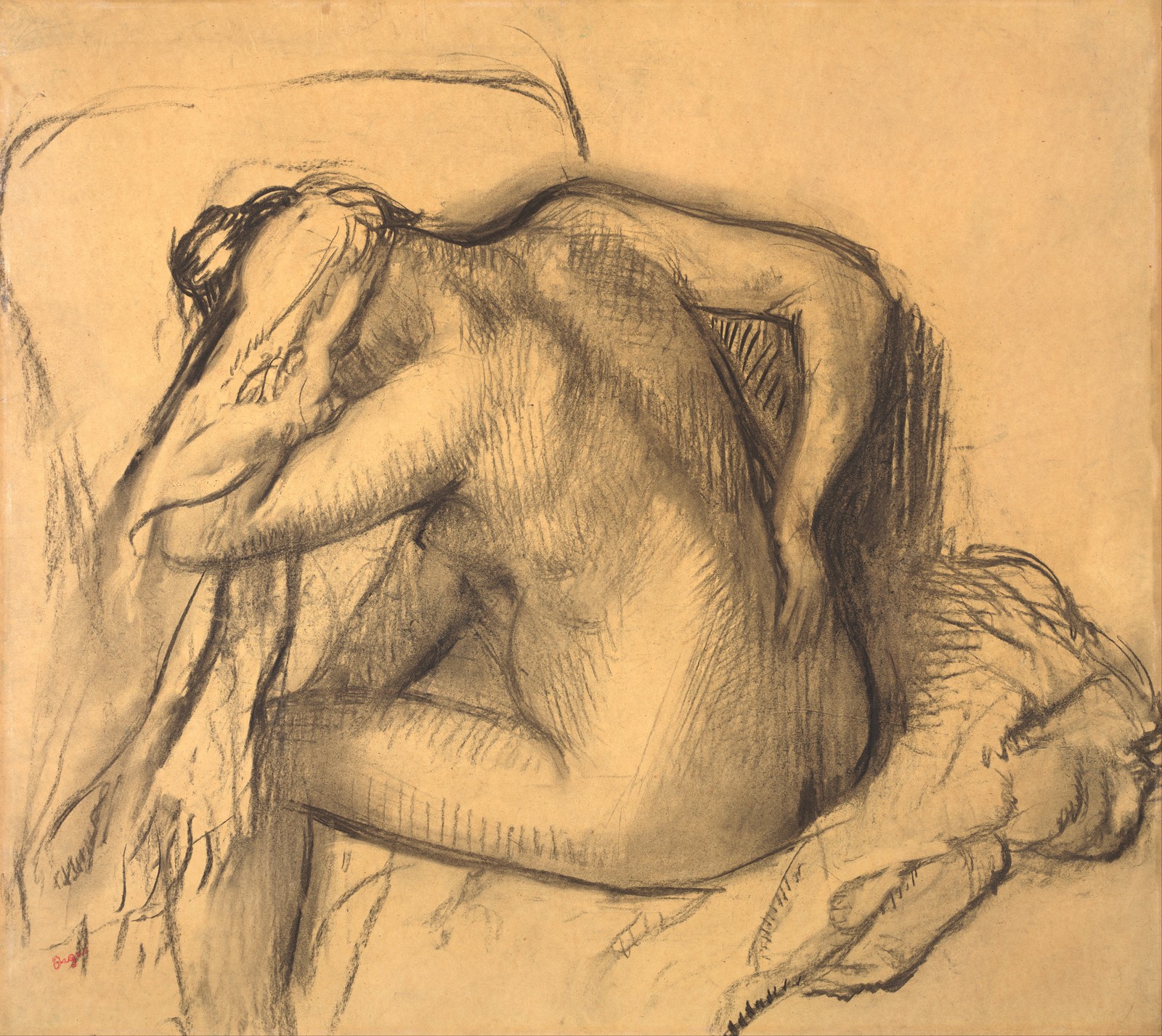
What scandalized viewers was simple: the women did not know anyone was looking. Degas described the effect he wanted in a phrase that has defined his reputation ever since. He wanted it “as if you looked through a keyhole.” His bathers never meet the viewer’s gaze. They bend, twist, and reach in the awkward geometry of real self-care, elbows out, spines curved, faces hidden or turned away. A woman crouches in a shallow tub, trying to wash her own back. That is the entire picture.
Degas was blunt about the shift. “Hitherto the nude has always been represented in poses which presuppose an audience,” he said. “But my women are simple, honest creatures, concerned with nothing beyond their physical occupations.” He went further, and his words have dogged him for a century: he compared his models to animals licking themselves clean. Critics then and now have heard cruelty in that line, and there is cruelty in it. Degas was a difficult man, a bachelor, an anti-Semite, a conservative who ended his life alienated from almost everyone who loved him. But the pictures are more complicated than the man. The bathers do not leer. They are tender in a way Degas rarely allowed himself to be in life.
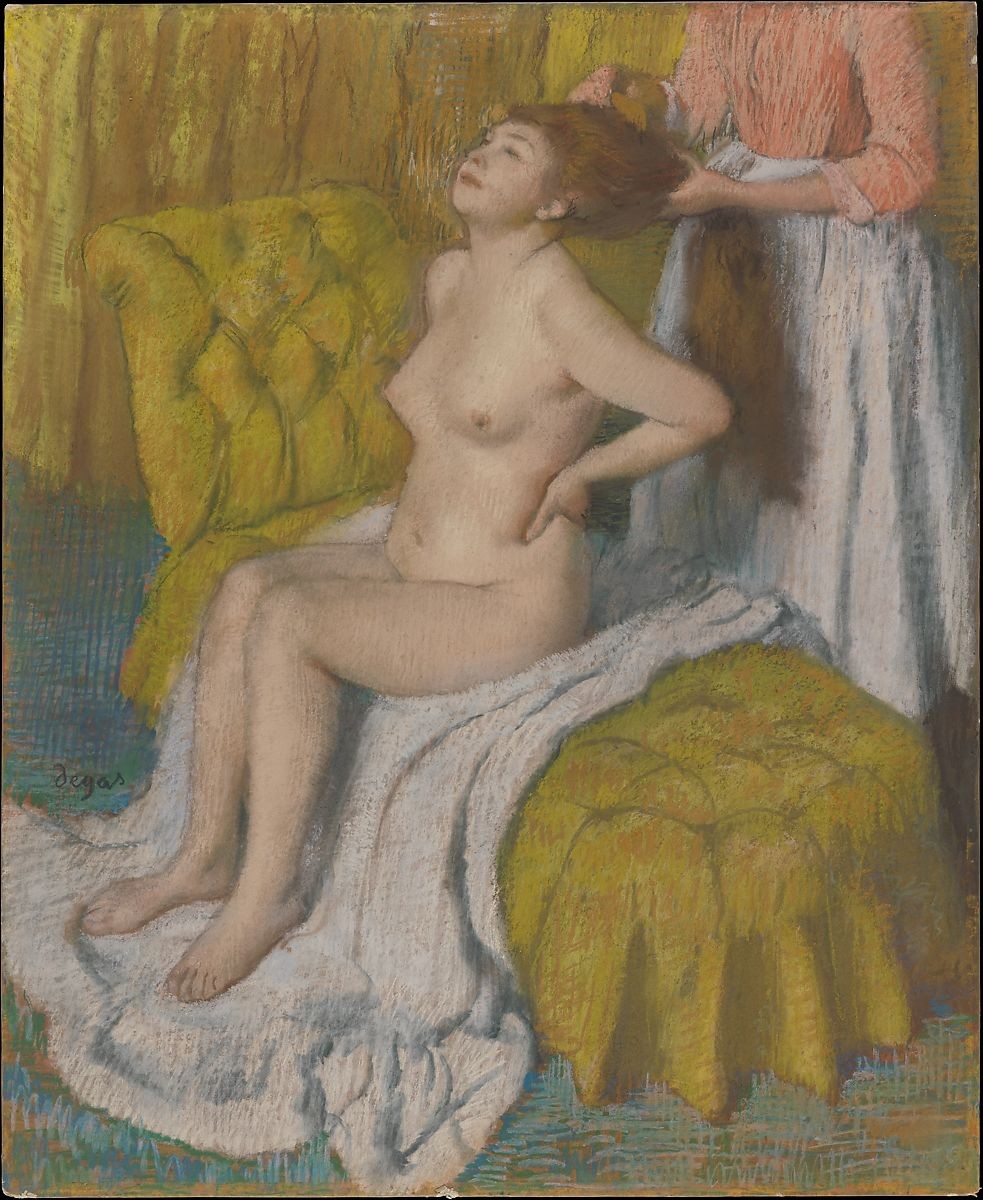
What Degas achieved was the dismantling of a four-hundred-year contract between painter, model, and viewer. Since the Renaissance, the painted nude had been a transaction: the artist arranged the body, the body offered itself, the viewer paid with attention. Degas broke the arrangement. His figures owe nothing to the viewer. They are occupied, absorbed, self-sufficient. In doing so he made the nude modern in a way the twentieth century has still not finished absorbing. Every photographer from Henri Cartier-Bresson to Nan Goldin who has captured a person unaware of the camera works in Degas’s shadow. So does every artist who refuses to let the body become a prop.
This is why Degas matters now, 109 years after his death. We live in a culture saturated with images of bodies, most of them posed, lit, and filtered for maximum legibility. The nude today is more often a performance than a person, engineered for an audience that the subject knows is watching. Degas’s bathers are the corrective. They remind us that the body has a life before the viewer arrives, a private, graceless, honest life of drying off and getting dressed. That life, Degas insisted, was worth the most demanding art of all.