Alexandre Cabanel was born in Montpellier on September 28, 1823, 203 years ago today. For three decades he was the most decorated painter in France, the preferred artist of Emperor Napoleon III, and one of the three most successful painters of the Second Empire, alongside Jean-Léon Gérôme and Ernest Meissonier. He built that standing on a single subject: the idealized female nude, finished to a surface so smooth it seems to hold no flesh at all.
The painting that made his name is The Birth of Venus, shown at the Paris Salon of 1863 and bought on the spot by Napoleon III for his private collection. The same year Cabanel became a professor at the École des Beaux-Arts. The canvas shows Venus stretched on the crest of a wave, eyes closed, hair spreading across the water, attended by a cluster of putti. There is no blemish, no shadow, no trace of a particular woman. It is a body that never existed, and that absence is exactly what the Academy praised as perfection.
The academic nude ran on a simple bargain. A naked body belonged in a painting only if it refused to be a real body. It had to present itself as a goddess, a nymph, an allegory, a personification. Cabanel honored the bargain completely. His flesh is enamel-smooth and hairless, his anatomy corrected toward an ideal inherited from Greek sculpture through Raphael and Ingres, his pose borrowed from Titian’s reclining Venus. The result is the nude as pure idea, kept at a safe distance from anything human.
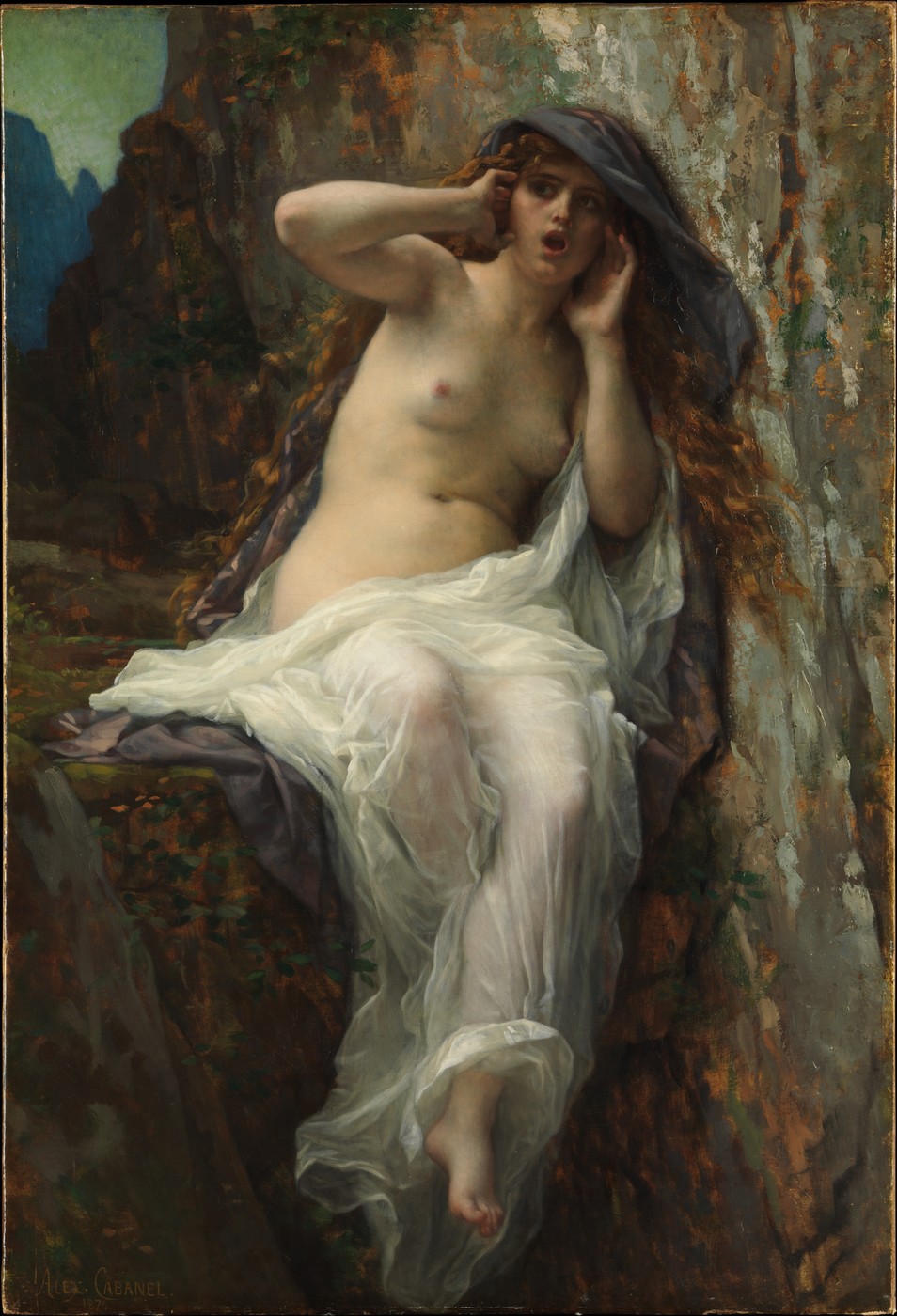
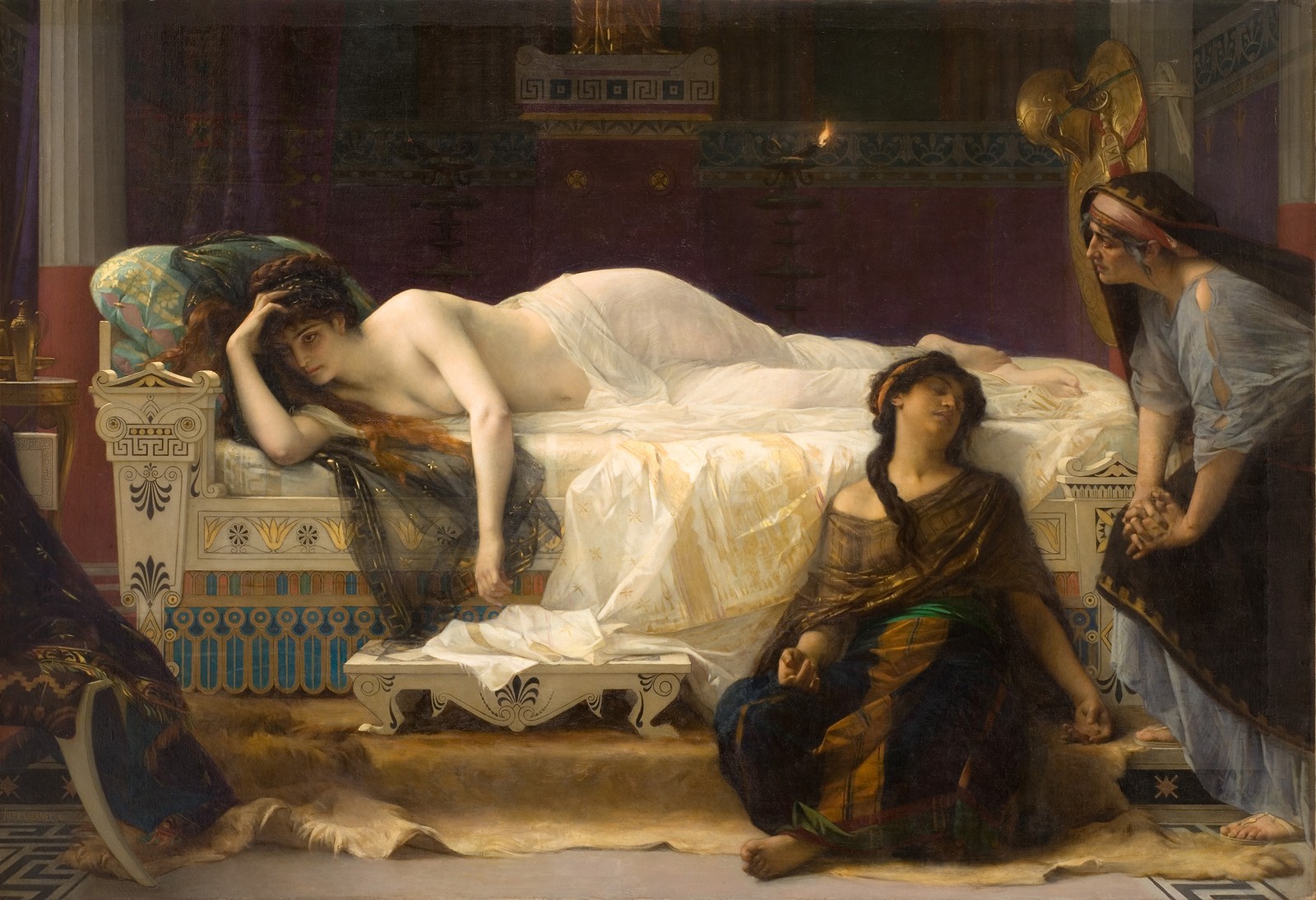
Echo, painted in 1874 and now in the Metropolitan Museum of Art, restates the formula as a single standing figure, one arm raised, her body bent into a graceful S-curve. It is a study in grace without weight. Six years later came the mature repetition of Phaedra, the reclining nude laid out once more with the assurance of a formula. Cabanel could produce these figures without end because the ideal, unlike a real body, does not age, resist, or change.
The Birth of Venus hung in the same Salon of 1863 that turned away Manet’s Le Déjeuner sur l’herbe and sent it to the Salon des Refusés. Two years later Manet’s Olympia reached the Salon of 1865 and scandalized Paris. The two painters frame the argument the nineteenth century was having with itself about the body. Both nudes borrowed their pose from Titian. Both showed a woman lying down. The difference was the reaction. Cabanel’s Venus read as an idea, and the critics found it reassuring. Manet’s Olympia read as a person, and the critics found it obscene. Cabanel gave the public the body it wanted to look at. Manet gave it the body it was afraid to see.
Cabanel’s craft was real, and it mattered. He won the Prix de Rome in 1845 at twenty-two. He taught for years at the École des Beaux-Arts, sat on Salon juries, and enforced a standard that every realist and Impressionist had to break through or work around. When we celebrate the nudes that told the truth, we should remember that the truth had to be told against a wall of polished perfection. Cabanel built the wall, and in building it he set the bar: modernism tested whether beauty could survive contact with an actual body.
The Birth of Venus remains one of the most reproduced nudes in the history of Western art, a fixture on posters and phone cases. People look at it and see beauty. That endurance is the strange power of the academic ideal. Cabanel proved that a body emptied of everything human can still hold the eye. The question he leaves behind, 203 years on, is what we want from a naked body in a painting: the perfection of a goddess, or the presence of a woman.