The nude is the loneliest subject in art. A single body, posed and lit, waiting to be seen. For five hundred years the painter’s problem stayed the same: how to render one figure, standing or reclining, without the mythology collapsing into embarrassment.
The kiss broke that solitude.
When two bodies meet in an embrace, the artist faces a problem the single nude never poses. Two figures have to balance. They have to counterweight each other, share gravity, and trade the viewer’s gaze for each other’s. The kiss is where the nude stops being an object on display and becomes a relationship. That is why it recurs, century after century, in some of the most demanding work art has ever produced.
The ideal embrace: Canova’s Psyche and Cupid
Antonio Canova’s Psyche Revived by Cupid’s Kiss, carved in marble between 1787 and 1793, is the embrace at its most classical. Cupid bends over the sleeping Psyche, whose body arcs up to meet him. His wing still spreads behind them, the drapery still gathers beneath, but the center of the whole sculpture is the point where their two bodies nearly touch.
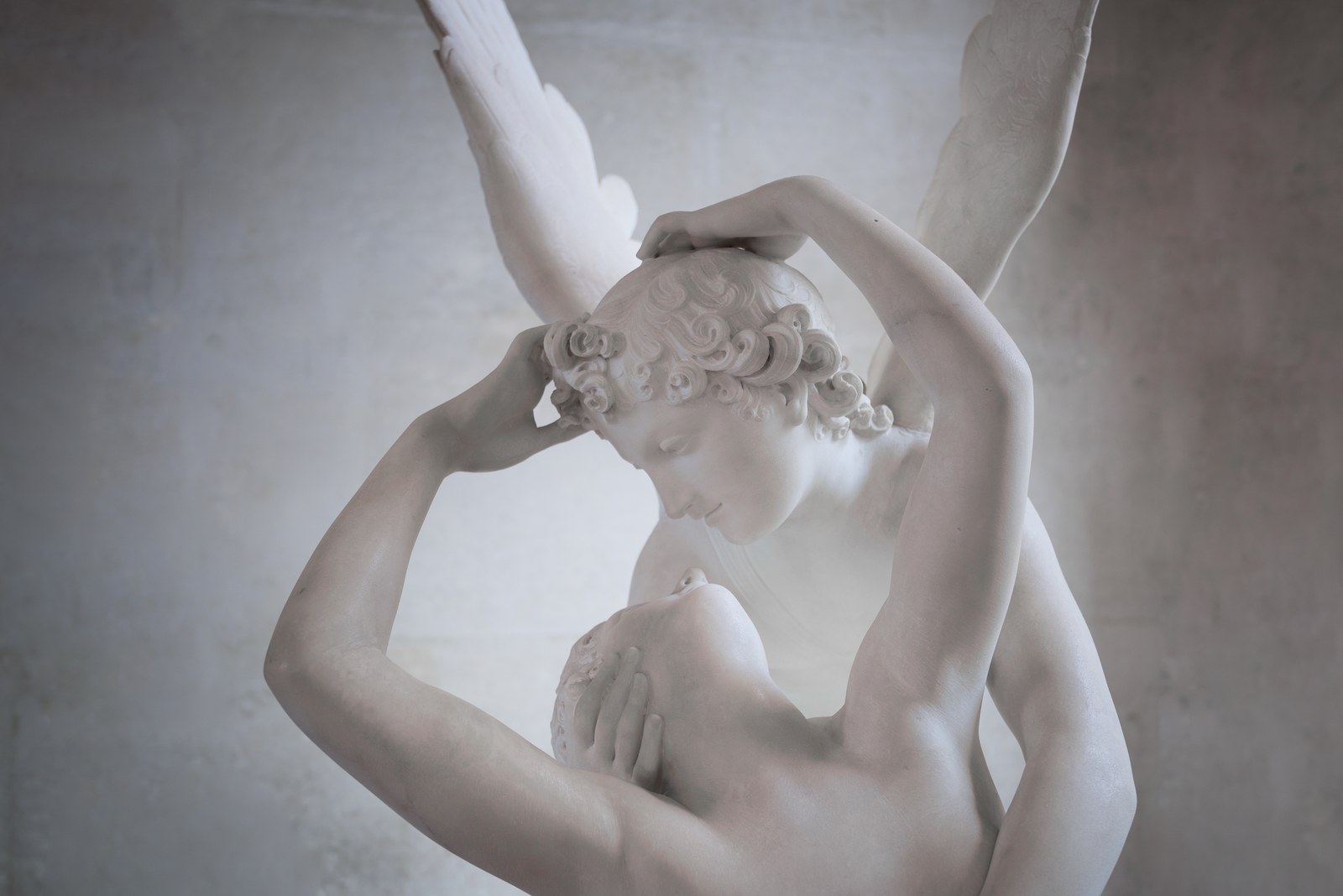
Canova set himself a problem only a sculptor would invent: to show two separate, ideal bodies caught in a single suspended moment. The interval between them is the subject. The kiss here is a revival, the climax of the myth, and Canova gives it the stillness of a held breath. Every muscle in both bodies exists to serve that one near-contact.
The real embrace: Rodin’s The Kiss
A century later Auguste Rodin took the same pose and made it flesh. His The Kiss, modeled from 1880 and cast in bronze, began as the doomed lovers Paolo and Francesca from Dante’s Inferno, figures Rodin was carving for his Gates of Hell. He pulled them out of that project and let them stand alone.
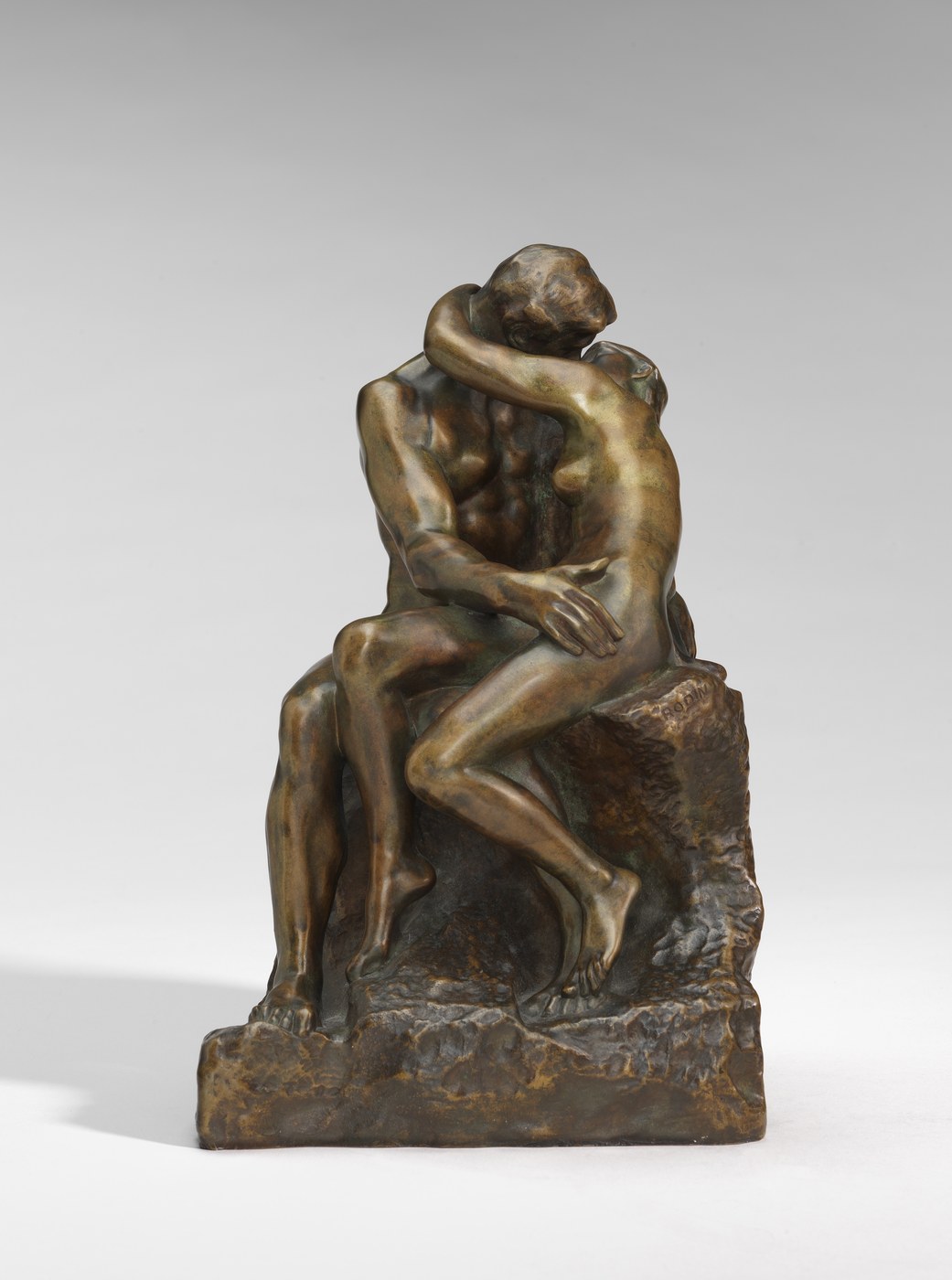
Where Canova’s lovers are weightless and ideal, Rodin’s are heavy and alive. Her leg hangs over his, his hand grips her thigh, and their mouths meet with the force of people who know the embrace is forbidden. The bronze and marble versions scandalized viewers precisely because the bodies looked real. Rodin answered Canova’s question with a different answer: two bodies actually in contact.
The dissolved embrace: Klimt’s The Kiss
Gustav Klimt’s The Kiss, painted in 1907 and 1908, dissolved the two bodies entirely. The lovers kneel on a field of flowers, wrapped in robes of gold leaf that merge into a single glowing shape. Only the faces and the hands survive as distinct.
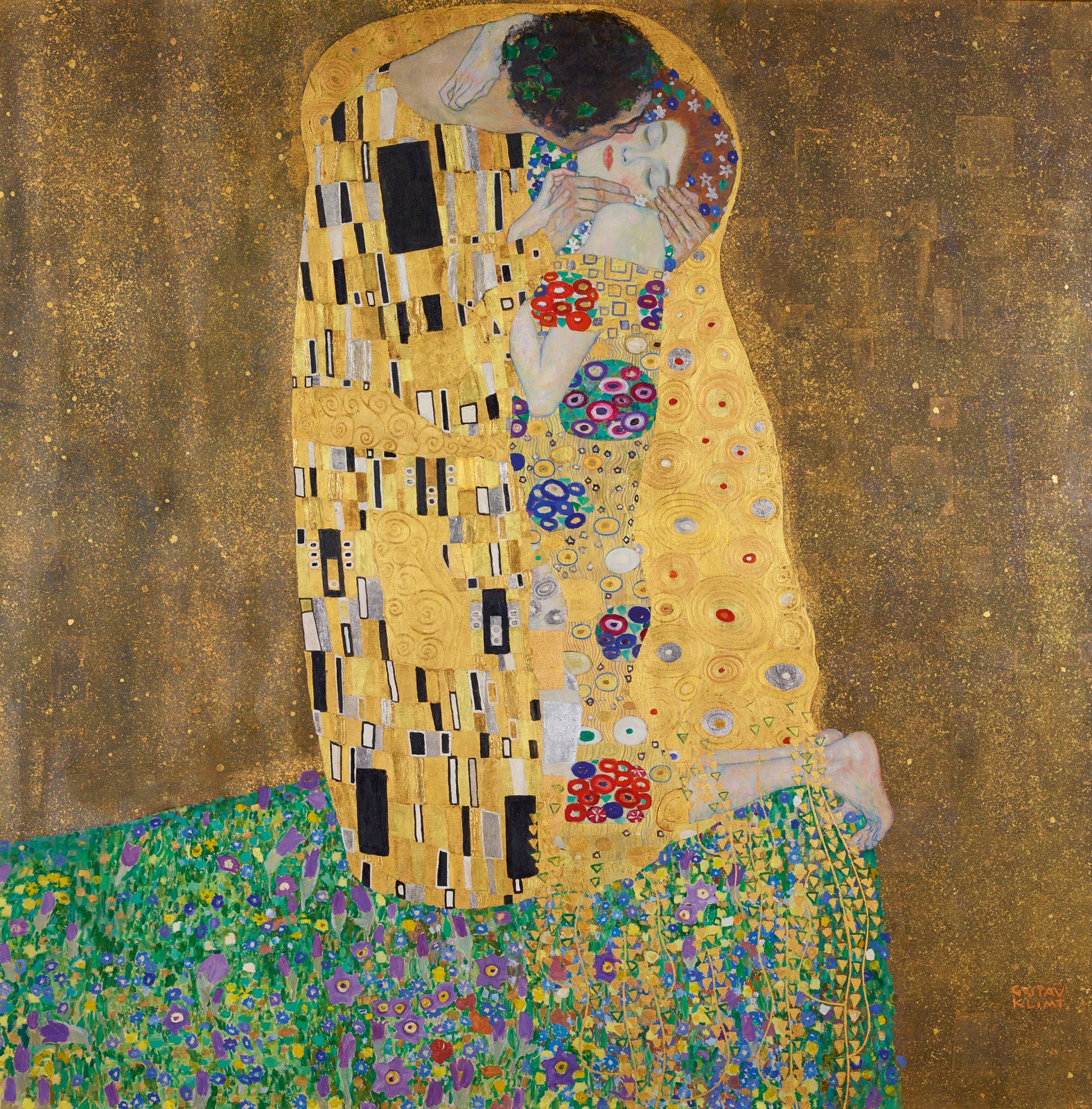
Klimt found the third answer. Canova kept two bodies apart in an ideal interval. Rodin pressed two bodies together until they were unmistakably separate people. Klimt made the embrace swallow both figures, so the kiss becomes an ornament, a pattern, a single luminous field with two faces looking out of it. The body becomes the shape of the bond itself.
The kiss is the nude’s hardest subject because it is its most human one. A single figure can be idealized into perfection. Two figures in an embrace cannot. The moment two bodies touch, the artist has to account for weight, for balance, for the exact place one person ends and the other begins. That accounting turned a classical myth into Rodin’s scandal and Klimt’s golden dream.
The solitary nude asks you to look. The kiss asks you to notice what the two figures give up to hold each other.