
Three women stand naked, arms linked. Two face forward; one turns away, so the circle of their bodies reads as a single turning form. This is the Three Graces, and for more than two thousand years it has been the West’s favorite way to picture the nude at its most social.
The figures are Aglaea, Euphrosyne, and Thalia: Splendor, Joy, and Bloom, daughters of Zeus and the sea-nymph Eurynome. In Greek and Roman reliefs, mosaics, and coins they attend Venus and dispense charm and generosity. Where most nudes in the tradition stand alone, posed for a single viewer, the Graces are always already in company. Their nudity is ease itself. There is nothing to hide, because nothing is being taken.
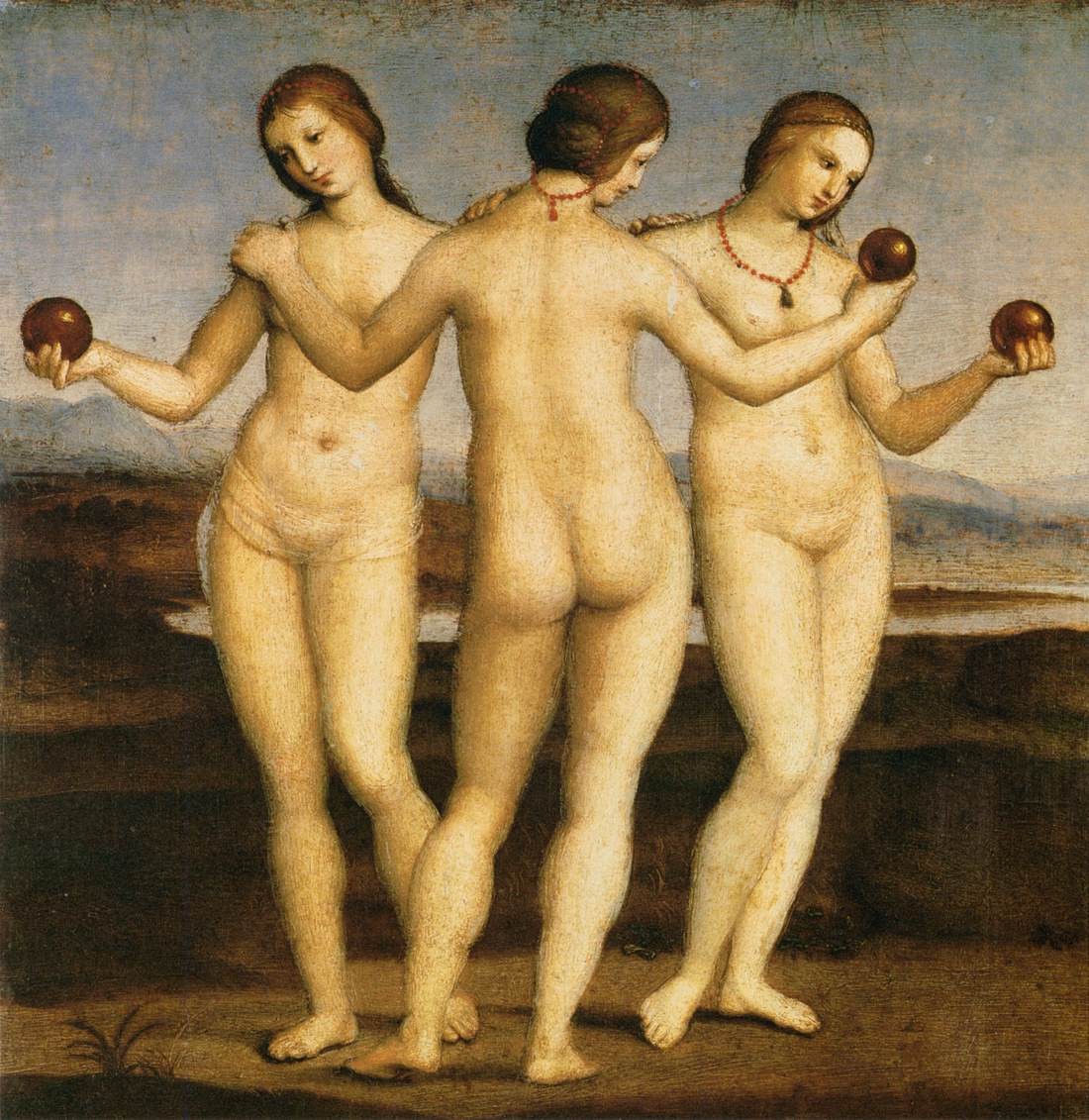
Raphael painted the group around 1504, barely out of his teens, as a jewel-like panel now at Chantilly. The three figures hold golden apples and turn toward one another with the poised rhythm of a slow dance. He had studied a Roman sculptural group of the Graces in Siena, and he translated its marble coolness into paint. For the humanists in Raphael’s circle the Graces carried a specific moral weight: they are the threefold gift, the body giving and receiving at once. One grace faces away from us, her back a reminder that every community has a side the outsider cannot see.
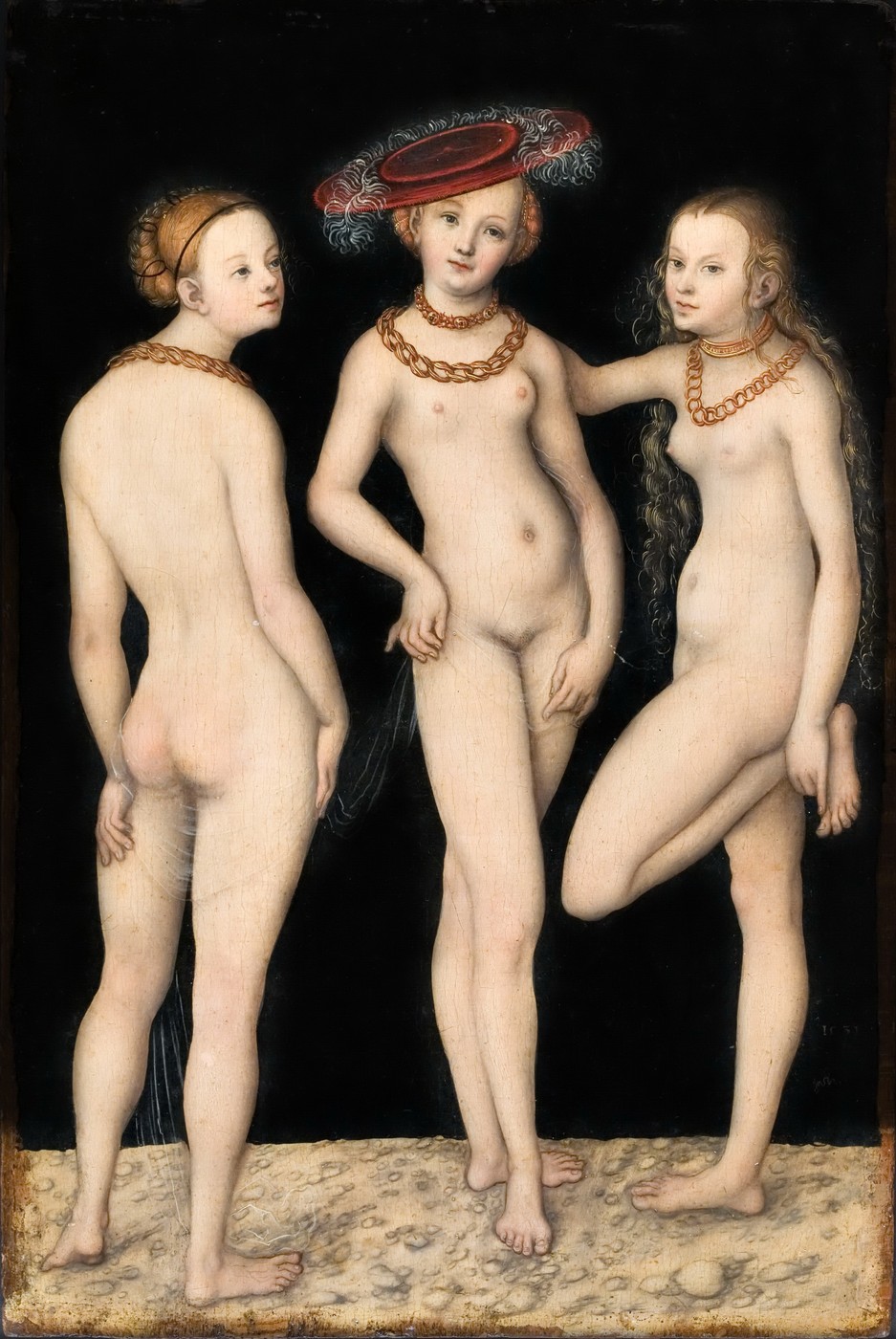
Lucas Cranach the Elder carried the motif north and gave it a different temperature. His Three Graces of 1531, now in the Louvre, stretch the bodies into long courtly lines, their nudity framed by translucent drapery and a shadowed wood. Where Raphael’s trio sits in calm daylight, Cranach’s is touched by the medieval habit of reading the Graces as an allegory of youth, beauty, and the passing of time. The Northern nude keeps a moral edge that the Italian nude had begun to shed.
Rubens closed the arc. His Three Graces, painted around 1635 and now in the Prado, sets the motif at full Baroque scale: three full-bodied women, partly painted from life, with the faces of his two wives woven into the group. Rubens celebrates flesh without apology. The linked arms and leaning hips turn abundance into a statement, the nude as generosity made visible.
Antonio Canova would later carve the group in marble for the neoclassical age, freezing the three figures into an ideal that museums still compete to show. The painterly versions carry the idea more fully, because they keep the living texture of skin. The Three Graces are the one great image in Western art where nakedness means belonging. Three bodies give each other what none of them could hold alone.
That is why the motif endures. The nude is usually discussed as a solitary object, an erotic subject, or a battleground for censorship. The Three Graces remind us it was also an image of reciprocity. In an era that isolates bodies behind screens and serves them one at a time to algorithms, a painting of three women holding each other is a quiet argument that the human figure was, at its best, a picture of connection.