William Hogarth died in London on 26 October 1764, at sixty-six. He left behind the most English body of figure painting the eighteenth century produced. We remember the satires: A Harlot’s Progress, A Rake’s Progress, Marriage A-la-Mode, Gin Lane. We forget that he also wrote a theory of the human body, and that he spent his last years trying to paint the nude as seriously as any Continental master.
In 1753 Hogarth published The Analysis of Beauty. His claim was close to heresy for its time. Beauty in the living body came from movement, from a serpentine line that wound through the form like a snake. He called it “the line of beauty and grace.” Straight lines, he argued, have no life in them. A curve begins to move. The S-curve was the line that made a body look alive.
He drew that line over the classical nudes themselves to prove the point. Plate I of The Analysis of Beauty shows a statuary’s yard littered with the plaster casts that filled every academy: the Belvedere Torso, the Farnese Hercules, the Laocoön. Beside and around them Hogarth numbered his figures and traced the winding line that lends each pose its grace. The classical nude, which the academy worshipped as a set of fixed proportions, turned out to be alive precisely because it bent. Hogarth took the nude the academy treated as an unchanging ideal and showed that it was a matter of line in motion.
The theory grew from the same instinct as his satires. Hogarth painted London as a swirl of bending bodies: the harlot’s collapsing spine, the rake’s drunken stagger, the bowing tradesman, the curtsying maid. He refused the stiff, upright posture of the portrait convention. His people lean, reach, and turn. The serpentine line was what he had been drawing all along.
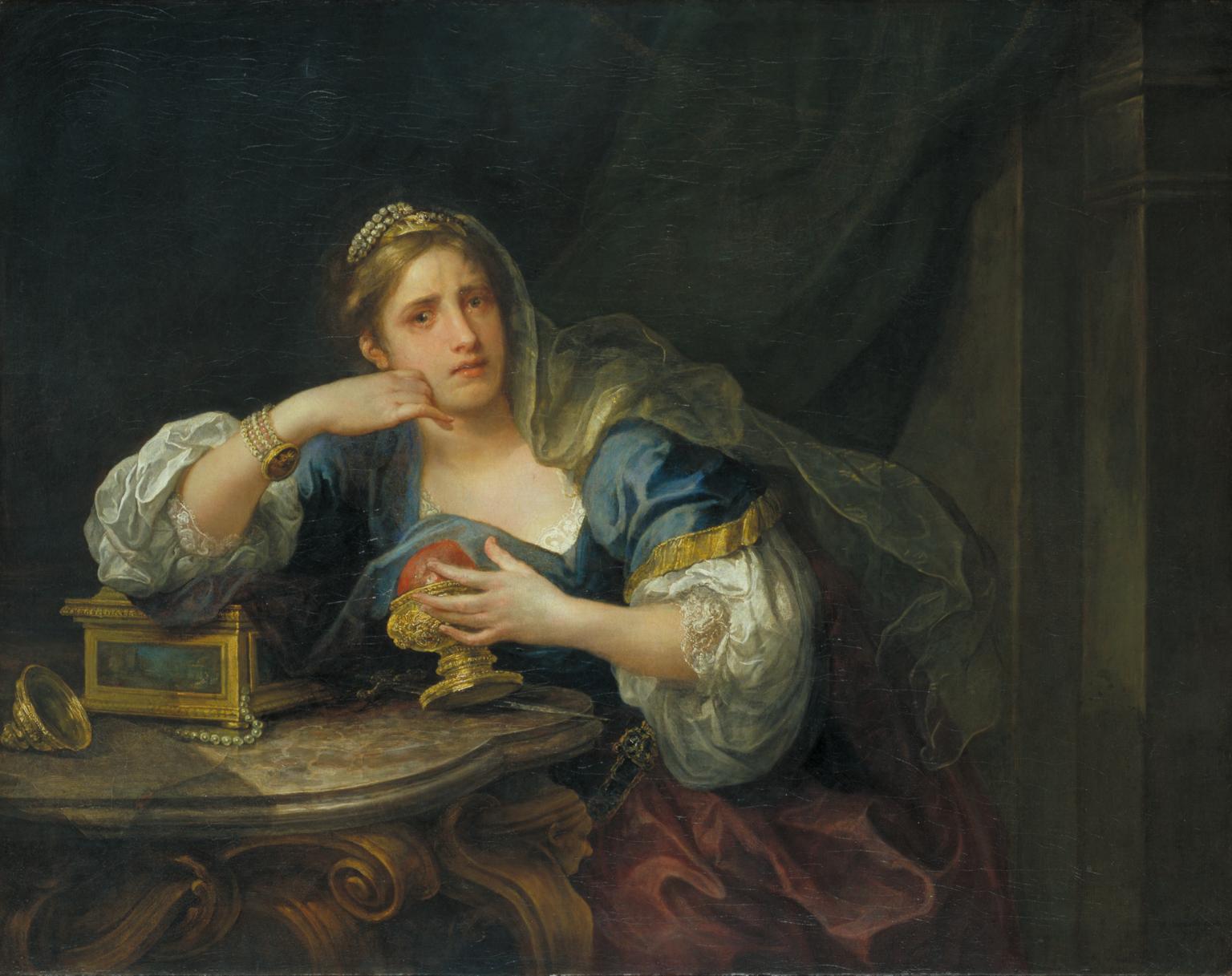
He wanted one last proof. In 1759 Hogarth painted Sigismunda Mourning over the Heart of Guiscardo, a full history picture of a grieving woman, her dress fallen from one shoulder and her breast half bared, weeping over the heart of her murdered lover. The picture was his deliberate bid to show that an English painter could carry the grand Continental subject, the serious semi-nude, alongside the comic print. It failed in its own time. Sir Richard Grosvenor, who commissioned it, returned the canvas when he saw it, and Hogarth sold it at a loss, stung and furious. He died still insisting the English could paint the body as nobly as the Italians.
He was right, and he was early. Within a generation the English figure moved the way Hogarth’s line moved, and the rigid academic nude never recovered its old authority. The serpentine line survives in every figure-drawing class taught today, in every life-room lesson on gesture and flow. The satirist who spent his life watching bodies bend left the human figure a theory of grace that outlived the academy he mocked.