Ninety-six years ago today, a monumental sculptor was born
On October 29, 1930, Catherine Marie-Agnès Fal de Saint Phalle was born in Neuilly-sur-Seine, outside Paris. The world came to know her as Niki de Saint Phalle, one of the few women ever to claim the title of monumental sculptor. She spent her life handing the female body back to itself.
From anger to celebration
She began with anger. In the early 1960s Saint Phalle made the Tirs, assemblages of paint and plaster that she shot with a rifle, exploding the pigment across the surface. The shots were aimed at everything the polite art world had done to women. Out of that anger came something nobody expected: joy.
The Nanas
In 1964 she began the Nanas, named for a French slang word for a woman. They were enormous, voluptuous, brightly colored female figures built of papier-mâché, polyester, and paint, all curves and laughter. They danced, they cartwheeled, they stood with their hips and bellies and breasts as their full, unashamed subject. The Nana was the female body as abundance, as power, as celebration.
Hon, the body you enter
The most radical Nana was Hon, built for the Moderna Museet in Stockholm in 1966. Hon was a gigantic reclining pregnant woman, nearly thirty meters long, lying on her back. Visitors entered through a doorway placed between her legs and found, inside, a bar, a cinema, a planetarium, and an aquarium. The female body stopped being a picture to look at and became a place to walk through. The nude had become architecture.
The body as monument
For centuries the Western nude was a body that lay down and waited. The reclining Venus, the odalisque, the bather glimpsed in private: these bodies belonged to the viewer. Saint Phalle broke that contract. Her Nanas were monuments to themselves, scaled for public squares and park lawns, built in the heroic dimensions that had been reserved for kings, generals, and gods. She took the grammar of the monumental male nude, painted it red and blue and yellow, and told it to dance.
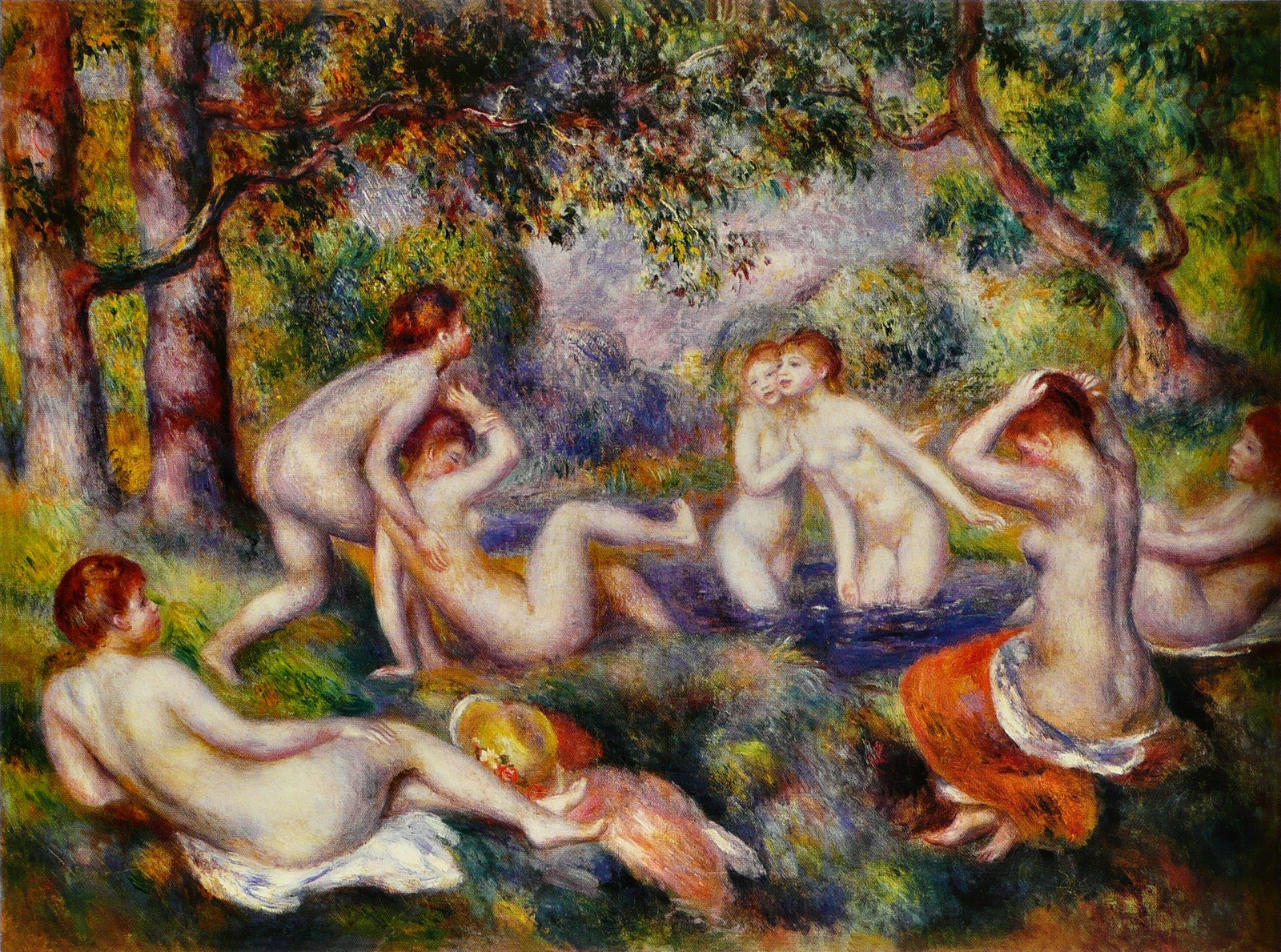
The lineage is there if you look for it. Pierre-Auguste Renoir spent his final years painting the female body as pure abundance, two monumental bathers filling a canvas with their own unhurried weight. Saint Phalle carried that celebration off the canvas and into three dimensions, where it could stand on its own and meet you at eye level.
A body that refuses the old pose
Her Nanas now stand in cities across the world, and the Tarot Garden she built in Tuscany turned her private mythology into a landscape of giant figures you can walk inside. Saint Phalle died in 2002, but her bodies still refuse the old pose. The nude she left behind is upright, laughing, and utterly unashamed.