The Western nude has always carried a favorite alibi: that the body on the canvas belongs to a goddess, a nymph, or an ideal, so no real woman is implicated. Most myths let the painter keep that fiction in place. Leda does not.
Zeus, king of the gods, desires Leda, the queen of Sparta. He does not court her, bargain with her, or even reveal himself. He arrives as a swan. The myth never records that Leda agreed. It records that a god turned himself into an animal and took a woman. From that single image, art drew four centuries of paintings, drawings, and sculptures, from Leonardo and Michelangelo to Correggio, Rubens, Boucher, and Cézanne. No other story has made the nude so honest about what the genre actually trades in: power.
The Renaissance made Leda beautiful, and that beauty is the trap. Correggio’s version, painted around 1532, shows a young woman seated in a garden while the swan rests in her lap, its long neck curving toward her. Every element of the composition reads as tenderness, courtship, even delight. Correggio drains out the violence and leaves the transaction. The viewer is invited to enjoy a scene that, read literally, describes an assault in progress. That is the myth’s genius and its danger: it teaches the eye to mistake force for romance.
The swan is the point of the story. Zeus could have appeared as himself; he chose an animal. The transformation strips the god of a face, a name, a body that could be held to account. Desire without a face is force, and the myth knows it. That is why Leda’s silence has always been the loudest thing about her: the sources never give her a voice, a refusal, or even a clear yes. She is the one nude in the Western canon whose own will is simply absent from the record.
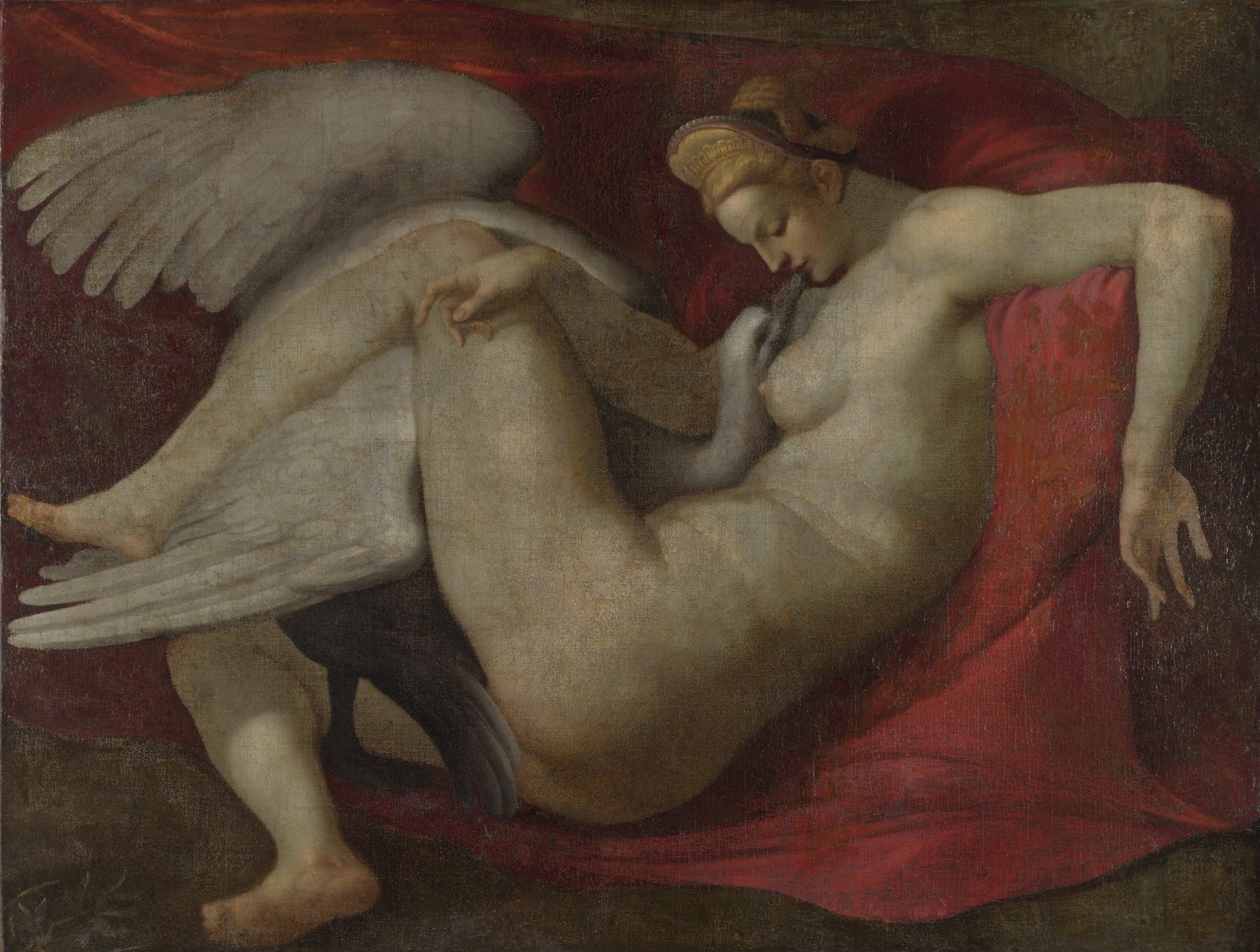
Michelangelo’s Leda survives only through copies, including the one in London’s National Gallery, because the original vanished long ago. Here the mood shifts. Leda reclines with the heavy, monumental limbs Michelangelo gave his figures, and the swan’s neck rises into the composition in a curve impossible to read as innocent. He made the encounter physical, almost sculptural. He did not need a face to tell you where the power sat; the geometry of the two bodies says it.
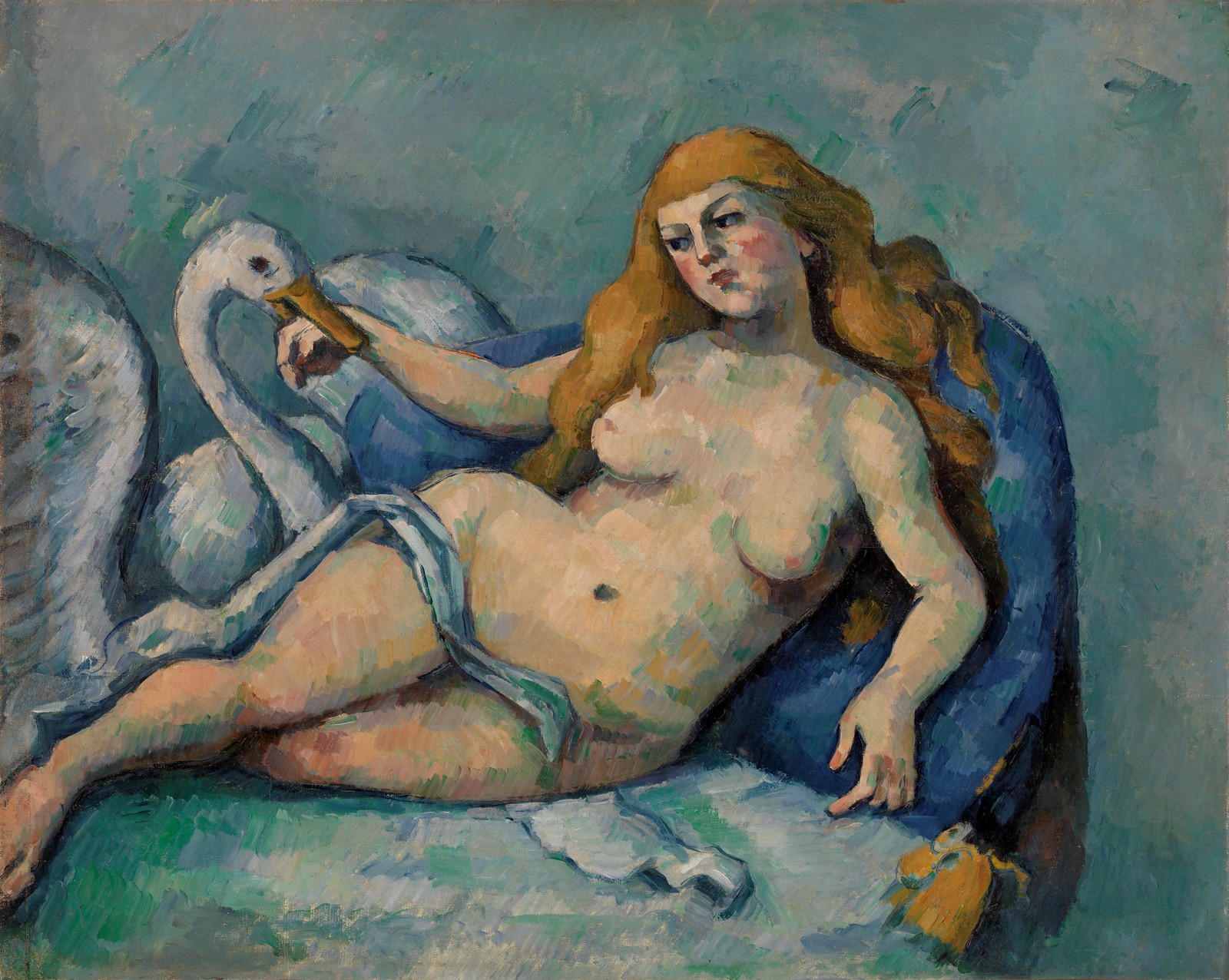
The myth outlived the old masters. Cézanne returned to it around 1880, and his Leda is the most revealing of all. The queen and the swan shrink to interlocking forms, the seduction stripped of its garden, its drapery, its silk. What remains is the essential shape: one body wrapped around another. Cézanne, who spent his life rebuilding the nude from pure construction, kept returning to Leda because she is the nude at its structural minimum: two bodies, one taking, one taken.
Why has this one story lasted where so many others faded? Because the nude as a genre has always had a problem with consent, and Leda is the single myth that refuses to look away from it. Venus invites the gaze. Diana punishes it. Susanna makes the viewer an accomplice who gets caught. Leda does something none of them do: she makes the act of looking itself complicit. To admire the painting is to enjoy, however distantly, the god’s victory. There is no neutral place to stand in front of a Leda.
The question the myth leaves behind is the question the whole genre leaves behind. Can the nude ever be painted as fully free, or does every nude carry this transaction at its heart? The artists who kept returning to Leda never answered it. They kept painting her instead, and that persistence is its own answer. The body that could not say no became the body art could not stop looking at.