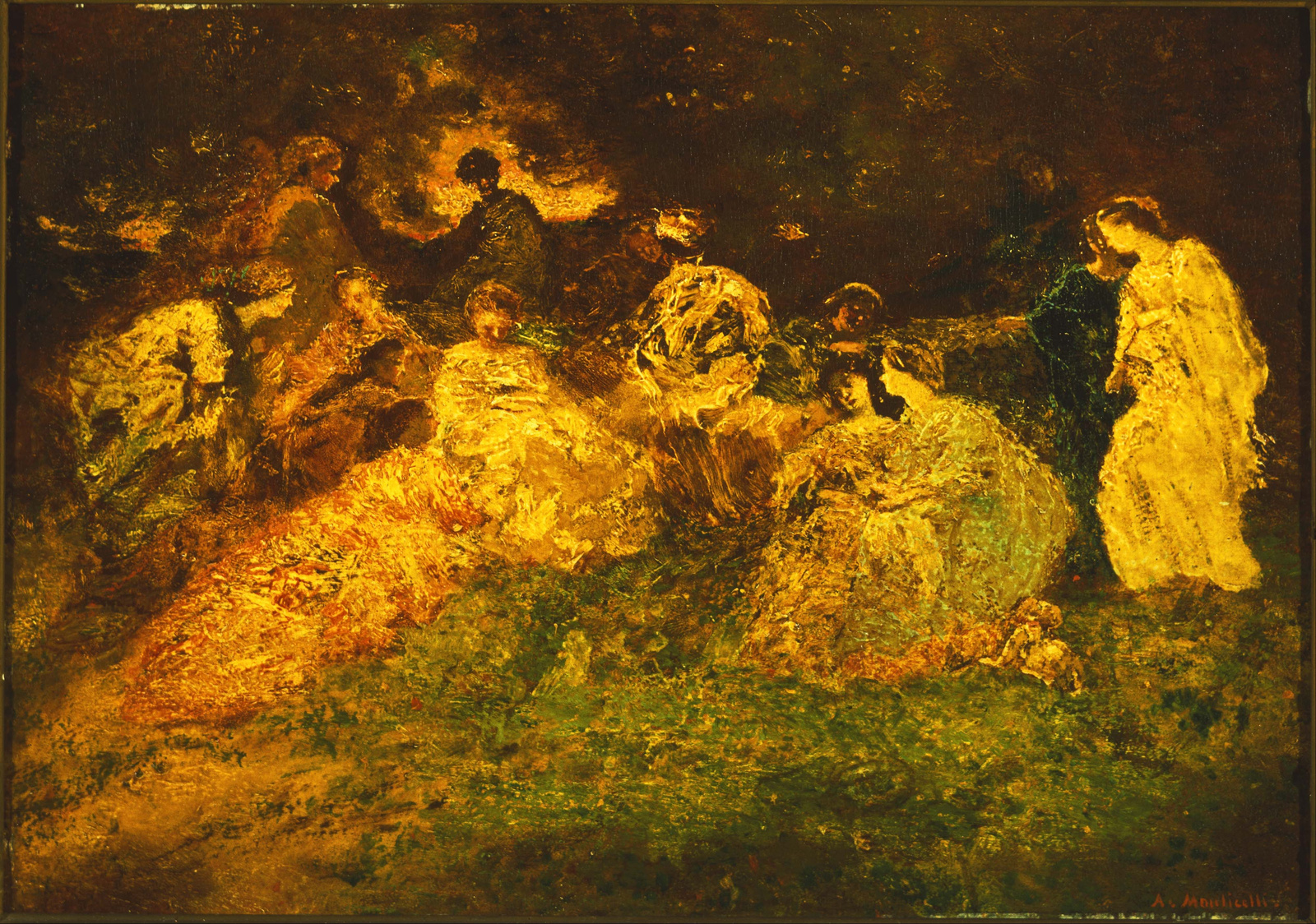
Adolphe Monticelli was born in Marseille on this day in 1824. For two decades before the Impressionists held their first exhibition, he painted bathers, nymphs, and courtly figures in a way that looked unfinished to the academy: bodies dissolved into thick, jewelled slabs of paint that caught the light and refused to hold still.
He trained briefly in Paris under Paul Delaroche but found his real teachers in the Louvre, where Delacroix’s color and Diaz de la Peña’s forest scenes showed him a picture that shimmered and moved. He returned south and spent the rest of his life making small canvases crowded with fêtes galantes, lovers, bathers, and nudes in landscapes, each one built with a palette knife and paint so heavy it rose off the surface like low relief.
The body, dissolved
The academic nude was an exercise in precision, an anatomy lesson set to canvas. Monticelli did the opposite. He knit the figure into the landscape so that a bather’s skin, the water around her, and the trees behind her all carried the same vibrating weight of pigment. Flesh becomes a field of color instead of a diagram of muscle.
The bridge to Impressionism
The Impressionists took the credit for this idea. Monticelli, who died in 1886, mostly took obscurity. The lineage runs straight through him all the same. Van Gogh owned his work and wrote about him with open reverence, praising a painter who worked in pure color the way a musician works in pure sound. Cézanne admired him too. When Van Gogh began loading his own canvases with thick, swirling strokes, he reached for the same thing Monticelli had already done.
Why he still matters
Monticelli leaves a lesson for anyone who looks at the nude today. The body spent centuries being rendered, measured, corrected, and idealized. Monticelli’s gamble was that it could mean more once it stopped being an object and started being an atmosphere. He painted the light a body gives off more than the body itself.
Two hundred and two years after his birth, the painter who stood in the gap between Romanticism and Impressionism deserves better than the footnotes. He decided the figure could dissolve into color and still hold its shape. He was wrong to be forgotten, and right about nearly everything else.