Camille Pissarro spent nearly forty years painting the fields, orchards, and villages of rural France. Peasants at work, market gardens, roads, and rivers. When he died on 13 November 1903, at seventy-three, the obituaries called him the father of Impressionism. What they dwelled on less was the strange late turn his art had taken: in his final decade, the painter of plowed fields and apple trees had begun painting the nude.
The nude came late to Pissarro, and it came hard. He was the only artist to show in all eight Impressionist exhibitions, the steady, generous center of a movement full of egos. He mentored Cézanne, who called himself Pissarro’s pupil, and Gauguin. He could render a hillside or a figure in a bonnet with total authority. But the unclothed body, the oldest subject in Western painting, had always sat outside his practice, and he knew it. In his sixties he set himself to learn it the way a younger man might, filling notebooks with studies and reworking compositions of women bathing at the water’s edge.
What makes these late bathers remarkable is where he put them. The academic nude lived in the studio, posed on a couch or a pedestal. Renoir’s nudes glow in warm interiors. Degas caught his bathers through a keyhole. Pissarro carried the nude outdoors, into the same light he had spent a lifetime chasing across the fields. His women bathe in rivers and ponds, half-hidden by reeds and trees, their bodies handled with the same brushwork as the foliage around them. The body stops being a goddess on display and becomes a figure in a landscape, another thing the sun falls on.
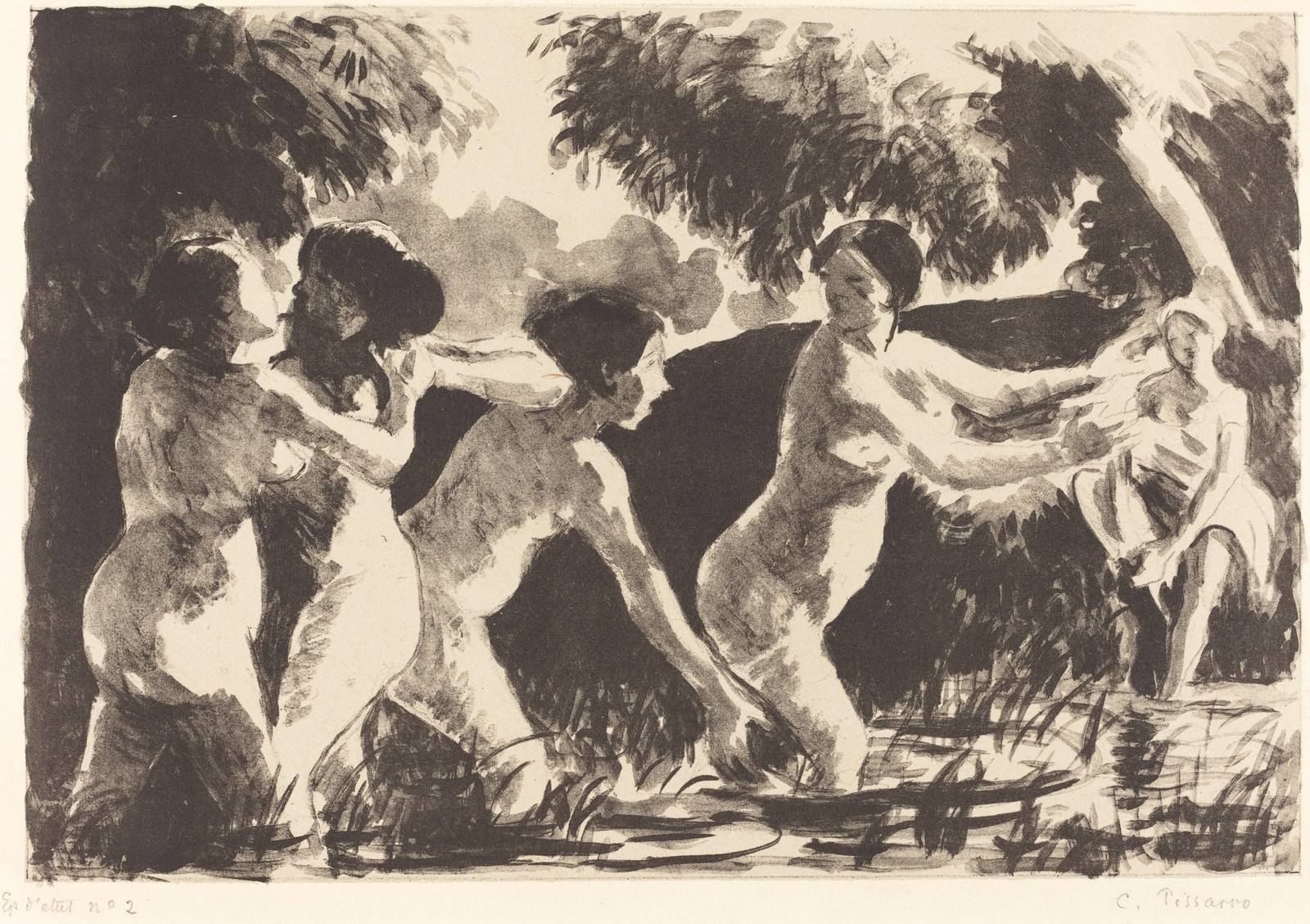
That was the point. Pissarro’s great subject had always been ordinary labor and ordinary light. A nude bather, for him, was a peasant woman at rest, a working body out of its clothes. He approached the oldest and most idealized subject in art with the same plainness he brought to a cabbage patch. The result feels less like a bid for the great tradition than a natural extension of everything he had already painted: people, in nature, in light, unposed.
He never stopped being anxious about it. To his son Lucien he wrote about the struggle of painting the figure, measuring himself against Renoir and Degas and finding himself short. The anxiety did not stop him. He kept at the bathers through the 1890s, in oil and in a long series of prints, right up to the end.
A painter in his sixties and seventies, already famous and already canonized as the father of a movement, went back to school on the one subject he had never mastered. He could have coasted on the landscapes everyone loved. Instead he spent his last years on the hardest thing in the room, the naked human body, and left it unfinished. The nude, for Pissarro, was a question he kept asking until he died.