
Charles Demuth died on 23 October 1935 at fifty-one, in the Pennsylvania town where he was born, and left American art with two reputations it could not reconcile. The public knew him as a Precisionist, the painter of hard-edged industrial landscapes and a small empire of watercolors of flowers, fruit, and vaudeville performers. The private Demuth painted a subject the public never saw in his lifetime: the male body, nude and desired, in watercolors he made for himself and hid in a drawer.
The body on stage
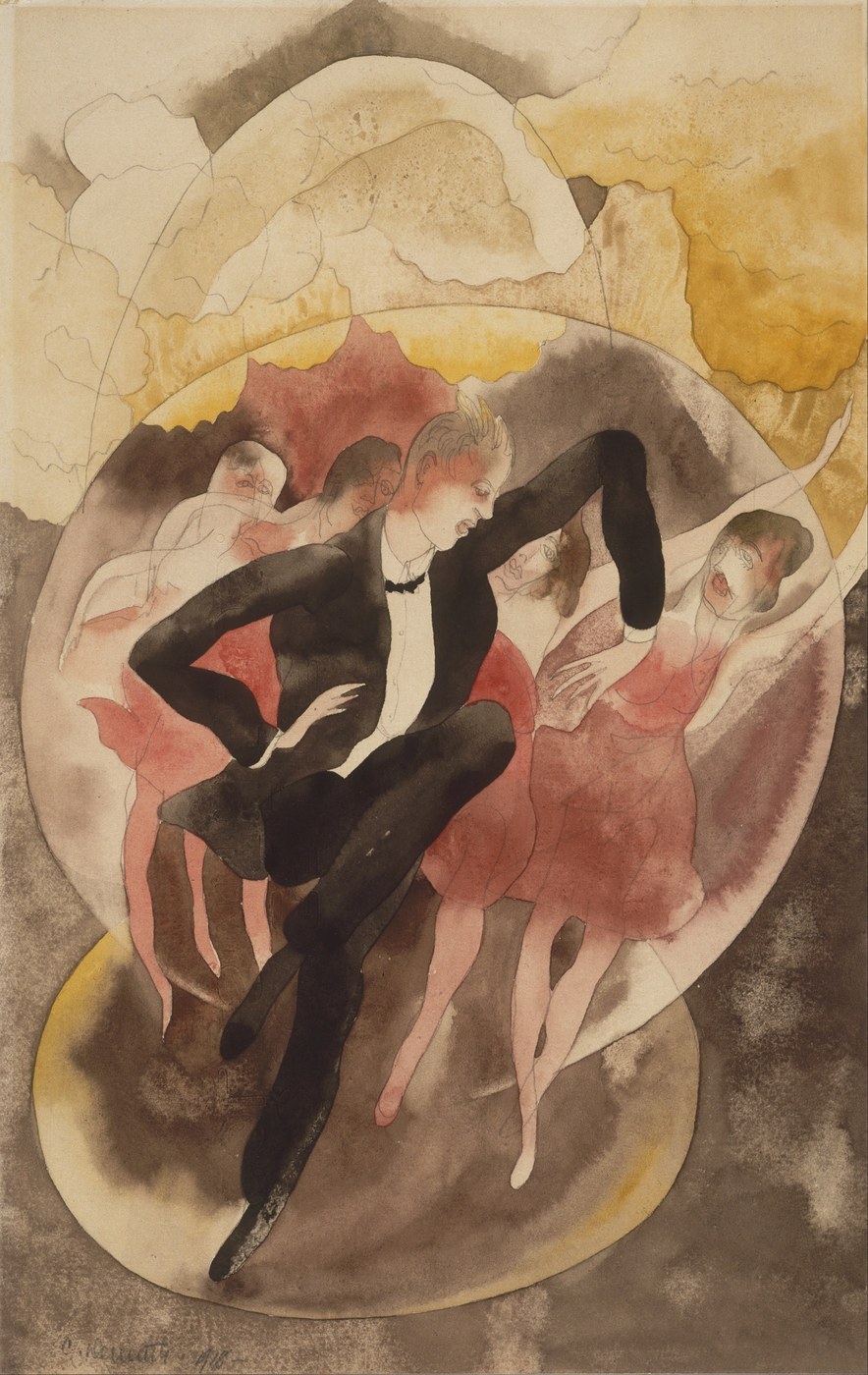
He kept the human figure in two registers. In public, the body was a performer. Between 1916 and 1919 Demuth turned out watercolors of acrobats, dancers, and circus riders caught mid-gesture, the body bent into its act and flattened into a stylized line. These were the figures he could show, bodies licensed by the stage, dressed in tights and costume, made safe by entertainment.
The body in secret
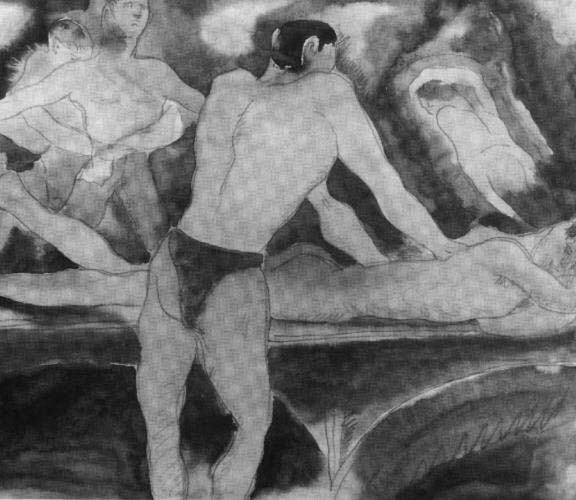
In private, the same hand drew a different body. From about 1915 Demuth painted male bathers and sailors in scenes no gallery of his era would have hung. The Turkish Bath of 1915 is the clearest example: nude figures in a bathhouse, the body at rest and in contact, rendered with the same economy of wash he used for his flowers, but aimed at desire. Demuth knew the bathhouses of New York, and the sailors who crowd his watercolors came from life and from longing.
This is where he belongs in a history of the nude. The Western nude spent centuries arranging the female body as its principal object, posed for a male viewer. Demuth reversed the terms and was never allowed to say so out loud. He painted the male nude as an object of male desire at a moment when doing so in public could end a career, and he chose secrecy over erasure. The watercolors stayed out of the exhibitions that built his name, passed quietly among friends instead.
The secrecy was not temperamental. Demuth came of age in an America that criminalized the love he painted. Sodomy laws stood in every state, and an artist who made erotic pictures of men risked arrest as well as ruin. The bathhouse watercolors were not a hobby kept from the critics; they were evidence kept from the law. So he split himself: the approved painter of flowers and façades for the galleries, and the man with a drawer of sailors for himself.
One body, two exposures
Precisionism gave Demuth his reputation, and the vaudeville watercolors gave him his audience. The nude gave him his subject. When the homoerotic watercolors emerged after his death, they unsettled the tidy story of a charming, delicate watercolorist. He had been painting his own desire for twenty years and keeping it private.
The two bodies he painted turn out to be one body. The acrobat and the sailor, the public performer and the private lover, are the same figure asked to perform two kinds of exposure, one for applause and one for no one. Demuth painted both, and he understood precisely which one the world was ready to see.