Edgar Degas Was Born 192 Years Ago Today. He Painted the Nude Body the Way It Actually Looks When No One’s Watching.
\n\n
Before Degas, the nude in Western art had a job. She was Venus, rising from the sea. She was an odalisque, reclining for the sultan. She was Susanna, surprised at her bath. The nude body was always performing \u2014 always aware of being seen, always arranged for a viewer who was, implicitly, not her.
\n\n
Degas blew that up.
\n\n
Born in Paris on July 19, 1834 \u2014 192 years ago today \u2014 Hilaire-Germain-Edgar Degas spent his first three decades as a dutiful classicist. He copied the Old Masters at the Louvre. He painted historical scenes. He could draw the human figure as precisely as Ingres, whom he revered. And then, sometime in the 1880s, he stopped painting bodies the way they were supposed to look and started painting them the way they actually look.
\n\n
The result was one of the most radical reinventions of the nude in the history of art.
\n\n
The Nude That Doesn’t Know It’s a Nude
\n\n
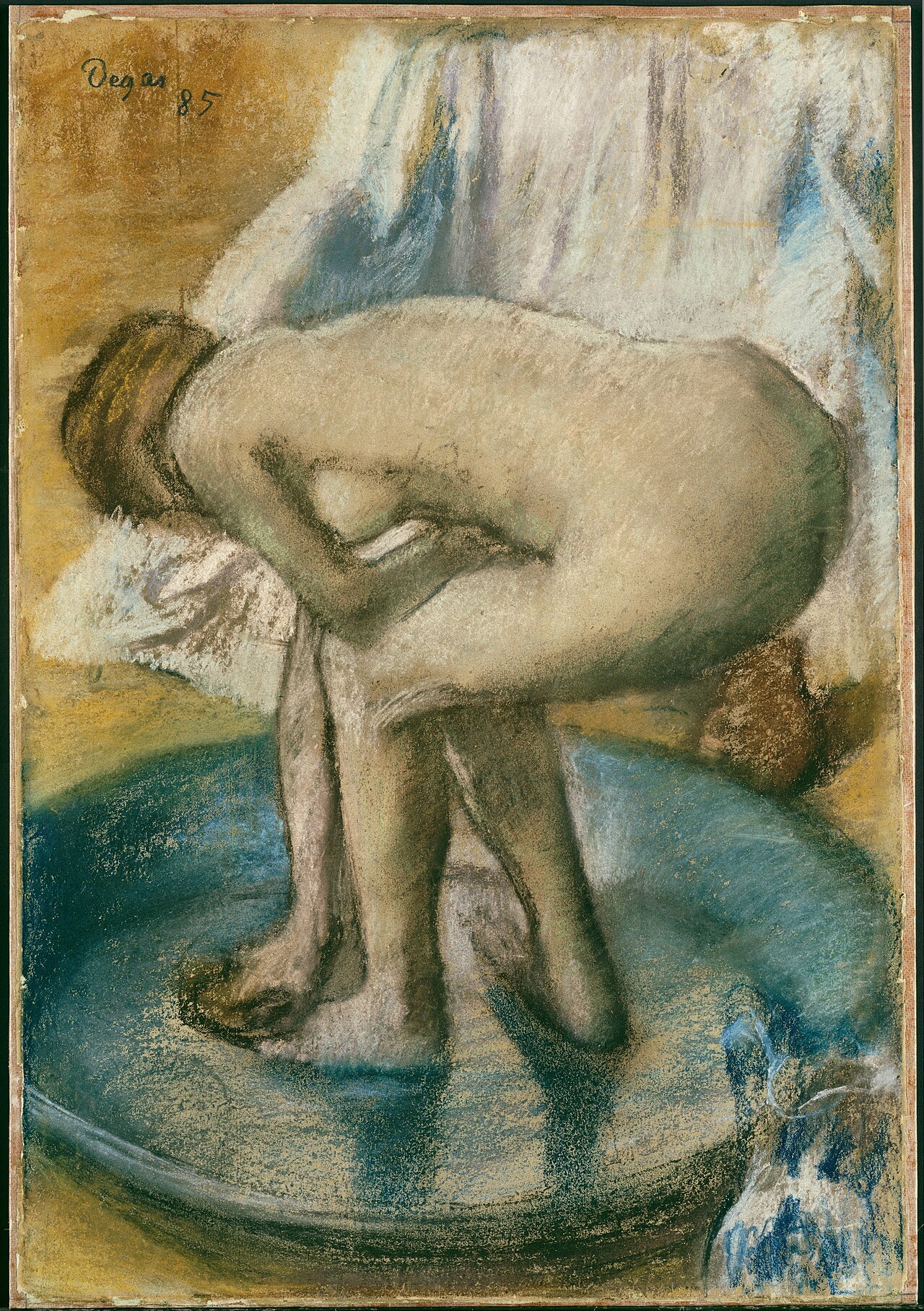
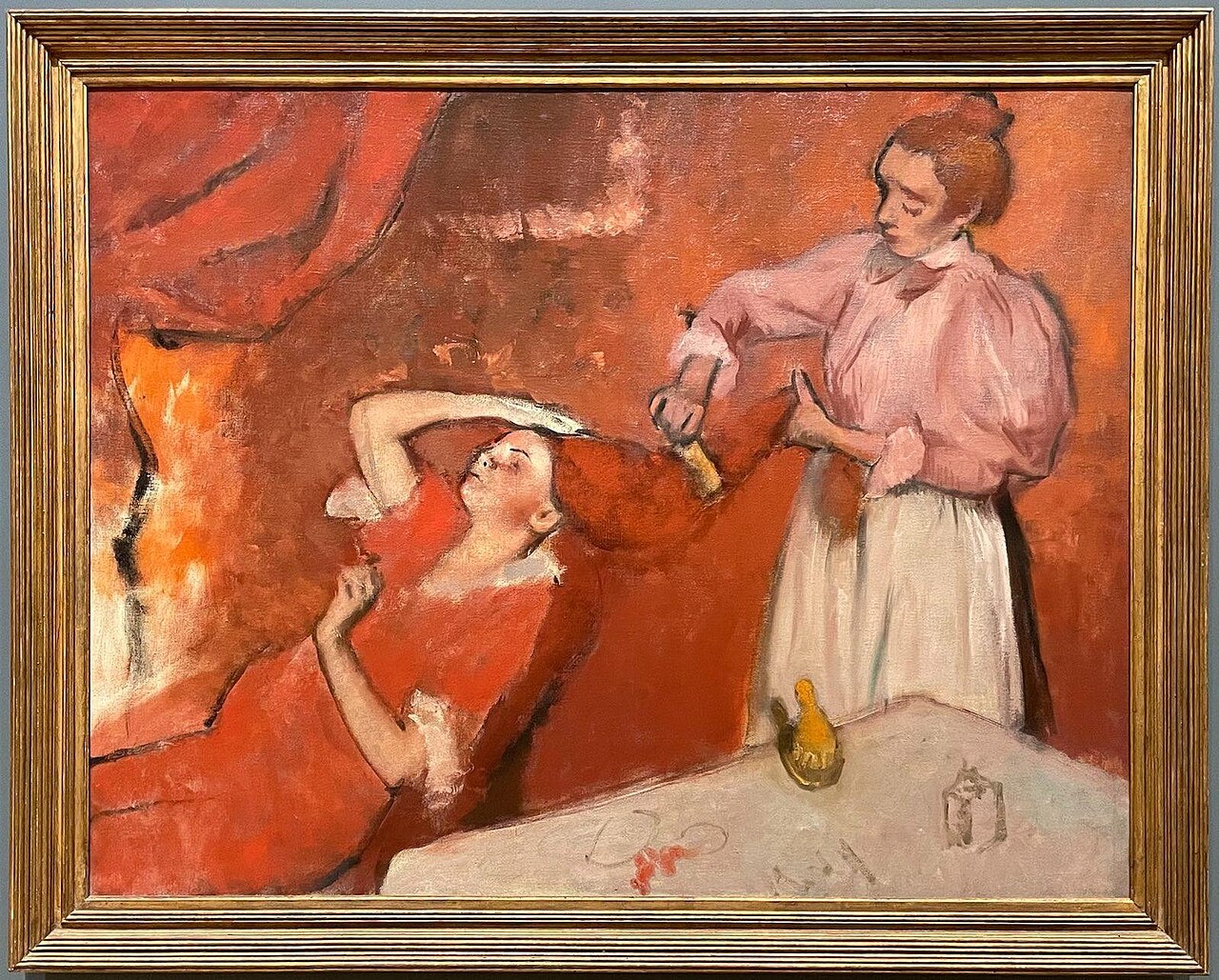
Degas’s late bathers \u2014 the pastels he produced obsessively in the last three decades of his life \u2014 show women at their toilette: stepping into a shallow tub, drying a foot with a towel, having their hair combed by a maid. These are not compositions. They are interruptions. The woman is absorbed in the physical task of her own body. She is not posing. She is not even aware of a viewer.
\n\n
Degas himself described it as painting a woman “as if you looked through a keyhole.” The phrase is uncomfortable \u2014 it acknowledges a voyeurism built into the act of looking \u2014 but it also captures something true. These nudes are radically private. The body is not on display. It is just there, doing what bodies do when no one is supposed to be watching.
\n\n
\n\n
Ugliness as Honesty
\n\n
Critics at the time were not kind. The bather series debuted in 1886 at the eighth and final Impressionist exhibition, and reviewers called the nudes “bestial,” “frog-like,” and \u2014 this one stuck \u2014 “ugly.” Degas’s women had spines that bent too far, limbs that foreshortened awkwardly, flesh that looked like flesh instead of marble.
\n\n
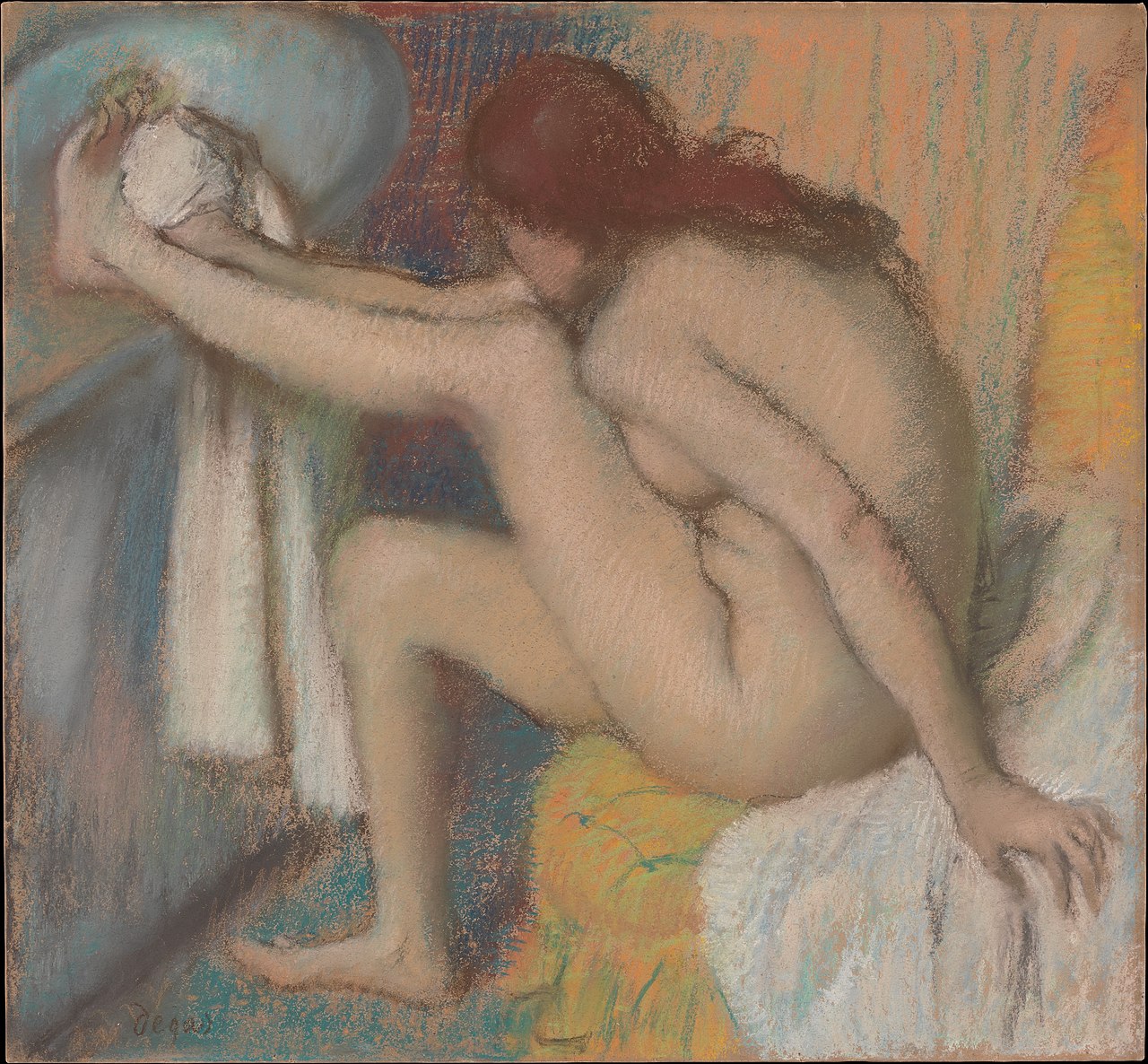
This was the point. The Academic nude had spent four centuries refining the body into an ideal that never existed. Smooth, symmetrical, hairless, posed. Degas painted the body that exists: a woman crouching in a tub with her shoulder blades jutting out, a foot propped up on a chair being dried with a towel, hair being pulled through a comb with the roughness of an everyday ritual.
\n\n
The “ugliness” critics complained about was simply the absence of flattery. Degas was not interested in making the body beautiful. He was interested in making it true.
\n\n
\n\n
The Pastel as Language
\n\n
Degas’s medium was as radical as his subject. He built his bathers in layers of pastel \u2014 sometimes dozens of them \u2014 applied to tracing paper, which he would layer and re-layer, shifting limbs by millimeters, erasing and redrawing contours. The result is a surface that vibrates. Hatching in orange, green, violet, and blue sits on top of flesh tones, creating a body that never sits still. The mark-making is visible. You can see the artist’s hand, the speed of the stroke, the pressure of the chalk.
\n\n
This was the opposite of Academic finish \u2014 the seamless, brushstroke-free surface that announced the painting as a window onto an ideal world. Degas’s nudes announce themselves as made things. The body is not a goddess descended from Olympus. It is a woman in a rented room, sketched rapidly, her physical presence rendered in urgent marks that refuse to resolve into smoothness.
\n\n
\n\n
Why It Still Matters
\n\n
Degas died in 1917, nearly blind and largely isolated, having produced more than 200 works depicting women at their toilette. He never married. He had no students. The nudes were, in a real sense, the private project of a private man \u2014 seen by few during his lifetime, and misunderstood by many who did see them.
\n\n
But the door he opened stayed open. Without Degas’s insistence that the nude body could be private rather than performative, you don’t get Bonnard’s bathroom nudes or Paula Modersohn-Becker’s self-portraits or Lucian Freud’s unflinching figures. The idea that a body in art need not be an ideal \u2014 that it can be awkward, absorbed, unposed, real \u2014 is Degas’s gift to the tradition.
\n\n
He once told the poet St\u00e9phane Mallarm\u00e9 that he had “too many ideas” for poems. Mallarm\u00e9 replied: “Poems are not made of ideas, Degas. They are made of words.” Degas could have said the same of his nudes. They are not made of beauty. They are made of bodies \u2014 real ones, caught mid-motion, going about the work of being alive.
\n\n
One hundred and ninety-two years after his birth, that still feels like a revolution.
\n