Domenico Zampieri, called Domenichino, was born on October 21, 1581, in Bologna. Across the next six decades he became the quiet conscience of the Baroque nude, the painter who kept the body disciplined while everyone around him set it loose.
His rivals called him the ox, il Bue. It was meant as a slur. Painters like Giovanni Lanfranco saw only a slow, plodding copyist, a man who drew the same figure a hundred times before he touched the canvas. Domenichino answered the insult by making method his argument. Where Caravaggio dragged saints down into the street and painted flesh that had known hunger, Domenichino rebuilt the body from the antique up: measured, drawn, corrected, restrained.
That discipline became a feud. When he painted the pendentives of Sant’Andrea della Valle, Lanfranco’s camp accused him of stealing from his own teacher. The charge was plagiarism, and it stung, but posterity acquitted him. The drawings survive, hundreds of them, and they are the real biography: a hand that refused to trust a lucky brushstroke.
The nudes of The Hunt of Diana, painted around 1616 and 1617 for Cardinal Scipione Borghese, make that discipline visible. Diana, goddess of the hunt and of chastity, presides over a company of nymphs in a green landscape. Some string their bows; others bathe in a pool in the foreground, their bodies arranged as a study in measure rather than an invitation. This is the female nude framed as self-command, not surrender.
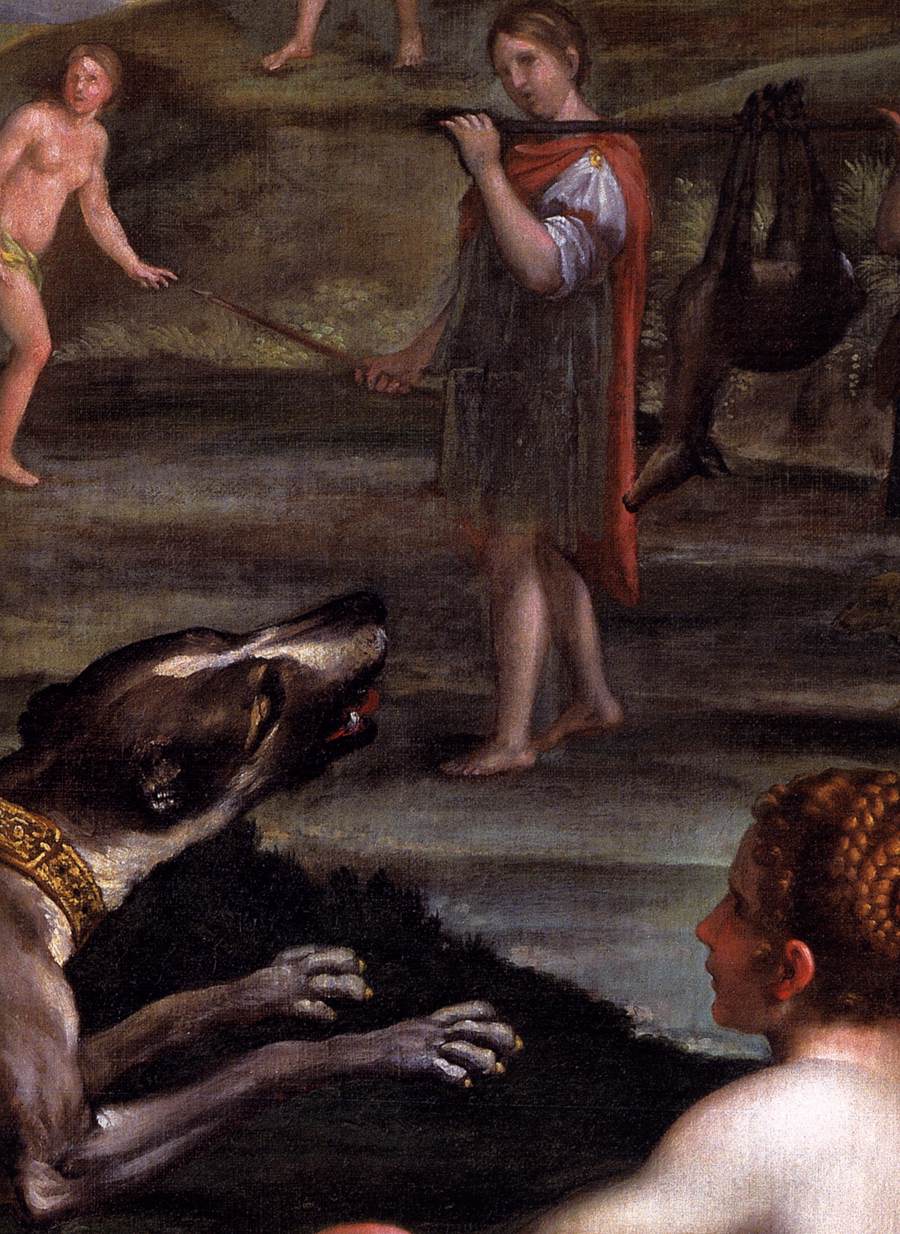
Domenichino understood something his more theatrical rivals missed. A body that has been drawn is a body that can be read. Restraint reads as respect, the painter’s decision that the figure deserves exactness. The chaste goddess gave him his perfect subject, because her story is about the power of refusing.
Four hundred and forty-five years on, we live in an age that confuses nudity with license and discipline with repression. Domenichino offers the counterargument. The nude at its most governed is the nude at its most eloquent. The line that measures the body is also the line that honors it.