When Jacopo della Quercia died in Siena on 20 October 1438, he left a name that art history filed beside the wrong men. He belonged to the same generation as Brunelleschi, Ghiberti, and Donatello, and he competed with all three for the same commissions. He had already given Siena its Fonte Gaia and carved the haunting recumbent tomb of Ilaria del Carretto in Lucca. But the door he made in Bologna is where he changed the course of the nude.
That door is the main portal of San Petronio, the vast brick basilica in Bologna. Between 1425 and 1434 della Quercia carved a cycle of Old Testament reliefs across its jambs: the Creation of Adam, the Creation of Eve, the Temptation, the Expulsion from Paradise. What he did to the nude inside those panels is the reason the door still matters.
The weight of the body
The medieval nude had grown thin. Gothic carving stretched the body, flattened it, turned it into a graceful emblem of sin or virtue instead of a thing of flesh. Della Quercia reversed all of that. His Adam and Eve are heavy. The shoulders carry mass, the torsos strain, the limbs plant themselves against the stone as if the figures were holding up their own weight. The nude in these reliefs is a body, and it feels the pull of the ground.
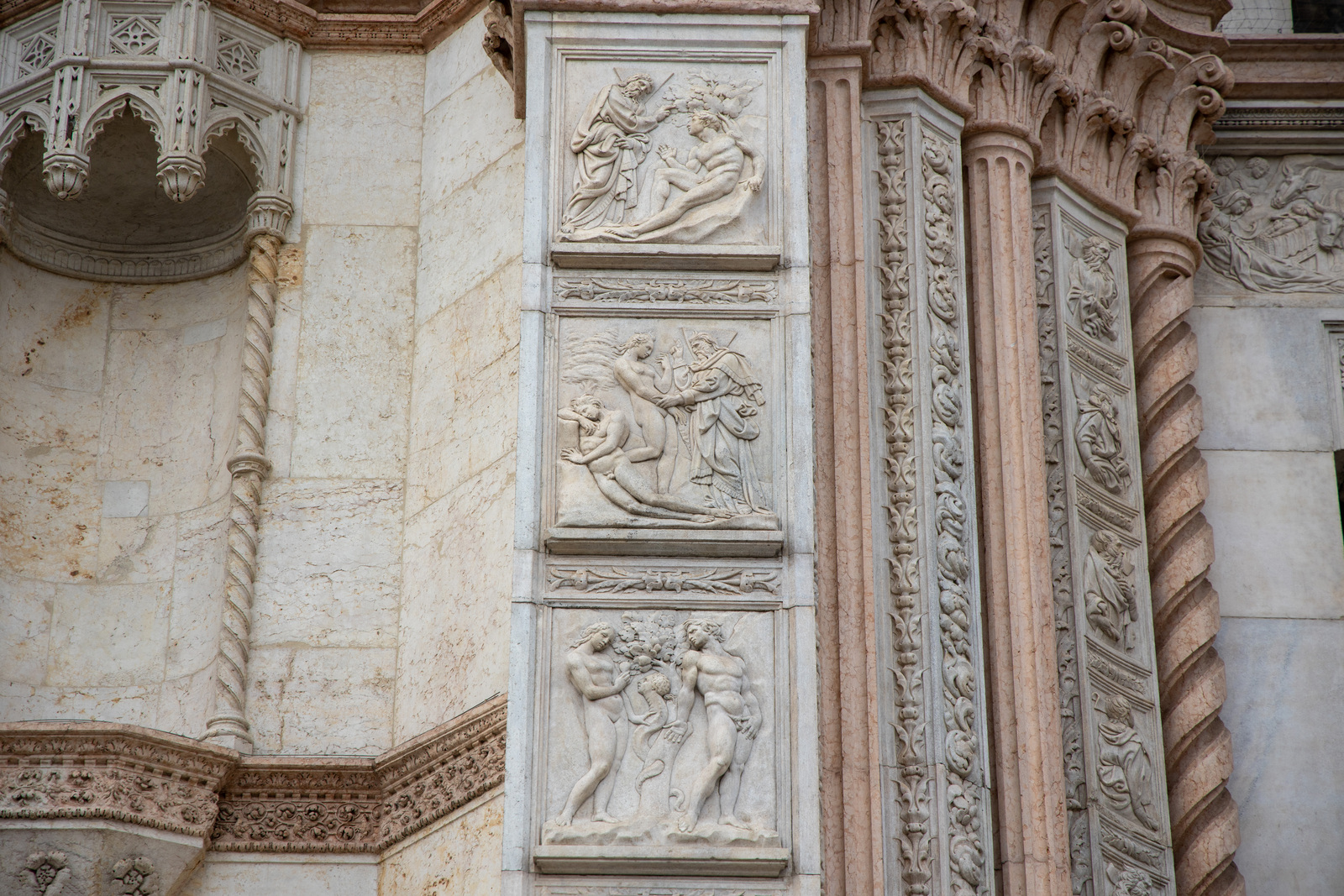
Look at the Expulsion, where Adam shields himself and Eve clutches at her shame. The gesture is the plain, unguarded motion of a person who has been cast out, and it works because the body has enough mass to feel the blow. Academic taste would later teach that the nude grows noble by turning ideal: smooth, weightless, symmetrical. Della Quercia bet on the opposite. He made the nude convincing by making it heavy, by lending it the muscular effort of a real body at work.
Michelangelo at the door
Michelangelo saw it. In 1494, with the Medici driven from Florence, the nineteen-year-old arrived in Bologna and stayed for months, carving small figures for the tomb of Saint Dominic. He studied della Quercia’s portal at close range. Vasari, who kept careful accounts of this kind of debt, wrote that Michelangelo admired the Bologna reliefs and shaped his own manner on them. The line is easy to trace. The ignudi of the Sistine ceiling, the massive seated nudes who carry the chapel’s architecture on their shoulders, hold della Quercia’s gravity. The Expulsion from Eden on that ceiling, with its ashamed Adam and grieving Eve, is the same scene della Quercia had carved seven decades earlier, redrawn in paint.
Della Quercia understood that a body persuades because it weighs something. Strip away the idealization, the proportion, the polish, and what remains is mass: the capacity to fall, to strain, to be hurt. Every figure artist since has worked inside that insight, whether they know the name or not. The nude that convinces is the nude that carries its own weight.
He died at about sixty-four, his last years spent on a portal he never finished. The job passed to other hands. The door he left in Bologna stands as a hinge in the story of the human figure: on one side the weightless medieval body, on the other the monumental nude that would fill the next century. Michelangelo walked through that door. Western art followed.