On July 22, 1882, in the shipbuilding town of Nyack, New York, Edward Hopper was born. He would become the painter of American solitude — empty streets at night, isolated diners, sun-washed rooms where nothing happens and everything happens. Hopper gave us the visual vocabulary of modern loneliness. But his most radical contribution to the nude figure in art history wasn’t about the body at all. It was about what the body does when it believes no one else is in the room.
Hopper painted nudes the way other painters painted landscapes: as environments of stillness. His figures aren’t offered to the viewer. They aren’t posed for our pleasure. They’re caught — mid-thought, mid-gesture, mid-absence — and the territory they inhabit is not a studio or a salon, but the private, unguarded interior of their own minds.
The Body That Doesn’t Know You’re Looking
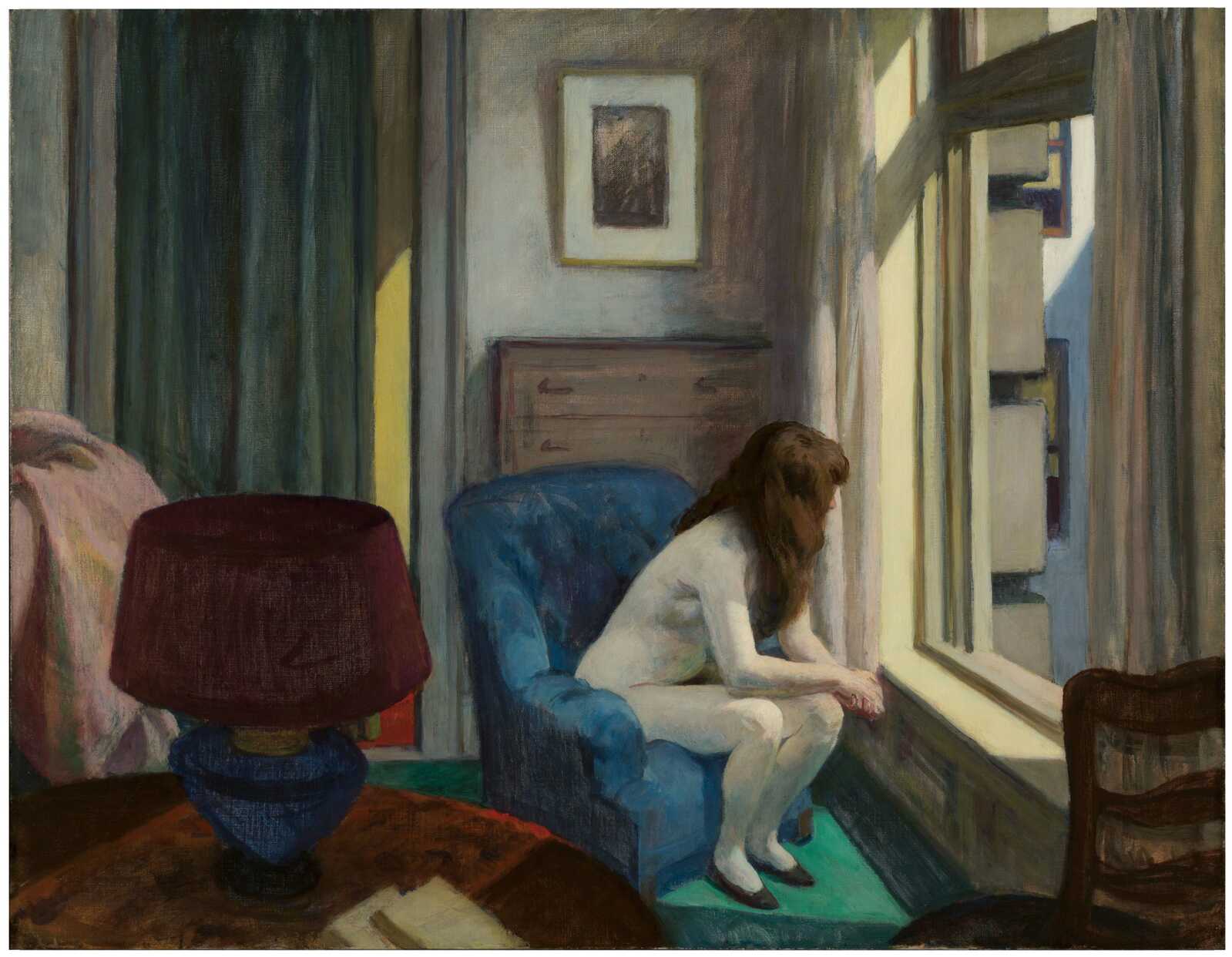
In Eleven A.M. (1926), a nude woman sits in an armchair facing a window. Her body is angled away from the picture plane; her face is in profile, lost in whatever she sees — or doesn’t see — through the glass. The morning light falls on her thigh, her shoulder, the arm of the chair. The room is spare. The mood is not erotic but existential.
We are not invited into this room. We have walked in on a private silence, and the painting does not care whether we stay. This is the fundamental difference between Hopper’s nudes and the European tradition he inherited. The odalisques of Ingres and Delacroix perform their nudity for the viewer — they are bodies on display, reclining in our direction, making eye contact with the room. Hopper’s nudes are bodies in solitude. The viewer is incidental. Almost voyeuristic.
Hopper was characteristically terse about his intentions. “I don’t think I ever tried to paint the American scene,” he once said. “I’m trying to paint myself.” But in painting himself — his own reserve, his own silences, his own habit of sitting in rooms and staring at windows — he captured something essential about the American psyche: the isolation that exists inside cities, inside apartments, inside bodies.
The Nude Without Glamour
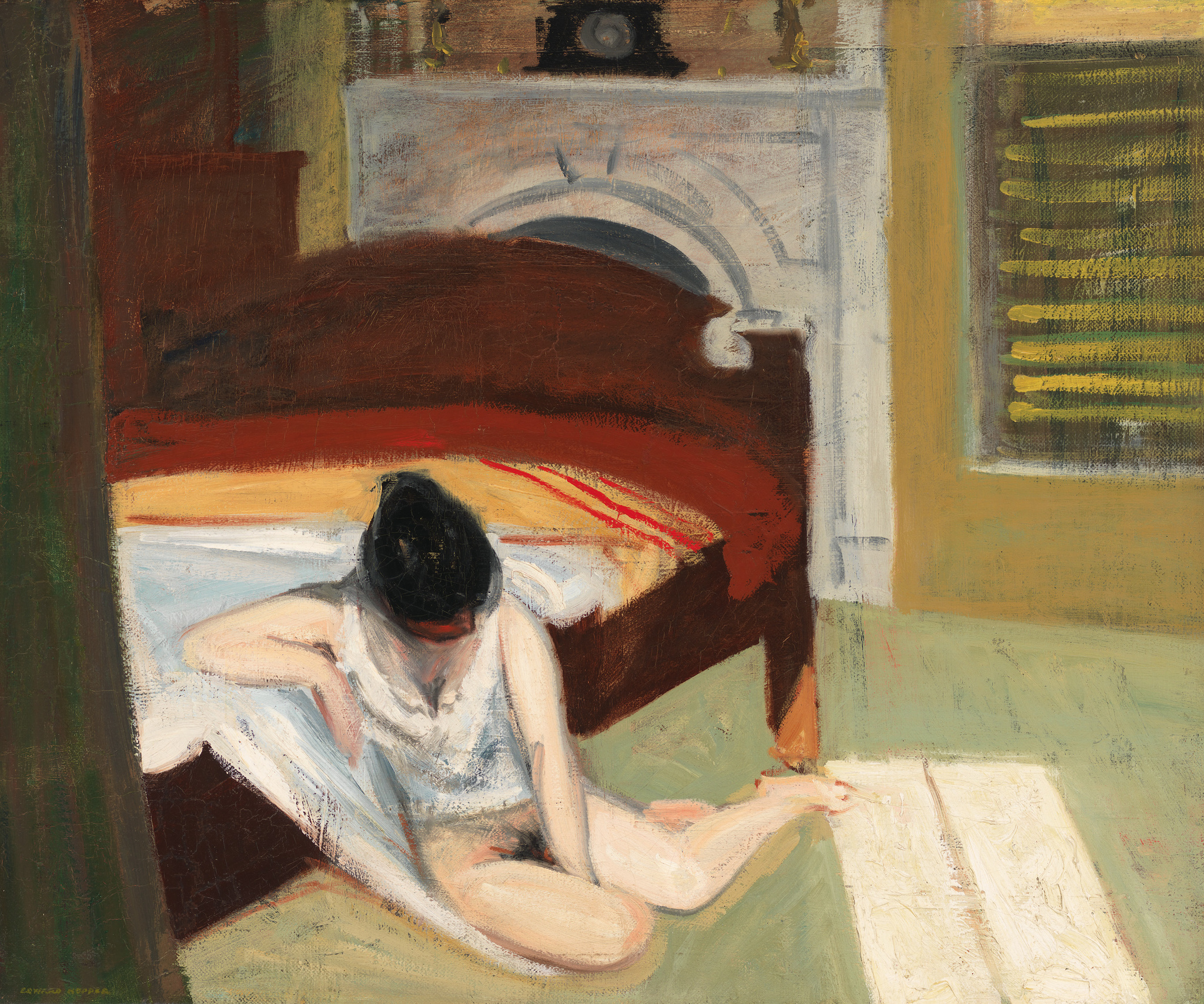
Summer Interior (1909), painted when Hopper was just twenty-seven and still finding his voice, shows a nude woman collapsed forward on a bed. Her face is hidden by her hair. Her posture is one of exhaustion or grief — the painting does not specify which. She could be sleeping. She could be weeping. The body doesn’t tell you, and the painting doesn’t either.
This is the Hopper nude stripped to its earliest essence: the body as a container for private experience, not a surface for public gaze. There is no glamour here. No invitation. None of the signals that the nude genre traditionally sends. What remains is something closer to documentary — a record of a human being in a moment of complete unselfconsciousness.
The painting is small — just 24 by 29 inches — and its intimacy is almost uncomfortable. Looking at Summer Interior feels like opening a door you were not meant to open. Hopper would refine this effect over the next five decades, but he never abandoned it. Every Hopper nude carries the charge of a private threshold crossed without permission.
The Body That Isn’t Performing
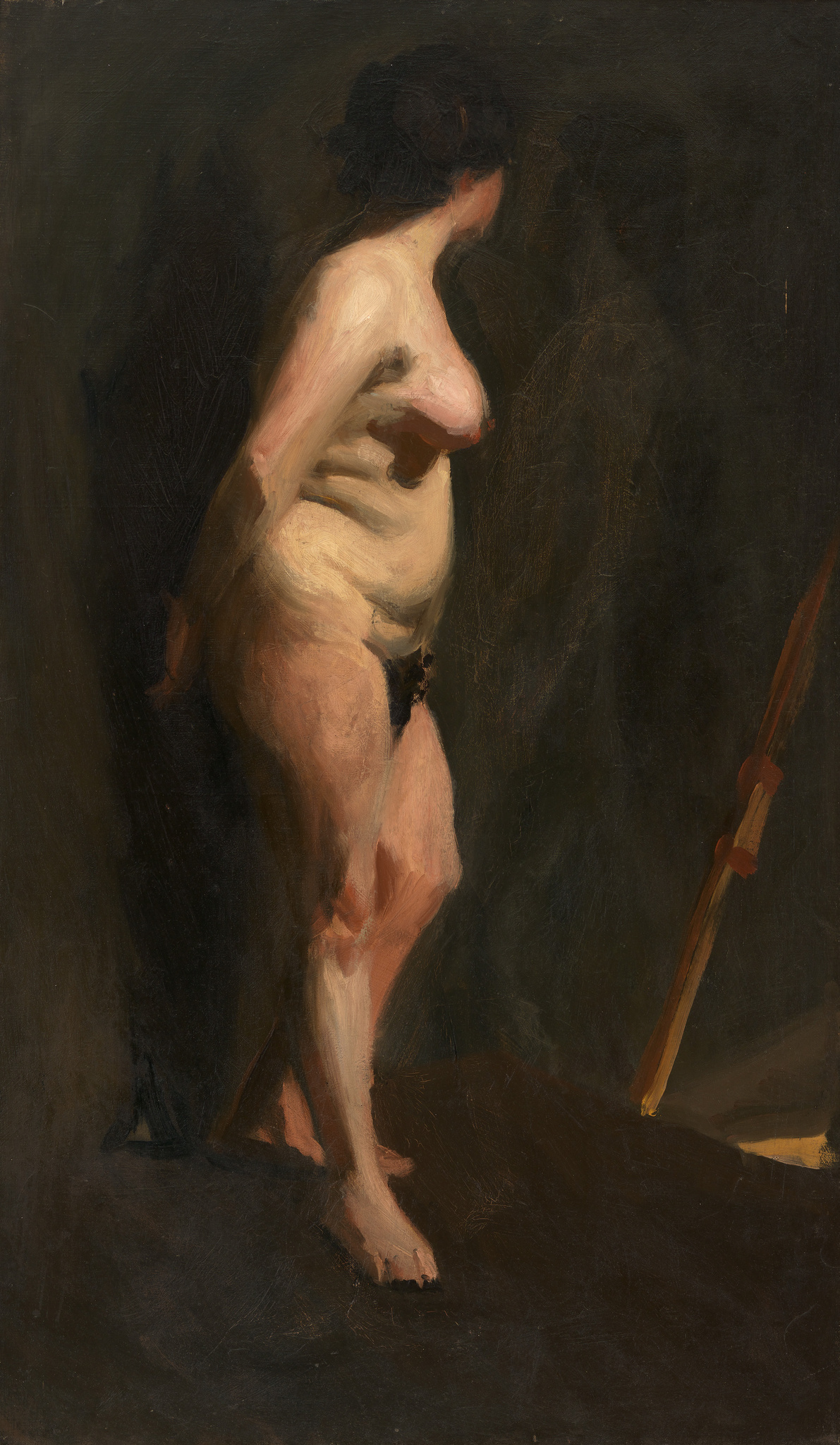
Hopper’s studio drawings from the same period reveal his method. In these charcoal and graphite studies — quick, economical, unsentimental — he worked through the technical problem of making a body look like it isn’t performing. The standing nude is not posed for a painter. She stands the way someone stands when they’re waiting for coffee to brew: weight shifted onto one hip, head angled slightly, present and absent in the same breath.
This was a deliberate technical project. To paint a body that doesn’t know it’s being painted requires a different kind of observation — not of anatomy, but of psychology. Hopper studied not how the body is shaped but how the body behaves when it thinks it’s alone. The result is a nude that feels startlingly contemporary, even a century later, because it refuses the entire apparatus of the art-historical nude: the reclining pose, the accessible gaze, the body as gift.
The Body Alone, the Body in America
Hopper’s nudes are an argument, and the argument goes like this: the nude body in Western art has, for centuries, been a body for someone. For the patron. For the male gaze. For the museum wall. For history. Hopper’s nudes propose a different possibility — a body that exists for itself, even inside a painting, even when you’re looking at it.
The woman in Eleven A.M. doesn’t know she’s being looked at. She doesn’t care. She has her own Wednesday morning, her own thoughts, her own relationship to the warm geometry of light moving across the floor. The painting doesn’t explain her. It just records her — the way a Hopper streetscape records an empty corner and lets it mean whatever it means.
This is what makes Hopper’s nudes feel so immediate, a century after they were painted. In an era when the nude figure was still largely the property of academic tradition, Hopper was already painting the body the way we actually experience it in life: alone, unposed, nobody’s property but its own. His nudes are not objects. They are subjects, and the subject is always the same — what it feels like to be a body in a room, in America, in the quiet hours when no one is watching.
One hundred and forty-four years after his birth, Edward Hopper’s solitary nudes still feel like the truest thing anyone ever painted about being alive in your own skin.
Join the conversation at Nude Art LA and explore more stories about the nude figure in art history.