When we talk about the nude in Western art, we tend to reach for words like ideal, beauty, perfection. Greek marble smoothed to impossible surfaces. Botticelli Venus floating ashore like she has never touched the ground. Ingres odalisque stretched like taffy into a spine that could not exist in nature. The nude as a thing to be admired, not inhabited.
Lovis Corinth never got the memo. Or rather, he got it and threw it out.
Born 168 years ago today — July 21, 1858, in Tapiau, East Prussia — Corinth spent his career painting the human body the way bodies actually feel: heavy, sweating, straining, bleeding, wanting. His nudes are not objects. They are subjects in crisis. And that is precisely what makes them so urgent, a century after his death.
A Career in Two Acts
Corinth trained at the Königsberg Academy, then Munich, then Paris at the Académie Julian — the standard route for a ambitious German painter in the 1880s. His early work was competent, muscular, academic. He co-founded the Munich Secession in 1892, then moved to Berlin in 1901, where he took over the Berlin Secession presidency from Max Liebermann. By 1910, he was one of the most successful painters in Germany. Fashionable portrait commissions. Major exhibitions. A beautiful young wife, Charlotte Berend, who was also his favorite model.
And then, in December 1911, at the age of 53, Corinth had a stroke. His left side was paralyzed. He had to relearn how to walk, how to hold a brush. Most painters would have retired. Corinth painted harder.
The post-stroke work is the Corinth that matters. The brushwork got looser, faster, angrier. The colors more violent. The bodies more exposed. What had been Impressionist observation became Expressionist confession — except Corinth, stubbornly, never joined the Expressionist movement. He didnt need to. The stroke had turned him into one whether he liked it or not.
The Body as Battlefield
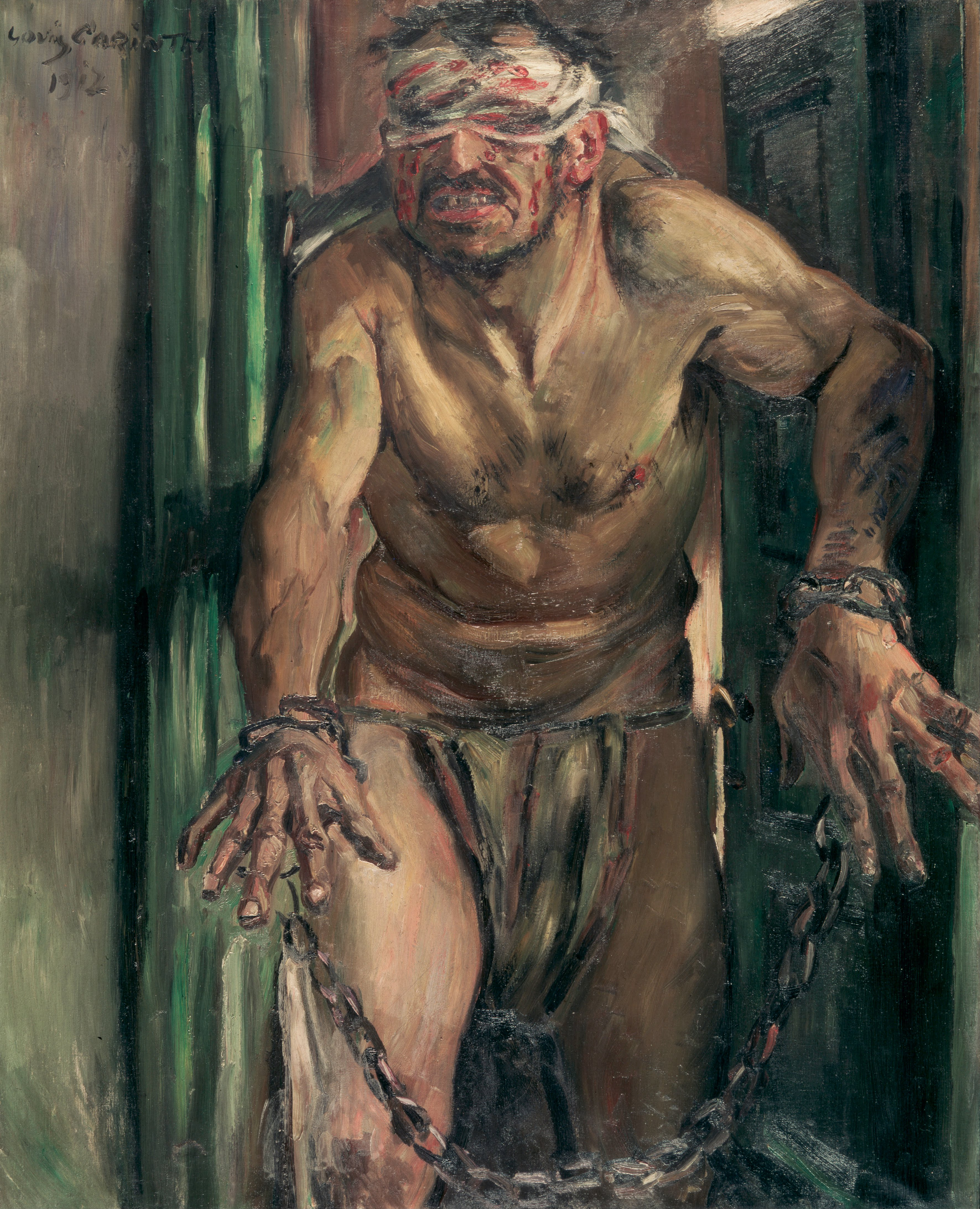
Corinths greatest nude is arguably The Blinded Samson (1912), painted the year after his stroke. The biblical strongman, betrayed by Delilah, captured by the Philistines and blinded, staggers forward in a massive, contorted body — every muscle a declaration of agony. This is not the idealized male nude of the Renaissance. This is a body that has been broken. The Philistines surround him, small and cruel, their spears prodding at his flesh. Samsons blindness is not symbolic. It is physical. You can feel it in the way his arms flail, in the useless turn of his head.
It is impossible not to read the painting autobiographically. Corinth, half-paralyzed, painting a blinded giant — the body that has been turned against its owner. But the painting is bigger than biography. It belongs to a tradition of German art that treats the nude body not as aesthetic object but as existential terrain. Matthias Grünewalds crucified Christ in the Isenheim Altarpiece — body as wound. Corinths blinded Samson — body as catastrophe.
Salome: The Nude as Predator
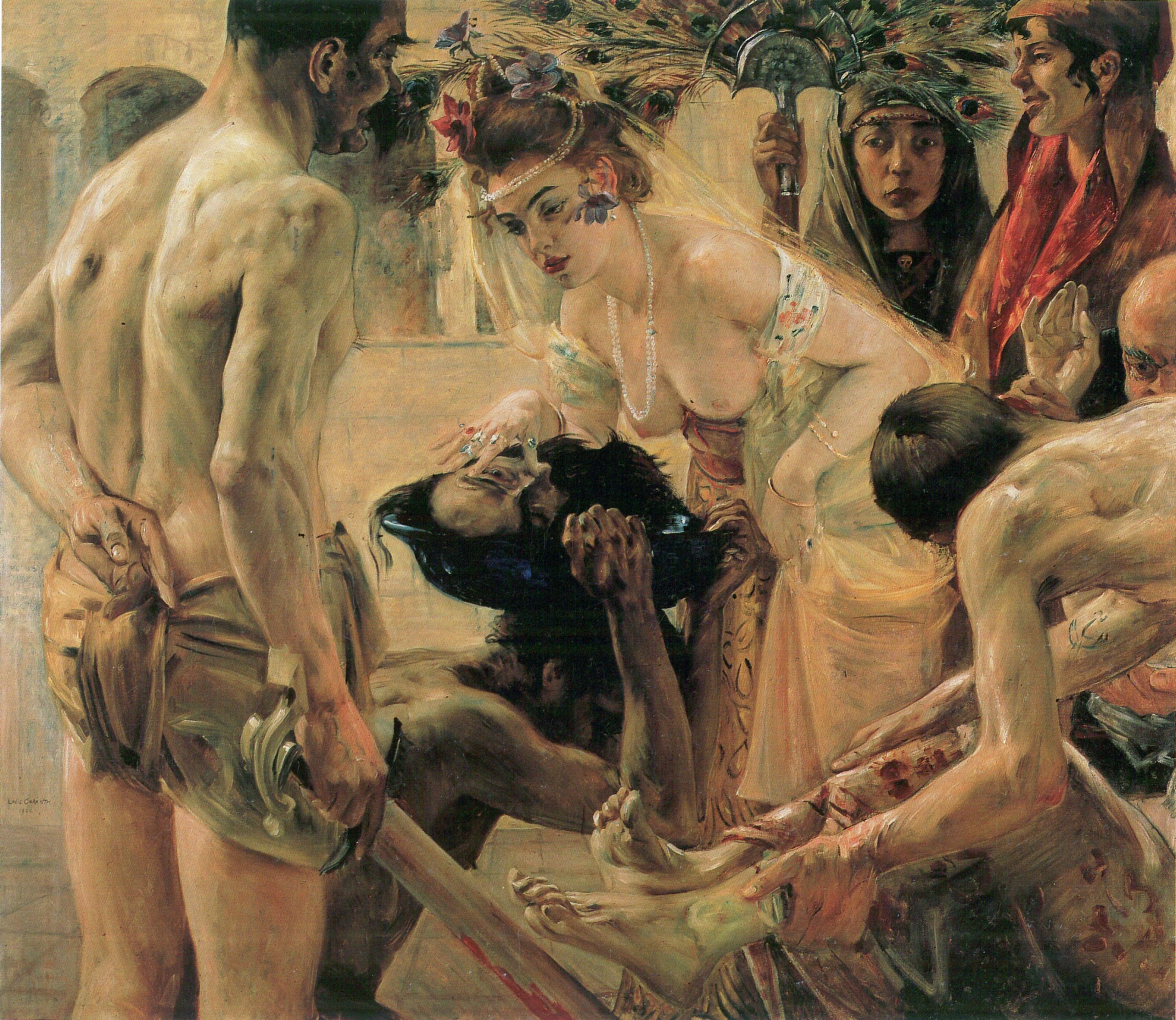
If Samson is the nude as victim, then Corinths Salome (1900) is the nude as predator — and it is one of the most unsettling paintings of the turn of the century. Salome stands bare-breasted, arms raised in a dancers gesture, while a servant presents the severed head of John the Baptist on a platter. The composition is lurid, theatrical, almost vulgar — and that is the point. This is not the coy Salome of Gustave Moreau or the fey Salome of Aubrey Beardsley. This is a woman who has weaponized her body and gotten exactly what she wanted. The nudity is not vulnerability. It is armor.
Corinth painted the subject three times, returning to it across his career. Each version grows more explicit, more erotic, more confrontational. The 1900 Salome is the rawest: the body is not idealized, the brushwork is almost sloppy, the lighting deliberately harsh. Corinth was not interested in making Salome beautiful. He was interested in making her dangerous.
Bacchanalia and the Collective Body
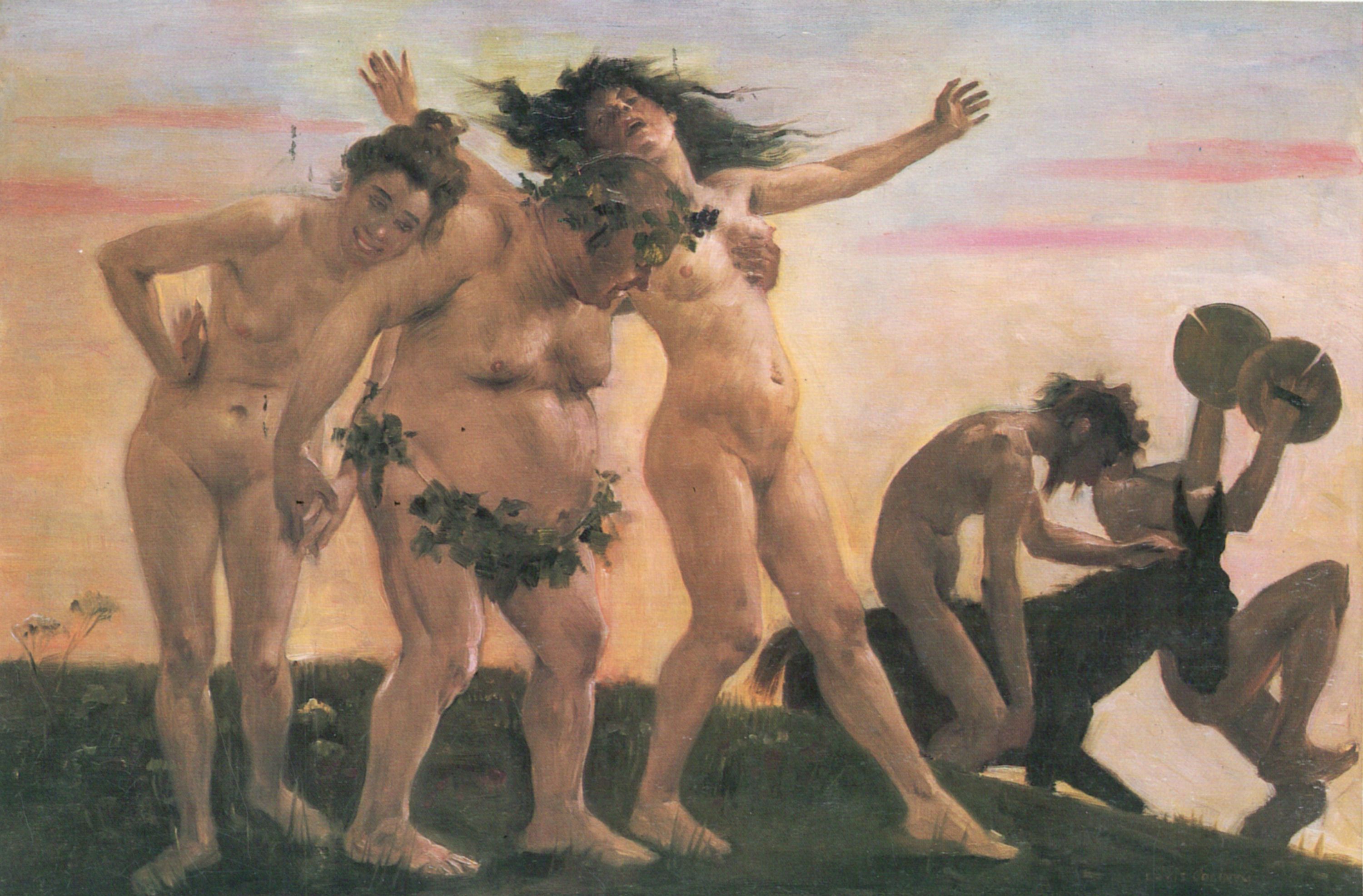
Corinth also painted joy — messy, intoxicated, Dionysian joy. Returning Bacchantes (1898) shows a group of nude followers of Bacchus stumbling home through a dark forest, their bodies tangled together, their faces flushed with wine and abandon. Unlike the polite mythological nudes of the French Academy — tidy Venuses arranged for the male gaze — Corinths Bacchantes are actually drunk. Their nudity is not on offer. It is the natural state of people who have lost their clothes somewhere in the ecstasy of the night.
This is the nude as collective experience — the body not alone, not performing, but absorbed into a group, into music, into ritual. It is a vision of the body that has almost nothing to do with the individual and everything to do with the dissolution of individuality. Corinth, who spent his entire career painting faces and personalities, also understood the body as a thing that could lose itself.
The Body Without Alibi
What unites Corinths nudes — Samson, Salome, the Bacchantes — is the refusal of alibi. The nude body in academic tradition always had an excuse: it was mythological, allegorical, historical, biblical. You werent painting a naked woman; you were painting Venus. You werent painting a naked man; you were painting Adam. The subject matter provided cover for the looking.
Corinth used the same alibis — Samson is biblical, Salome is biblical, Bacchantes are mythological — but he used them to smuggle in bodies that refused to behave like allegories. His Salome is too real to be merely symbolic. His Samson is too wounded to be merely heroic. His Bacchantes are too drunk to be merely decorative. The alibi is there on paper, but the paint tells a different story.
This is the move that makes Corinth a bridge figure. His early career belongs to the 19th century — the Salon, the Secession, the academy. But his late work, accelerated by the stroke, points directly toward the 20th centurys confrontation with the body as raw material. Without Corinths Samson, it is harder to imagine Francis Bacons screaming popes — bodies dissolving under pressure. Without Corinths Salome, it is harder to imagine Egon Schieles self-lacerating nudes, or even the later self-portraits of Lucian Freud.
Death and Legacy
Corinth died on July 17, 1925, during a trip to Zandvoort in the Netherlands. He was 67. He had spent his last years painting with increasing ferocity — landscapes that vibrated with color, portraits that cut into their subjects, and nudes that refused to flatter. While recovering from pneumonia in 1925, he painted his final self-portrait: an old man staring out from a hospital bed, eyes huge, hands clutching the blanket. Not a nude, but a body nonetheless — the body as terminus, as the place where we run out of road.
The Nazis declared Corinths work “degenerate” in 1937 and removed 295 of his works from German museums. They were right to be afraid of him — not because his art was decadent, but because it told the truth about bodies, and fascism cannot tolerate truth about bodies. Fascism needs bodies to be symbols. Corinth painted bodies that were flesh.
In the years since the war, Corinths reputation has stabilized but never quite soared to the household-name level of a Klimt or a Schiele. This is partly because he is hard to categorize — too late for Impressionism, too early for Expressionism, too individual to join any movement that would have him. But it is also because his nudes are difficult. They do not offer the easy pleasures of the idealized body. They offer something rarer: the body as it is actually lived, from the inside, in all its desperation and hunger and failing strength.
On what would be his 168th birthday, that is worth remembering. The nude body in art is not one thing. It can be a dream. It can be a lie. Or it can be, as Corinth proved across a hundred canvases, a battlefield — and every battlefield tells the truth about what we are.