Henri-Edmond Cross Died 116 Years Ago Today. The Neo-Impressionist Who Dissolved the Nude Into Pure Light.
On May 16, 1910, Henri-Edmond Cross died in Saint-Clair, a tiny hamlet on the French Riviera where he had spent the last two decades of his life painting the Mediterranean light. He was 53 years old, and cancer had finally caught up with a man who had spent his career teaching pigment how to escape the gravity of matter.
Cross — born Henri-Edmond-Joseph Delacroix in Douai in 1856 — is remembered as a master of Neo-Impressionism, the movement that took Georges Seurat’s pointillist technique and ran with it into the twentieth century. But for the history of the nude, Cross matters for something subtler: he was the first painter to treat the human body not as a solid form but as a cluster of luminous vibrations, barely distinguishable from the light that surrounds it.
His nudes don’t pose. They shimmer.
From Realism to Radical Color
Cross began as a realist. His early work was dark, somber, derivative of the Barbizon school and Courbet. But by the late 1880s, after meeting Paul Signac and immersing himself in the circle of the Société des Artistes Indépendants, his palette began to crack open.
The shift happened in the South of France. Cross moved to Cabasson in 1891, then settled in Saint-Clair near the modern-day Saint-Tropez. The Provençal sun did something to his eyes — and his brush. His colors went incandescent. The tiny dots of Seurat’s divisionism gave way to broader, blockier strokes. The surface of his canvases began to resemble mosaics, each tessera of color vibrating against its neighbor.
This was the second phase of Neo-Impressionism, and Cross was its quiet revolutionary.
L’Air du Soir: The Nude as Atmosphere
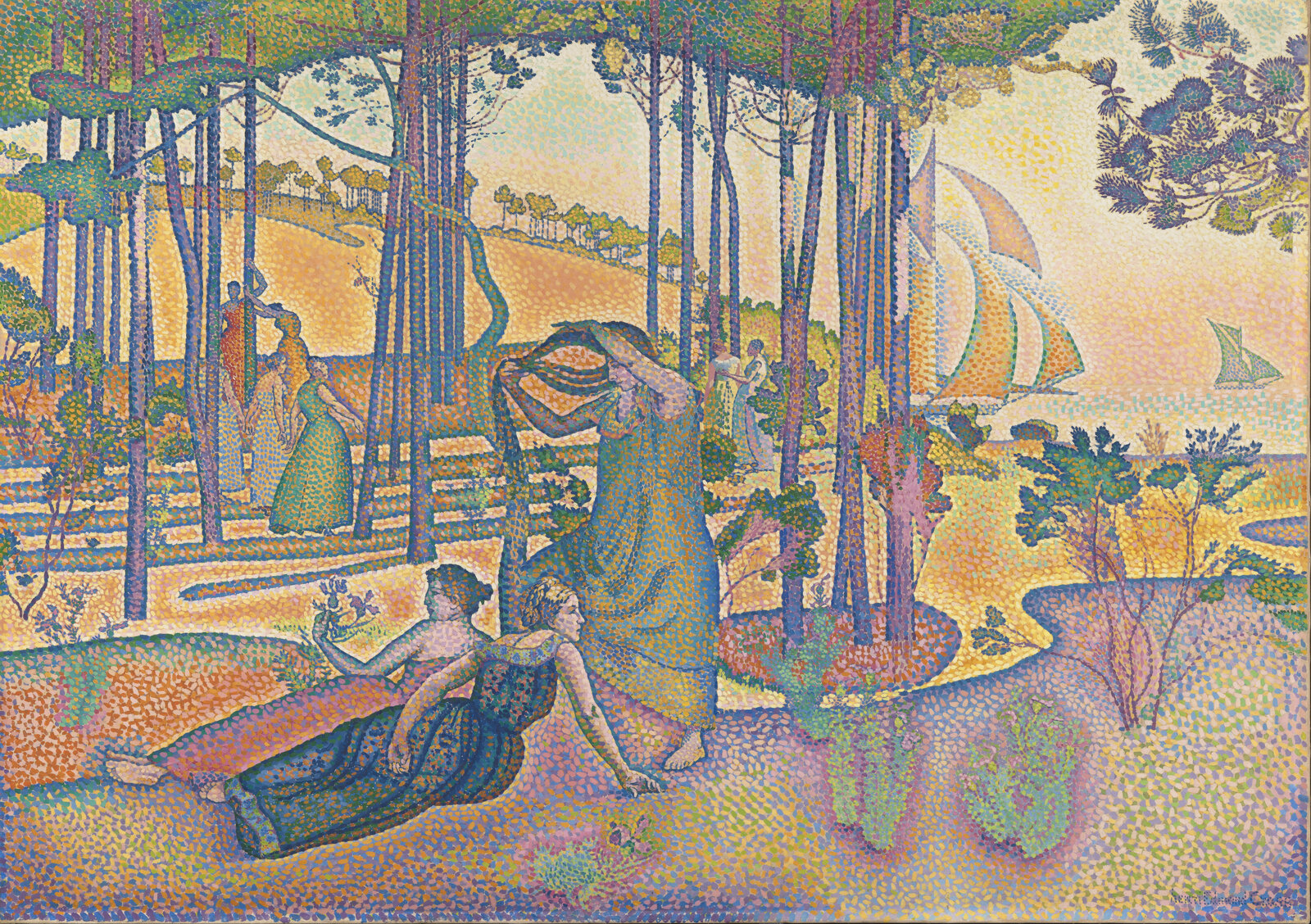
Cross’s masterpiece, L’Air du Soir (The Evening Air), painted between 1893 and 1894, is the key to understanding his contribution to the nude in art.
The painting shows a group of figures on a Mediterranean hillside at dusk. A nude woman reclines in the foreground, her body turned away from the viewer, her form composed of the same pink, lavender, and gold dots that make up the hillside she lies on. Behind her, clothed figures stand and stroll. In the distance, the sea dissolves into the sky in a haze of blue-green pointillist flecks.
What makes this painting radical is not what it shows — a leisurely evening scene, a bucolic fantasy of Mediterranean life — but how it shows it. The nude body in L’Air du Soir is not a figure in a landscape. It is a figure as landscape. The same particles of color build both skin and grass, both hair and hillside. There is no outline, no contour separating flesh from earth. The nude has been dissolved into its environment, and the result is both sensual and strangely transcendent.
In academic painting — Bouguereau, Gérôme, Cabanel — the nude was always an object: polished, contained, staged for the viewer’s gaze. Cross undid that logic. His nude is not an object but an event, a momentary coagulation of light on canvas that could, at any second, shimmer back into the atmosphere it came from.
The Flight of the Nymphs: Freedom Through Fragmentation
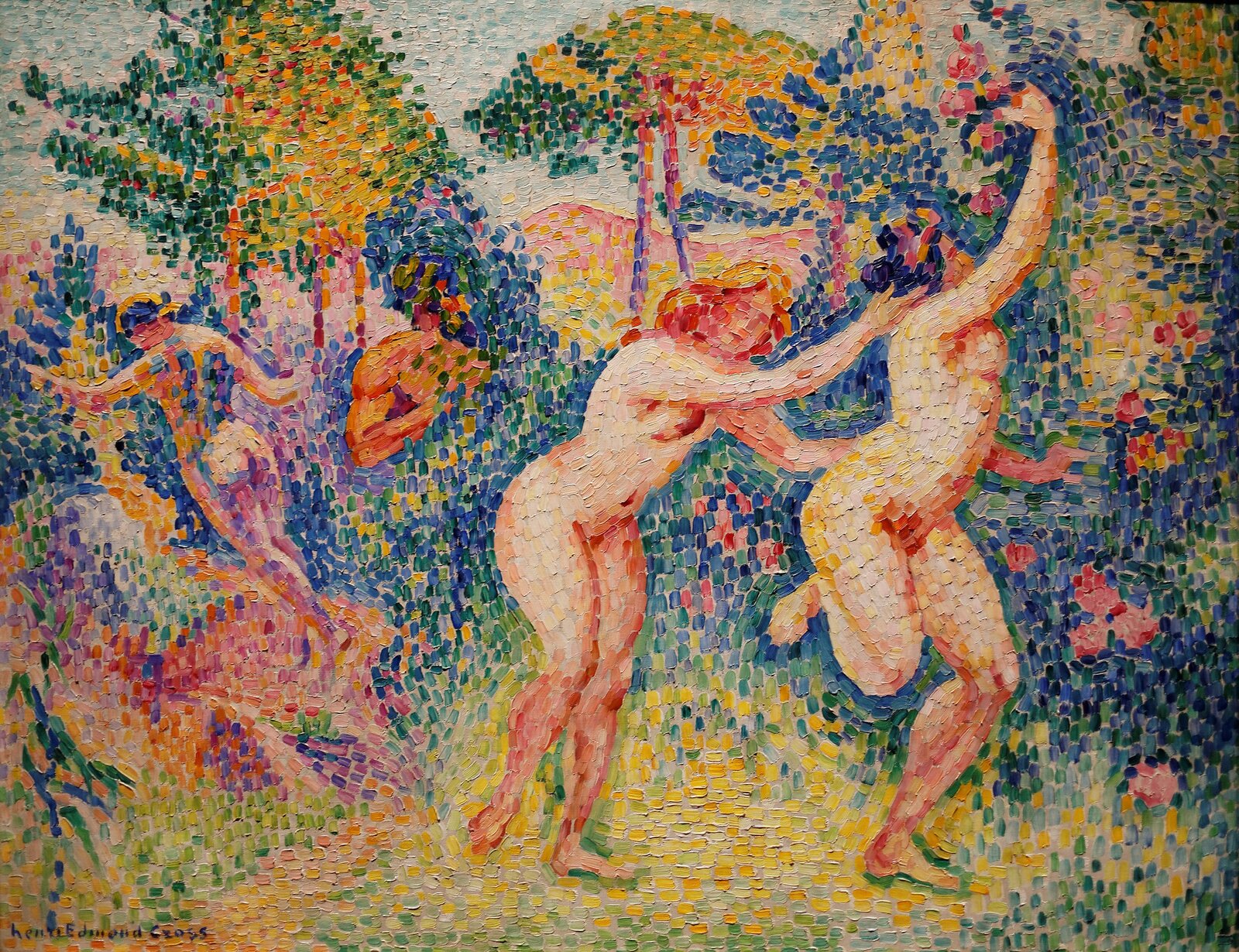
Cross’s La fuite des nymphes (The Flight of the Nymphs) pushes this idea further. Here, nude female figures flee through a sun-dappled forest glade, their bodies picked out in flecks of rose, ochre, and aquamarine. They are not classical nymphs in the mythological sense — they are barely figures at all. Cross has fragmented them into the same colored light that filters through the trees, so that body and leaf, limb and shadow, are woven from the same chromatic thread.
This fragmentation was not a failure of skill. It was a philosophical choice. Cross was an anarchist — not in the bomb-throwing sense, but in the utopian sense shared by Signac, Pissarro, and other Neo-Impressionists who believed that art could prefigure a freer, more harmonious world. His fragmentary nudes are not about the body as property or spectacle. They are about the body as part of a whole — one node in a vibrating field of color and energy. The nude in Cross’s hands becomes a metaphor for the dissolution of hierarchy: not man over nature, not viewer over viewed, but mutual shimmering.
From Cross to Matisse: The Nude That Became Fauvism
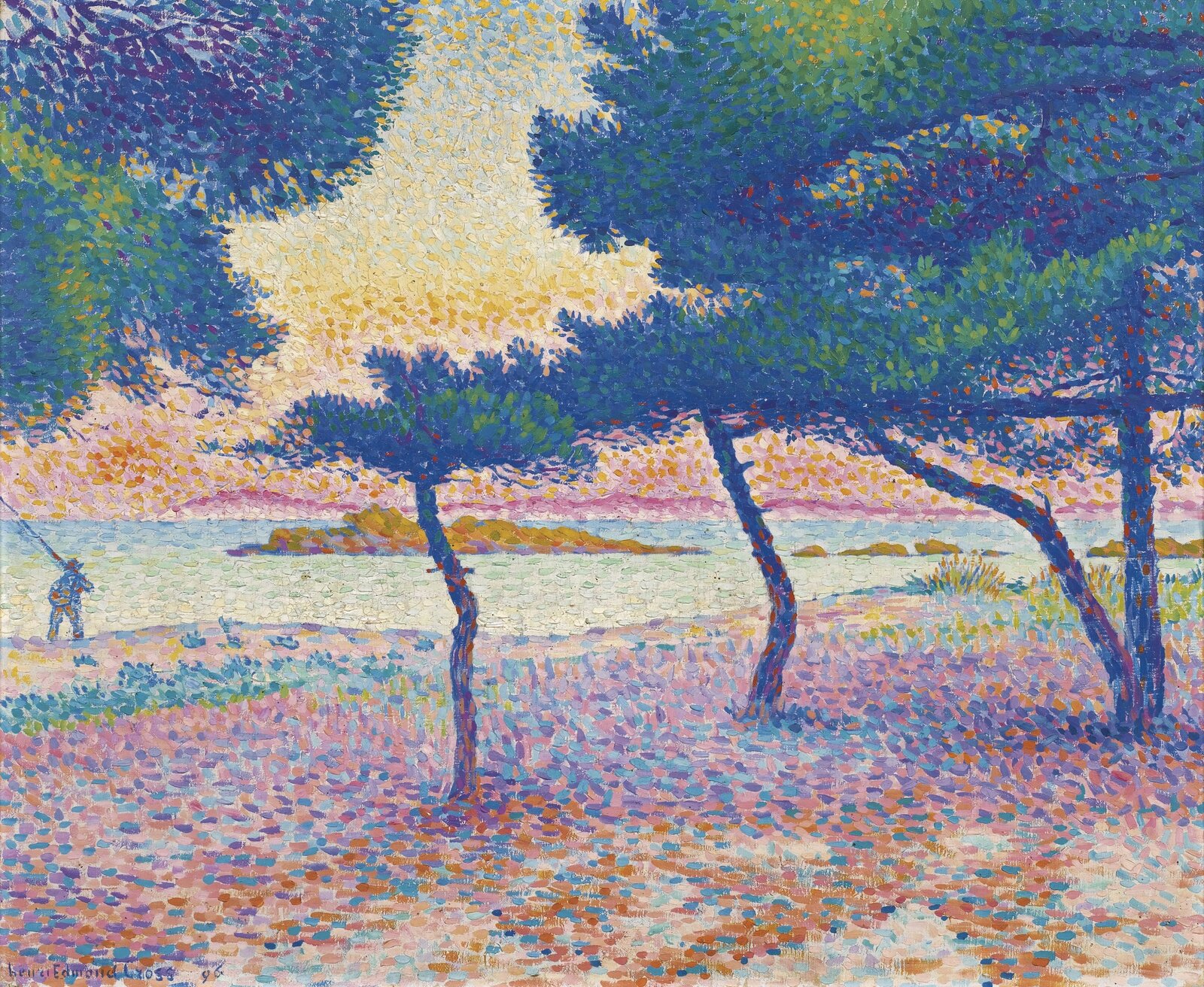
Cross’s late work — the broad, blocky mosaics of his final decade — had an influence far beyond his own output. Henri Matisse, André Derain, and the young Fauves saw Cross’s paintings at the 1905 Salon des Indépendants and at Galerie Druet, where Cross’s first solo exhibition was mounted that same year. The critic Félix Fénéon called Cross’s work “softly charged with a granular, atmospheric glow.” Matisse borrowed that glow and pushed it harder, turning the nude into raw color shapes in Le Bonheur de Vivre (1905-1906), a painting that owes an unacknowledged debt to L’Air du Soir.
Cross died before Fauvism peaked, before Cubism, before everything that followed. But his approach to the nude — as a field of color rather than a figure in space — opened a door that twentieth-century modernism walked straight through.
Why Cross Matters Now
In an era when the nude in art has become a battleground — contested, censored, politicized — Cross offers a reminder that the body can also be a place of pure visual pleasure. Not the dubious pleasure of surveillance or objectification, but the pleasure of seeing a human form so thoroughly integrated with its world that the distinction between figure and ground becomes meaningless.
Cross’s nudes do not demand to be looked at. They invite you to look with them, to experience what it might feel like to be a body made of Mediterranean light, reclining on a hillside as the evening air settles around you.
That is its own kind of radical act.
— NALA