Henri Matisse died on November 3, 1954, in Nice, at the age of eighty-four. He spent his final years in bed after surgery, and when he could no longer stand at an easel, he found another way to keep working. He cut shapes out of paper painted with gouache and pinned them to the wall of his studio. Among the first shapes he cut were nudes.
The nude was Matisse’s longest subject. He returned to it for more than half a century, from the color idylls of his Fauvist years to the flat blue silhouettes of his final cut-outs. Across those decades he kept returning to one question: how little does a body need before it is still a body?
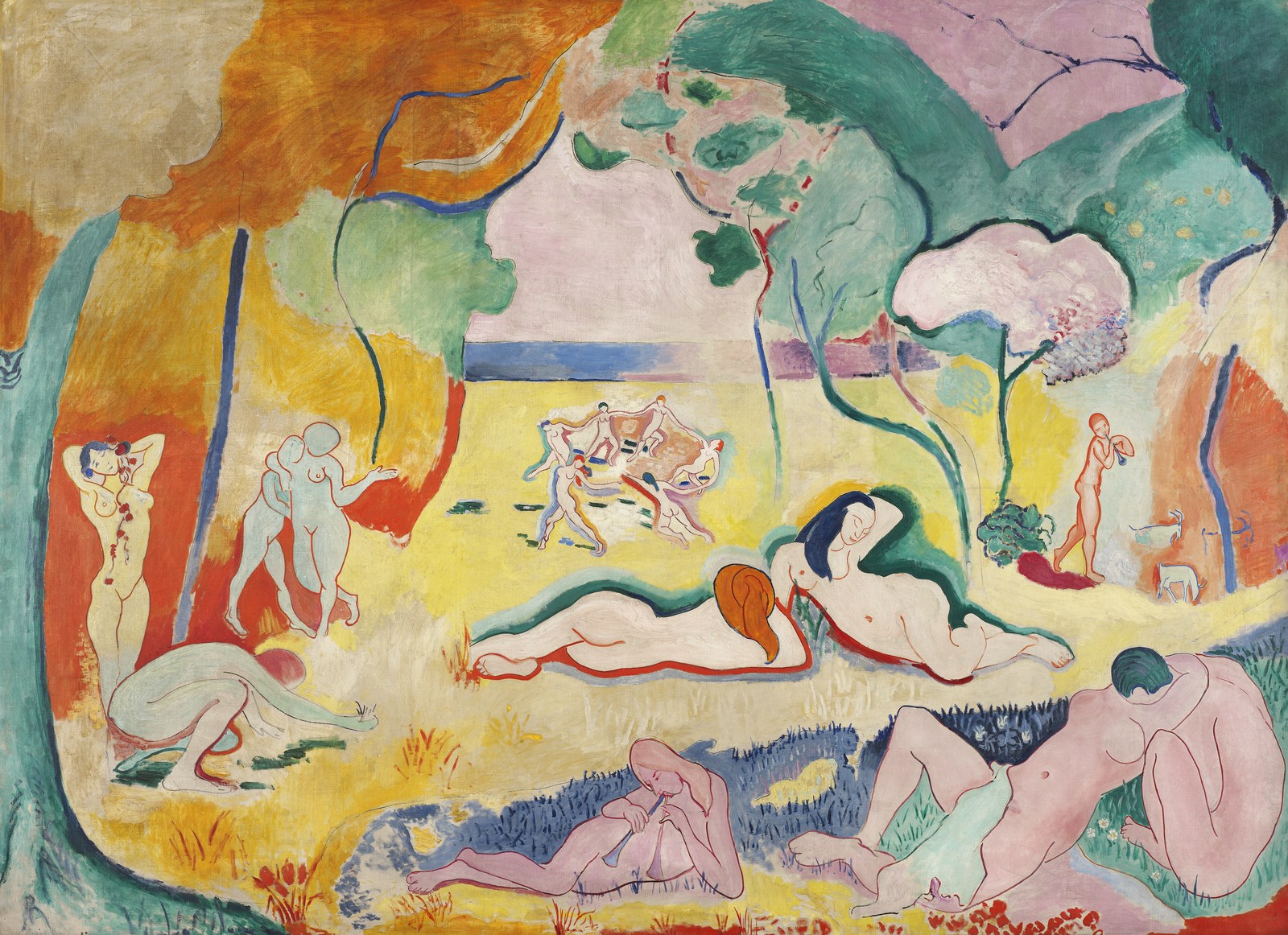
In The Joy of Life, painted between 1905 and 1906, the nude lives inside a landscape of pure, unmodulated color. The figures recline, embrace, and dance across a field of yellow, pink, and green. Matisse took the academic nude, the Venus studied from plaster casts and life drawings, and set her down in a flat garden of his own invention. The body stopped being an object to render and became a shape to arrange.
The Dance of 1910 went further. Five figures, reduced to a single red, join hands and wheel across a band of blue and green. Matisse stripped the body of modeling, of individual features, of anything that would make one dancer a portrait and the next a person. What remains is rhythm. The Russian collector Sergei Shchukin commissioned the painting for the staircase of his Moscow mansion, and the reason is plain: it moves.
The endpoint came after the surgery. Bedridden, Matisse could no longer model flesh with brush and paint, so he cut the nude out of colored paper. The Blue Nudes of 1952 take the body to its last reduction: a single blue figure, scissored into a pose, with no interior detail at all. Matisse called the cut-outs “drawing with scissors,” and he meant it as a liberation. A body cut from a sheet of blue needs no anatomy, no light, no shadow. It is pure shape, and it is enough.
Matisse’s career reads as an argument about the nude. The classical tradition treated the naked body as the hardest thing to draw, the summit of skill, proof that an artist had mastered bone and muscle and the fall of light. Matisse asked a different question. He wanted to know whether the body could carry feeling without any of that apparatus, whether a red figure with no face could still dance, whether a blue shape with no hands could still be a woman at rest. His answer, delivered over fifty years, was yes.
That is why Matisse still matters to anyone who thinks about the human figure. He separated the nude from its alibis: from myth, from academic skill, from the slow machinery of rendering flesh. He kept the body and threw away everything that was not essential to it. In the end he proved that the nude is a feeling you can cut out of a piece of paper.
Seventy-two years after his death, his nudes hang in the same museums as the marble Venuses he grew up copying. The two traditions could not sit further apart. One builds the body up; the other takes everything away. Matisse took everything away, and the body survived.