
The oldest beauty contest in Western art had no sash, no stage, and no swimsuit. It had three naked goddesses, one golden apple, and a shepherd who was asked to make a choice that started a war.
Eris, the goddess of discord, was left off the guest list for the wedding of Peleus and Thetis, so she rolled a golden apple into the feast inscribed with the words “for the fairest.” Hera, Athena, and Aphrodite each reached for it. Zeus refused to judge his own wife and daughters, so he sent the three of them to Mount Ida, where a prince named Paris lived as a shepherd. Each goddess made him an offer. Hera promised power, Athena promised victory in battle, and Aphrodite promised the most beautiful woman alive, Helen of Sparta. Paris handed the apple to Aphrodite, and the Trojan War followed.
Painters returned to this scene for three centuries for a simple reason. It gave them a legitimate excuse to paint three naked women side by side, compared against one another on a single canvas. The Judgment of Paris is the nude’s founding alibi, because the myth builds the comparison into the picture. The painter can line up three bodies and study their differences without ever admitting that the differences are the point.
Peter Paul Rubens understood this better than anyone. His Judgment of Paris, painted between 1632 and 1635 and now in the National Gallery in London, lines up the three goddesses as an argument in flesh. Hera stands to the left, Athena beside her, Aphrodite to the right with Cupid at her feet and a satyr raising a mirror. Paris still holds the apple, and he looks unsure. Rubens gives each body a different abundance and a different temperature of skin, so the eye compares them exactly as Paris does. The viewer becomes the judge.
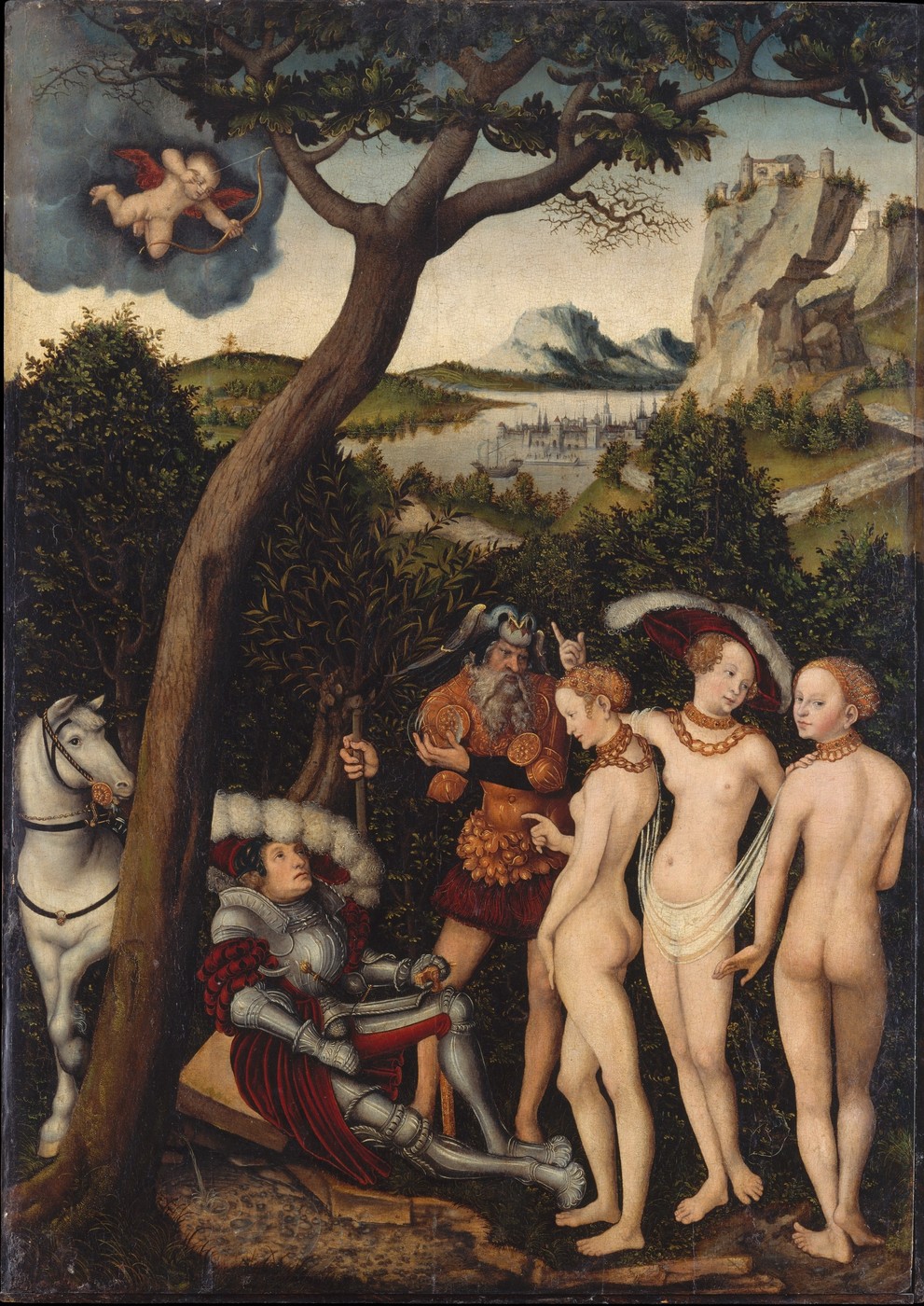
Lucas Cranach the Elder painted the same scene more than a dozen times, and his versions tell a different story. In his Judgment of Paris of 1528, now in the Metropolitan Museum of Art, the goddesses stand as slender, elongated, architectural figures. Cranach worked as a court painter to the Electors of Saxony, and his Judgment reads as a diagram of beauty. The body shrinks into a measuring problem.
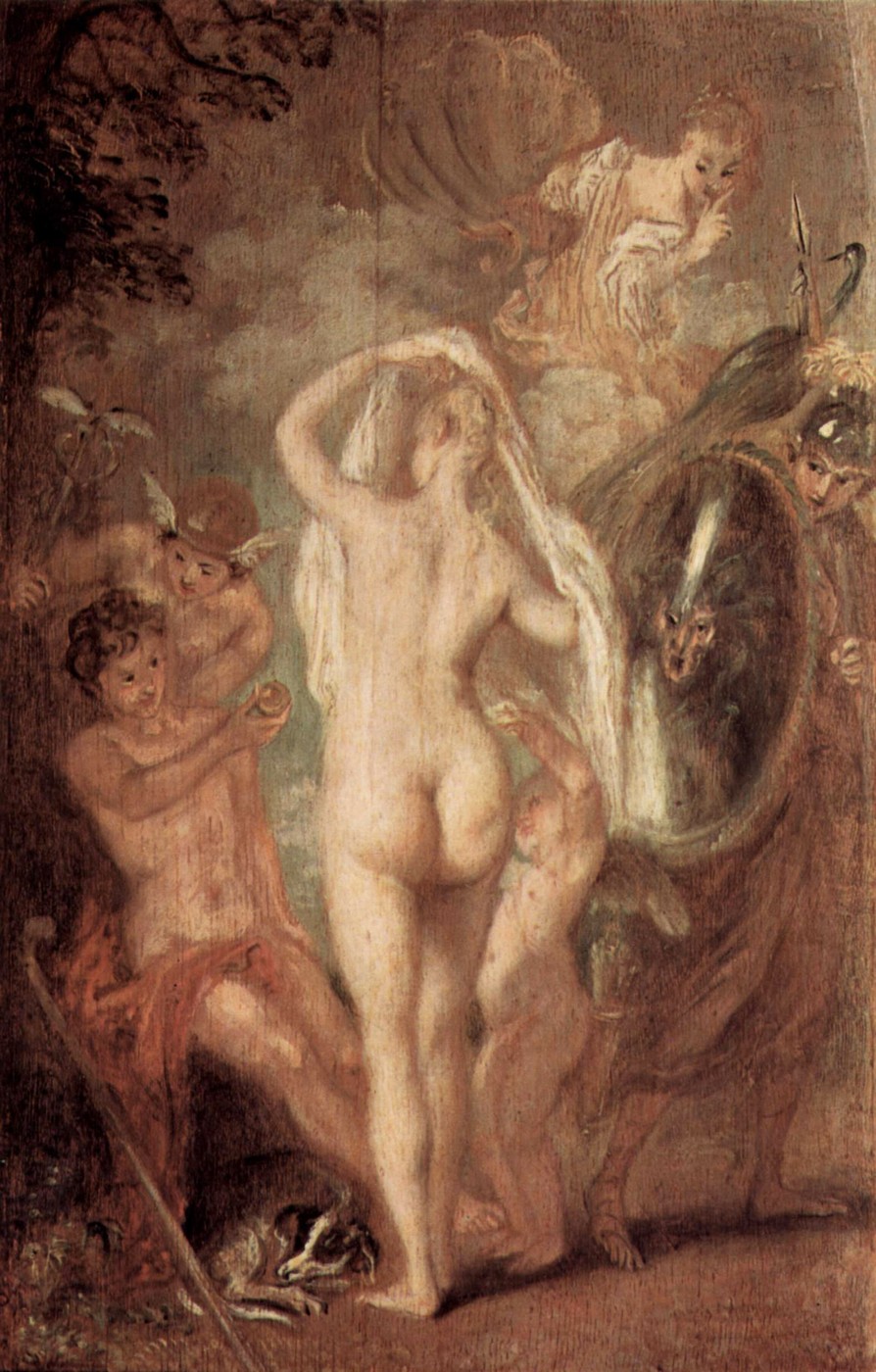
Antoine Watteau, a century later, collapsed the suspense. In his Judgment of Paris of around 1718 to 1721, now in the Louvre, the verdict is already in. Venus sits crowned, Cupid kneels at her feet with the apple, and the whole scene has softened into a Rococo afterthought. Watteau had no need to compare the three goddesses, because the tradition he inherited had already made the choice for him. The nude had hardened into a formula.
The Judgment of Paris is the moment the nude became a competition. From this scene descends an entire apparatus for ranking the female body. The three goddesses are the first lineup, the golden apple is the first prize, and Paris is the first judge, which makes him the first judge to be bribed. Every pageant, every cover, every ranking of bodies owes something to this myth. The Western nude has spent three thousand years staging a beauty contest while claiming it was looking at art.
The myth carries its own warning, and painters have always half-known it. The judgment is never innocent. Paris does not choose freely; he chooses between bribes. The gods who send the body to be judged have already rigged the outcome, and a nude that exists to be compared can never be seen as itself. Three thousand years after that apple rolled into the feast, the question the scene keeps asking is still open: what would a body look like if no one were scoring it?