
236 years ago today, a Swiss-born sculptor arrived in Paris carrying a chisel and a secret. He would go on to make the Louvre blush.
James Pradier was born on May 23, 1790, in Geneva — then the independent Republic of Geneva — to a Protestant family originally from Toulouse. At seventeen, he left for Paris to work alongside his elder brother, an engraver, and enrolled at the École des Beaux-Arts in 1808. Four years later, he won the Prix de Rome, sending him to study at the Villa Medici from 1814 to 1818.
In Paris, he studied under Jean-Auguste-Dominique Ingres, the greatest draftsman of the age. He debuted at the Salon of 1819, joined the Académie des beaux-arts in 1827, and became a professor at the École des Beaux-Arts. By any measure, he had become a pillar of the establishment.
But the cool marble he carved told a different story.
The Scandal That Rocked the Salon of 1834
At the Salon of 1834, Pradier unveiled Satyr and Bacchante — a marble group depicting a satyr and a maenad locked in an ecstatic, erotic embrace. The work was technically staggering: the figures twist around each other in a composition that defies the gravity of stone. The satyr’s hand grips the bacchante’s thigh. Her head falls back, eyes closed, mouth slightly open. The marble itself seems to breathe.
The scandal was immediate and ferocious. The prudish government of King Louis-Philippe refused to purchase it — an astonishing snub, given that the Salon was supposed to be the state’s showcase for the best French art. Worse, society gossips claimed they recognized the sculptor’s own features in the satyr — and those of his mistress, the actress Juliette Drouet, in the bacchante.
Pradier’s cool response, if he offered one, has been lost. But the work itself survived: Count Anatoly Demidov, a Russian industrialist and art patron, purchased it and installed it in his palazzo in Florence. It would be decades before Satyr and Bacchante finally entered the Louvre — and when it did, it arrived in the same building that had once rejected it.
The Eroticism the Myths Couldn’t Hide
The description that follows Pradier through art history is telling: “The cool neoclassical surface finish of his sculptures is charged with an eroticism that their mythological themes can barely disguise.”
This is the central tension of Pradier’s work — and of neoclassical sculpture’s longstanding relationship with the nude body. Classical mythology was the cover story. The actual subject was desire.
Les Trois Graces, now in the Louvre, is a perfect example. Three nude female figures, their arms intertwined, their bodies pressed together in a rhythmic circle. The composition is faultless. The finish is immaculate. And yet the effect is unmistakably sensual. You are not meant to admire the goddesses from a distance. You are meant to feel their presence.
His Niobid (also in the Louvre) shows a dying daughter of Niobe, her body arched in agony, one arm reaching back as if to ward off an invisible arrow. Even in suffering, Pradier renders the female form with the same charged physicality — the curve of the spine, the tension of the ribcage, the vulnerability of exposed skin.
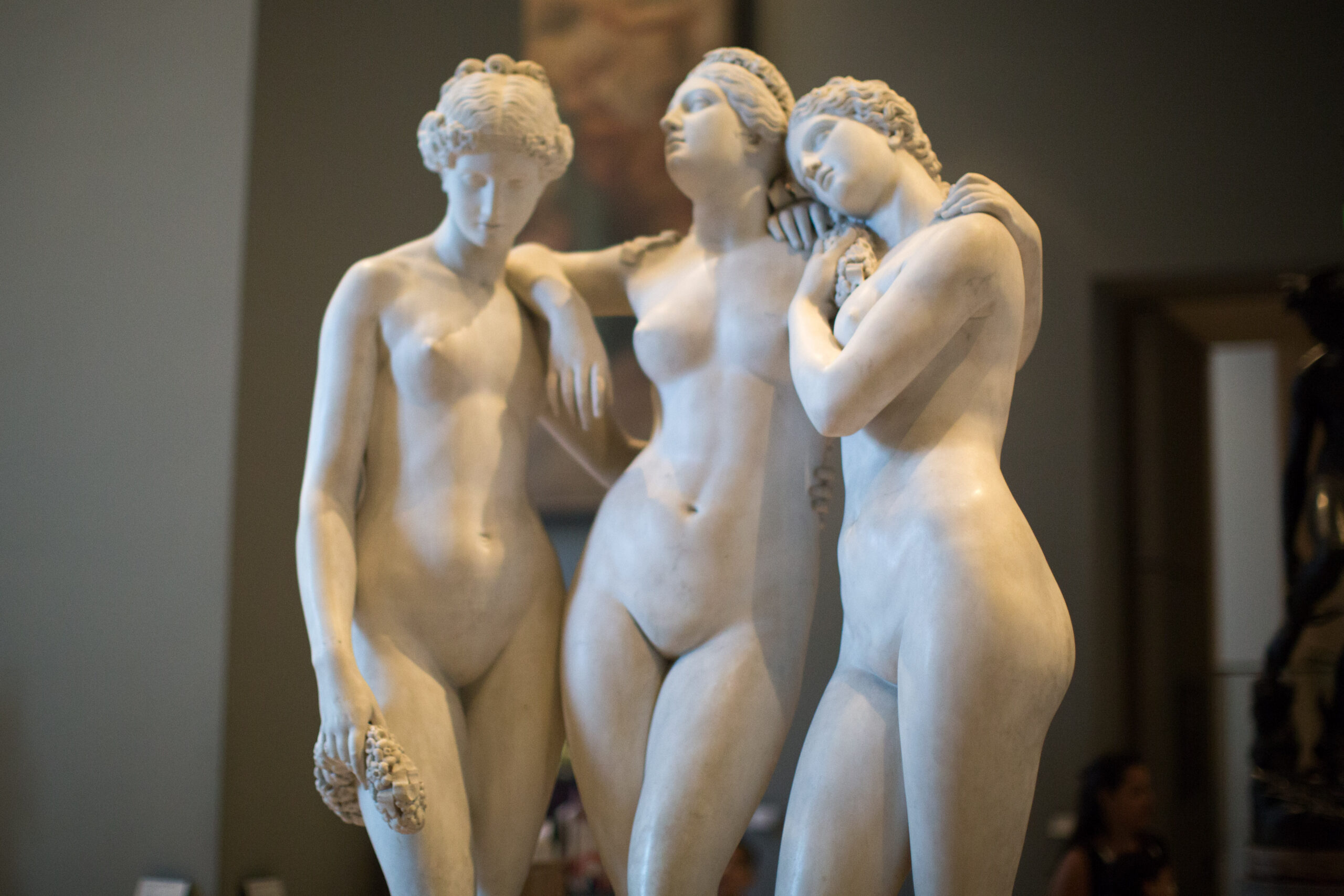
James Pradier, Les Trois Graces — Louvre Museum. Public domain via Wikimedia Commons.
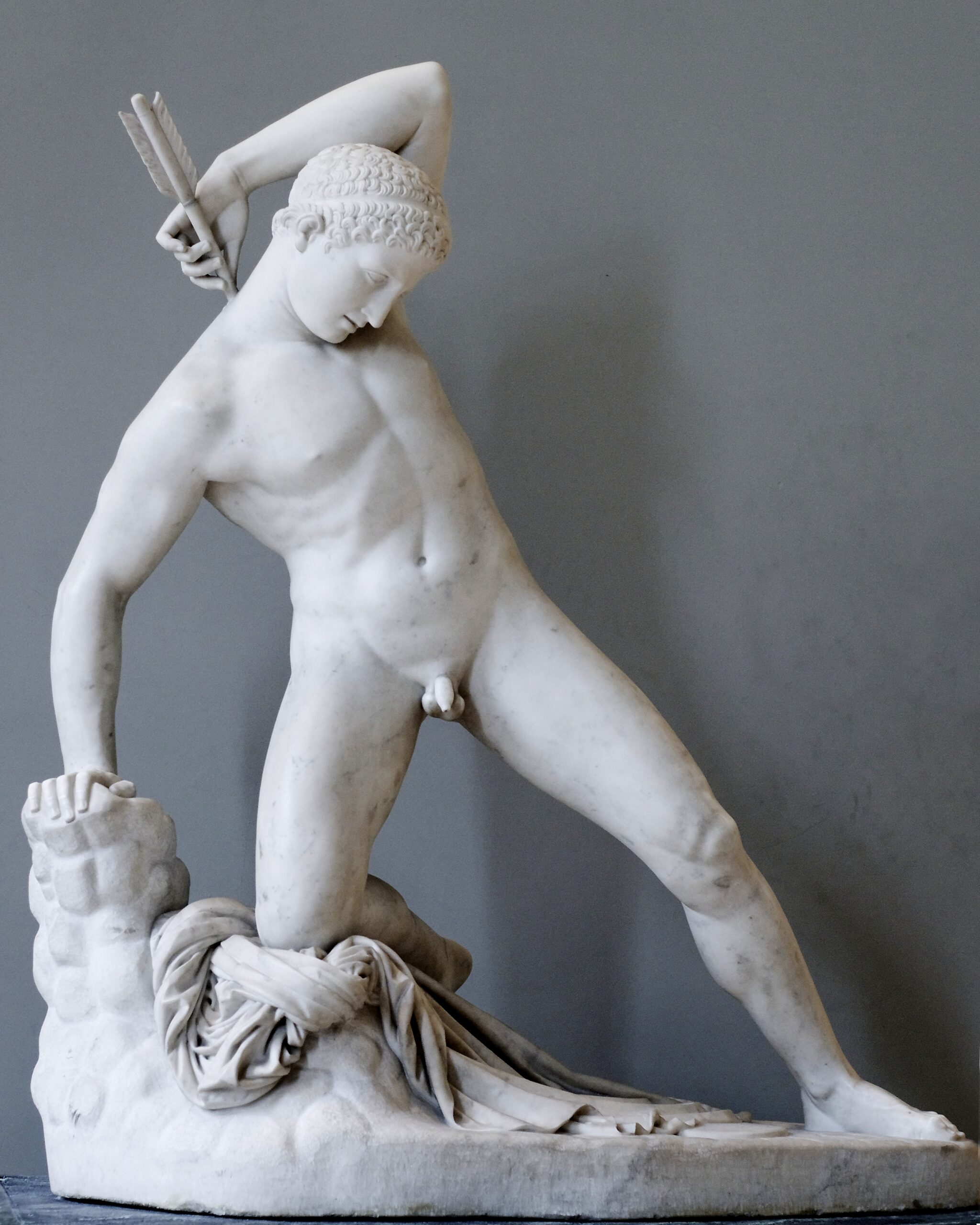
James Pradier, Niobid — Louvre Museum. Public domain via Wikimedia Commons.
A Workshop at the Center of Parisian Culture
Pradier’s workshop became a gathering place for the most brilliant minds of Romantic Paris. Victor Hugo, Alfred de Musset, Théophile Gautier, and the young Gustave Flaubert all counted themselves as friends. When Pradier’s marriage to Louise d’Arcet collapsed — she had taken numerous lovers and run up extraordinary debts — Flaubert found in her a model for the most famous fictional adulteress in literature: Emma Bovary.
Pradier himself was no stranger to complicated relationships. His former mistress, Juliette Drouet — the woman believed to have posed for the bacchante — went on to become Victor Hugo’s lifelong companion, writing him over 20,000 letters and managing his household for half a century.
The Marble Legacy
Beyond the Salon scandals, Pradier left an indelible mark on the city of Paris itself. His allegorical figures of Lille and Strasbourg stand at the Place de la Concorde. Four figures of Fame adorn the spandrels of the Arc de Triomphe. His Marriage of the Virgin graces the church of the Madeleine. The twelve Victories around Napoleon’s sarcophagus at Les Invalides — each representing a different battle — were among his final works.
He died on June 4, 1852, at the age of 62, having spent his life proving that marble could be made to feel like flesh.
Why Pradier Matters Now
In an age when art is increasingly dematerialized — digital, conceptual, ephemeral — Pradier’s work is a reminder that the body in art is never just a body. It carries social meaning. Political weight. Erotic charge. The same debates that swirled around Satyr and Bacchante in 1834 — What is art? What is obscenity? Who decides? — are alive today on Instagram, in museums, and in courtrooms.
Pradier was not a revolutionary. He was a classicist who carved the revolution the only way he knew how: in white marble, with a surface so smooth you can almost feel the warmth of the skin beneath.
Explore more about James Pradier’s work at the Louvre and the Musée d’Orsay. For NALA’s perspective on the nude in art, visit our get involved page.