Pontormo Was Born 532 Years Ago Today. His Twisted Nudes Invented Mannerism — and Changed the Body in Art Forever.
On May 24, 1494, Jacopo Carucci — known to history as Pontormo — was born outside Florence. By the time he died in 1557, he had done something no Renaissance painter had dared: he made the human body look wrong on purpose.
Not wrong in the sense of incompetent. Wrong in the sense of revelatory. Pontormo’s figures don’t stand in calm, balanced contrapposto like Michelangelo’s or Raphael’s. They twist. They elongate. They slide past each other in compositions that feel unstable, anxious, almost feverish. And that was precisely the point.
Pontormo invented the visual language of anxiety in the body — and in doing so, became the father of Mannerism, the movement that dared to ask: what if perfection is boring?
The Apprentice Who Rebelled
Pontormo trained under Andrea del Sarto, the most technically perfect painter of his generation. He studied Leonardo’s smoky sfumato and Michelangelo’s muscular anatomy. He could paint a “correct” Renaissance figure in his sleep.
But he chose not to.
His early masterpiece, the Deposition from the Cross (1525–1528) in the Capponi Chapel of Santa Felicita, Florence, shows the problem. The figures are arranged in a floating, impossible cluster — no ground, no cross, no tomb. Bodies curve into each other like water. Their proportions are off: elongated torsos, small heads, hands that seem to reach across impossible distances. The colors are shockingly bright — pinks, greens, apricots — nothing like the sober earth tones expected for a Crucifixion scene.
Vasari, the Renaissance biographer, called it “strange.” He meant it as a criticism. We recognize it as genius.
The Body as Emotional Instrument
Pontormo’s true innovation was treating the nude body not as an ideal form to be perfected — the Renaissance project — but as an instrument of emotion. His figures are elongated not because he couldn’t draw, but because distortion conveyed spiritual intensity better than anatomical correctness ever could.
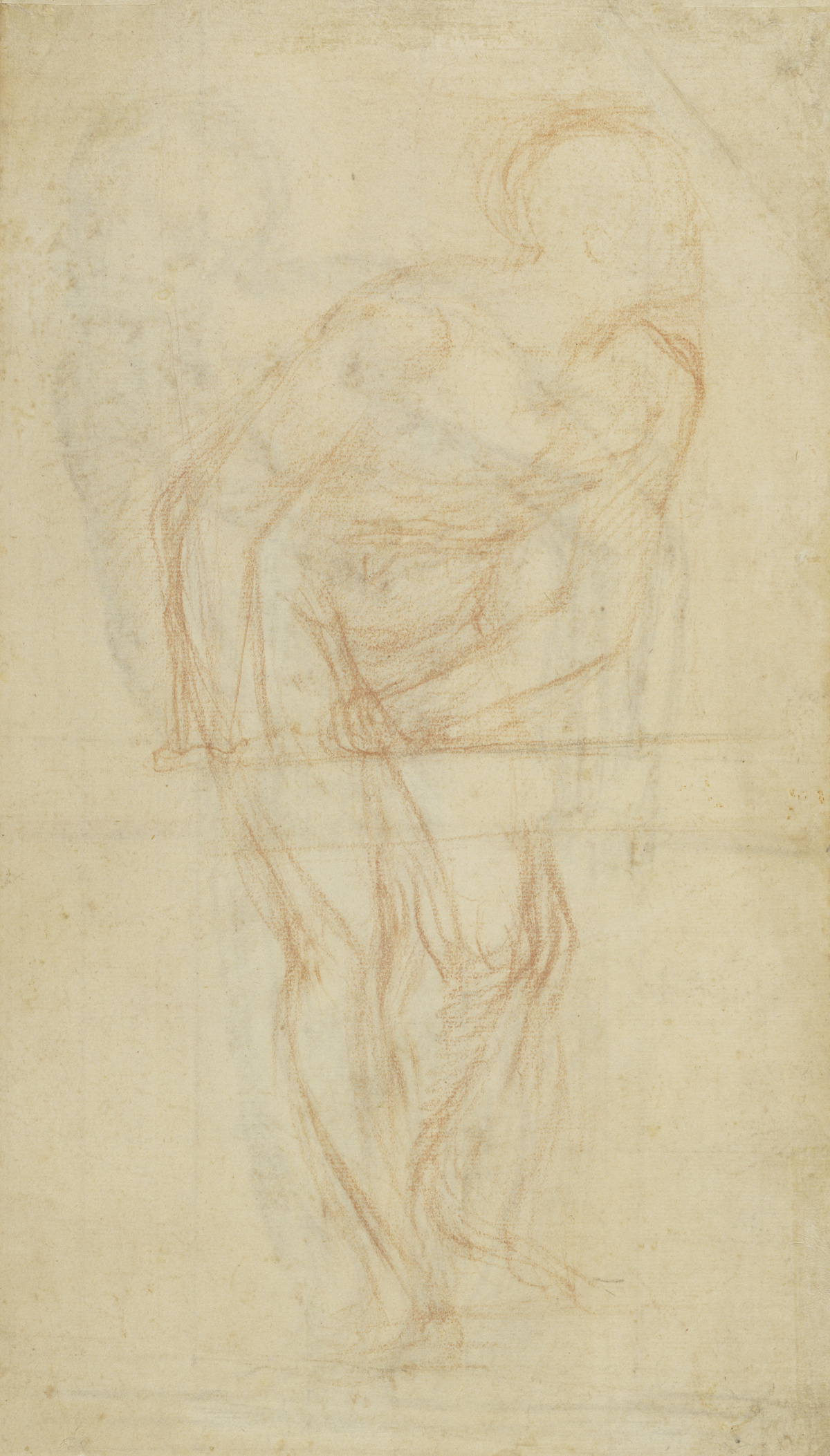
Consider his male nude studies. In A Standing Male Nude (c. 1520s, now at the Getty), a chalk drawing of unmatched delicacy, the figure’s pose is unstable — weight shifted, spine curved, one arm reaching into space. The body doesn’t hold itself still for the viewer’s inspection. It moves. It yearns. The sfumato modeling gives the flesh a pulse.
In A Nude Man Lying Face Downwards (British Museum), the vulnerability is almost uncomfortable. The figure is completely exposed, face hidden, spine a long arc of defenseless flesh. It’s a pose that wouldn’t look out of place in a Schiele drawing — three centuries before Schiele was born.
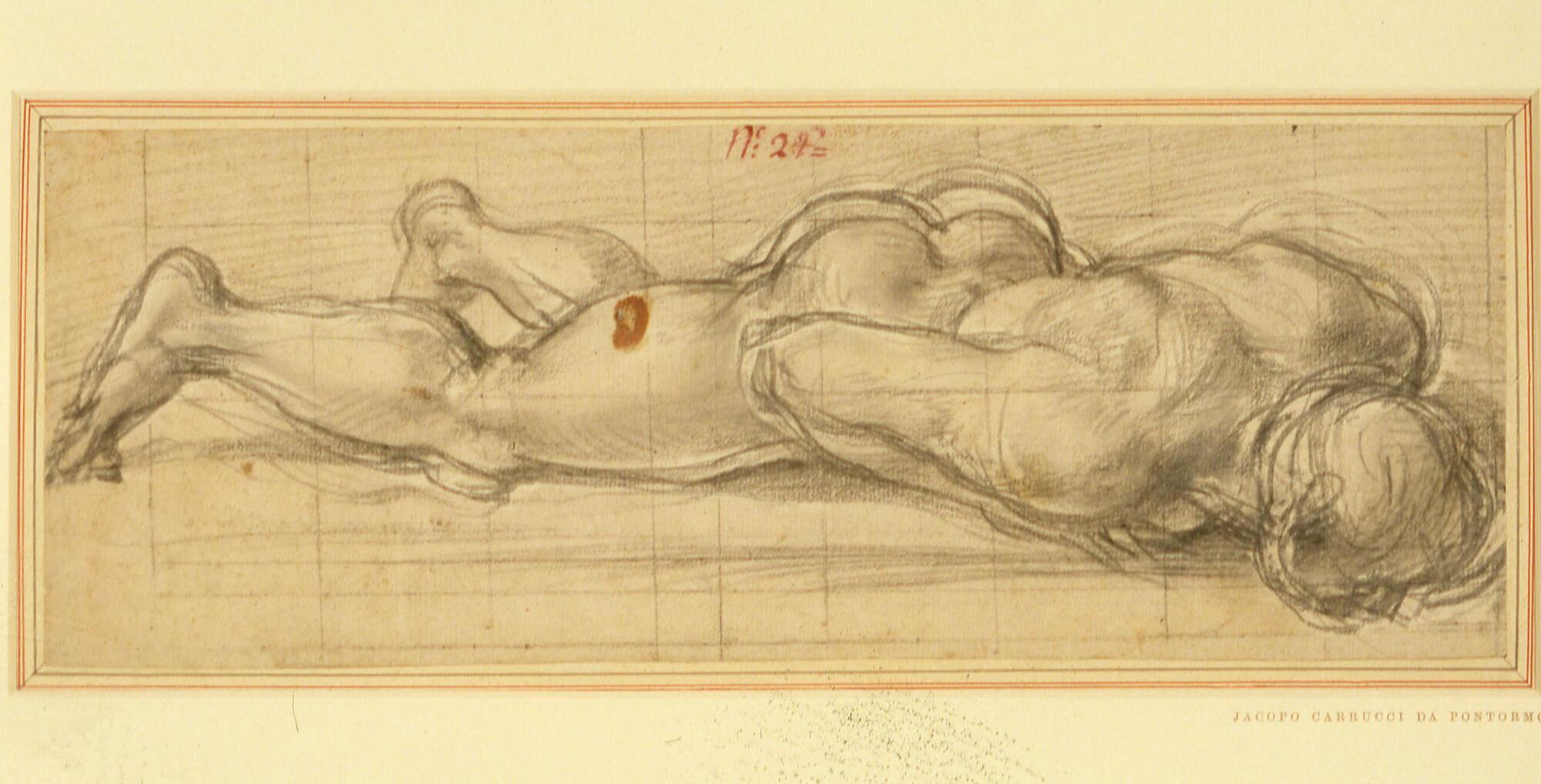
These drawings weren’t meant for public display. They were private experiments. But they reveal Pontormo’s lifelong obsession: the body as a carrier of psychic states, not just anatomical data.
Venus After Michelangelo
Pontormo’s Venus and Cupid (c. 1533), painted from a cartoon by Michelangelo, is a fascinating hybrid. The pose is unmistakably Michelangeloesque — the turned torso, the raised arm, the powerful thigh. But the execution is pure Pontormo: the Venus is slimmer, more elegant, more nervous than anything Michelangelo would have drawn. Her face is delicate, almost melancholic. She’s not the triumphant goddess of love. She’s a woman who knows the cost of desire.
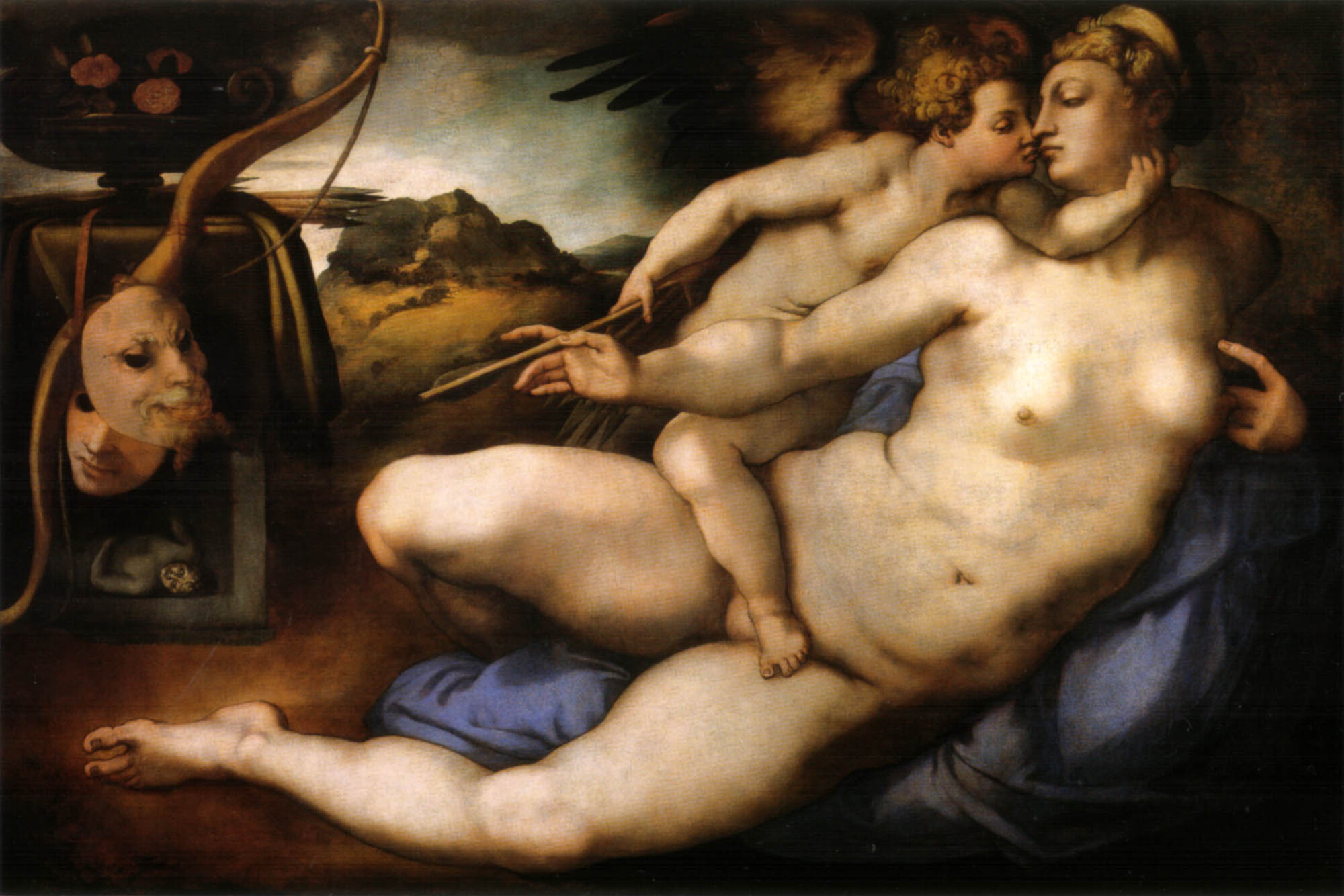
This collaboration between the aging Michelangelo (then in his late 50s) and the younger Pontormo represents a passing of the torch. Michelangelo gave Pontormo the template; Pontormo broke it, stretching and refining it into something new. The muscular remains, but the spirit is entirely Mannerist.
The Lost Frescoes of San Lorenzo
Perhaps the greatest tragedy in Pontormo’s career is the loss of his life’s work: the frescoes in the choir of the Basilica of San Lorenzo in Florence. He worked on them for over a decade (1546–1556), obsessively, refusing to let anyone see them until completion. When he died in 1557, the frescoes were only partially finished. They were eventually destroyed in the 18th century — whitewashed over during a renovation.
We know what they looked like from preparatory drawings: writhing masses of nude figures, a Last Judgment that made Michelangelo’s version look restrained. The saved and the damned were indistinguishable — all bodies, all flesh, all caught in the same whirlwind of divine terror and ecstasy. Pontormo had taken the nude body to its theological extreme: stripped of all context, all clothing, all social identity, the body itself became the subject of judgment.
The Legacy of the Twisted Body
Pontormo died in 1557, largely forgotten by the art establishment. The Baroque would reject his elongated figures in favor of Caravaggio’s naturalism and the Bolognese school’s classical balance. For three centuries, Mannerism was treated as a decadent, degenerate style — the moment Renaissance ideals collapsed into mannered excess.
The 20th century saw it differently. Modernists recognized in Pontormo’s distortions something deeply familiar: the refusal to prettify, the embrace of anxiety as a legitimate subject for art. Expressionism, Surrealism, even Francis Bacon’s screaming popes — all owe something to Pontormo’s twisted nudes and his radical belief that the body was not a temple or an ideal, but a question mark.
Why Pontormo Matters Now
In an era of AI-generated bodies and Instagram-filtered perfection, Pontormo’s figures feel bracingly real. They are not polished. They are not symmetrical. They do not conform to any ideal of beauty. And that’s precisely their power.
The nude body in art has always been a battleground between the real and the ideal. Pontormo chose the real — not in the sense of naturalism, but in the sense of psychological truth. He understood that the body’s power lies not in its perfection, but in its capacity to express what words cannot.
Five hundred and thirty-two years after his birth, we still haven’t caught up.
— NALA
Explore more of art history’s most radical bodies. Join NALA’s community and be part of the conversation about the nude in art, then and now.