
James Tissot was born on October 15, 1836, in the port city of Nantes, and died in 1902 as the definitive painter of the fashionable woman: the corseted, bustled, ribboned figure who glides through his canvases of Parisian and London high society. For a century afterward, critics filed him under costume and silk, a recorder of dress rather than of bodies.
That filing misses the point. Tissot painted the body obsessively. He understood that the body never enters the social world bare; it always arrives dressed, by fabric or by fantasy.
The body under the silk
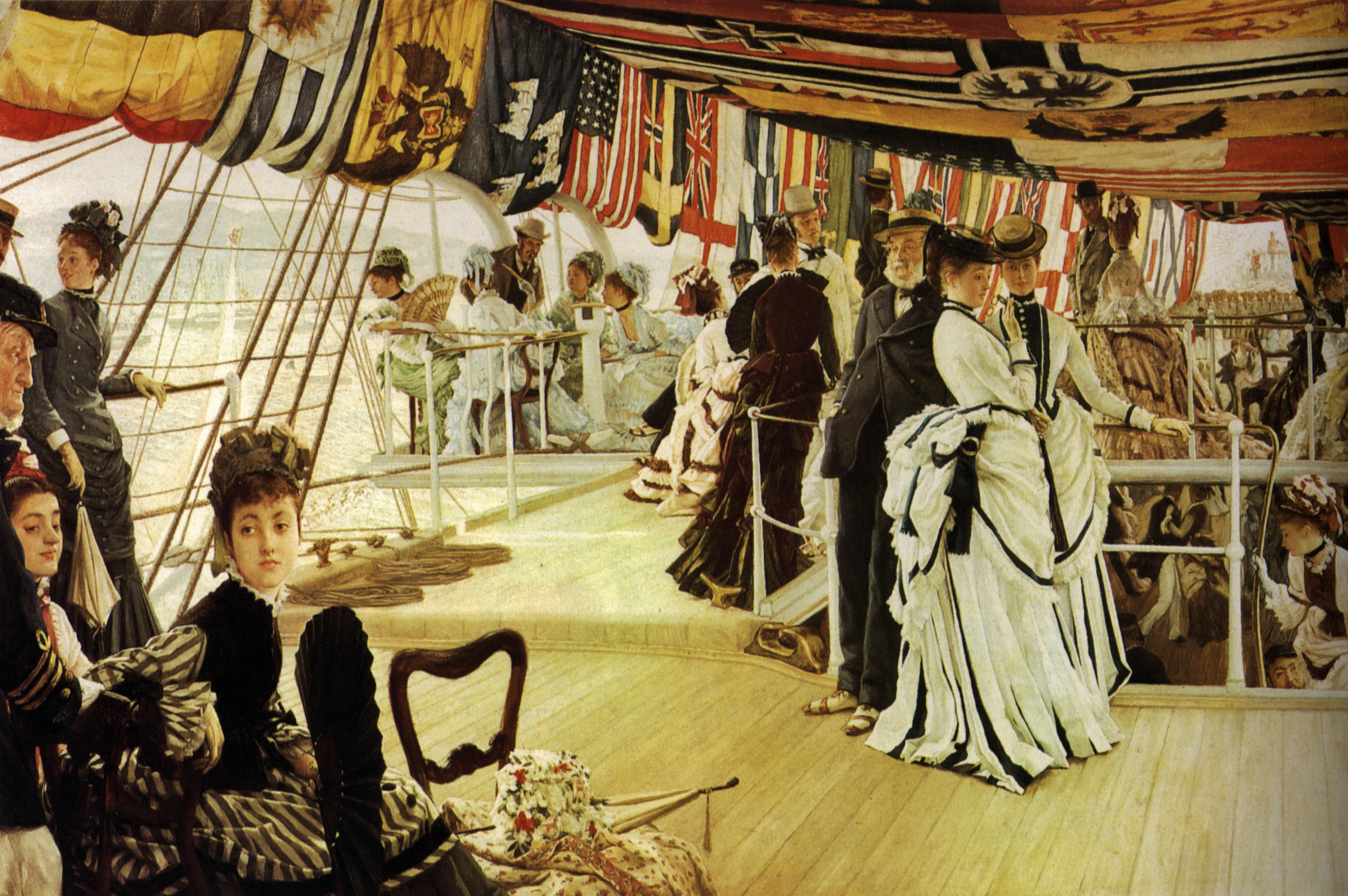
Consider The Ball on Shipboard (1874), the picture that sealed his London reputation. Officers in gold braid and women in layered gowns crowd the deck. Every figure is encased. Corsets cinch the women into an ideal silhouette; gloves reach the wrist, veils and parasols complete the armor. Tissot turned cloth into architecture, and the body underneath receded into rumor. He commanded that rumor: a sleeve, a ruffle, a sliver of neck carries more charge in his hands than most painters manage with a whole naked figure.
The body in the bath
But in 1864, ten years earlier, he painted the body undressed. La Japonaise au bain shows a woman bathing in a shallow wooden tub, her back to the viewer, in a room hung with a kimono and Japanese screens. She is nude, a modern woman at ease inside a private, invented Japanese interior.
The picture rode the first wave of Japonisme. Japan had opened to Western trade only a decade before, and its prints, silks, and objects flooded Paris. Tissot borrowed the setting wholesale and, in doing so, revealed his real subject: he dressed the naked body in exoticism. The kimono on the wall, the lacquer, the screen, they costume the nude as thoroughly as a bustle costumes the woman at the ball. He restyled the body and wrapped it in an imagined East.
The woman behind the work
This thread runs through Tissot’s whole career. His fashionable women and his bather are one subject seen from two sides: the female body as a surface to be adorned. He never pretended to reach a body without a costume. To paint a woman is to decide how she is dressed, and naked counts as a costume among the rest.
The point sharpens when you meet the woman behind the work. In the mid-1870s Tissot met Kathleen Newton, an Irish divorcée who became his model, his companion, and his subject for six years. He painted her constantly, in armchairs, at tables, in gardens, always in the meticulous dress of the day. When she died of tuberculosis in 1882, aged twenty-eight, he left London, left the society scene, and returned to France to paint the Life of Christ, a decade of sacred figures in flowing robes.
A painter who spent his maturity dressing the body in silk ended his life dressing it in scripture. The obsession never changed; only the wardrobe did. On his 190th birthday, that is Tissot’s worth: he saw that the body in art never arrives bare. It wears something, whether satin, a kimono, or a halo.