There is a room in Florence’s Galleria dell’Accademia where four figures struggle to be born. They emerge from rough stone \u2014 a shoulder here, a thigh there, a face half-formed, a torso still married to the marble that contains it. Michelangelo called them his Schiavi \u2014 the Slaves, or Captives. And in their incompleteness, they say more about the human body than any finished masterwork ever could.
\n\n
The Body in the Stone
\n\n
Michelangelo famously believed that every block of stone contained a figure inside it, and that the sculptor’s job was simply to remove the excess matter that concealed it. “I saw the angel in the marble and carved until I set him free,” he is said to have written. This wasn’t mere mysticism \u2014 it was a radical theory of the body as something already there, waiting to be revealed.
\n\n
\n\n
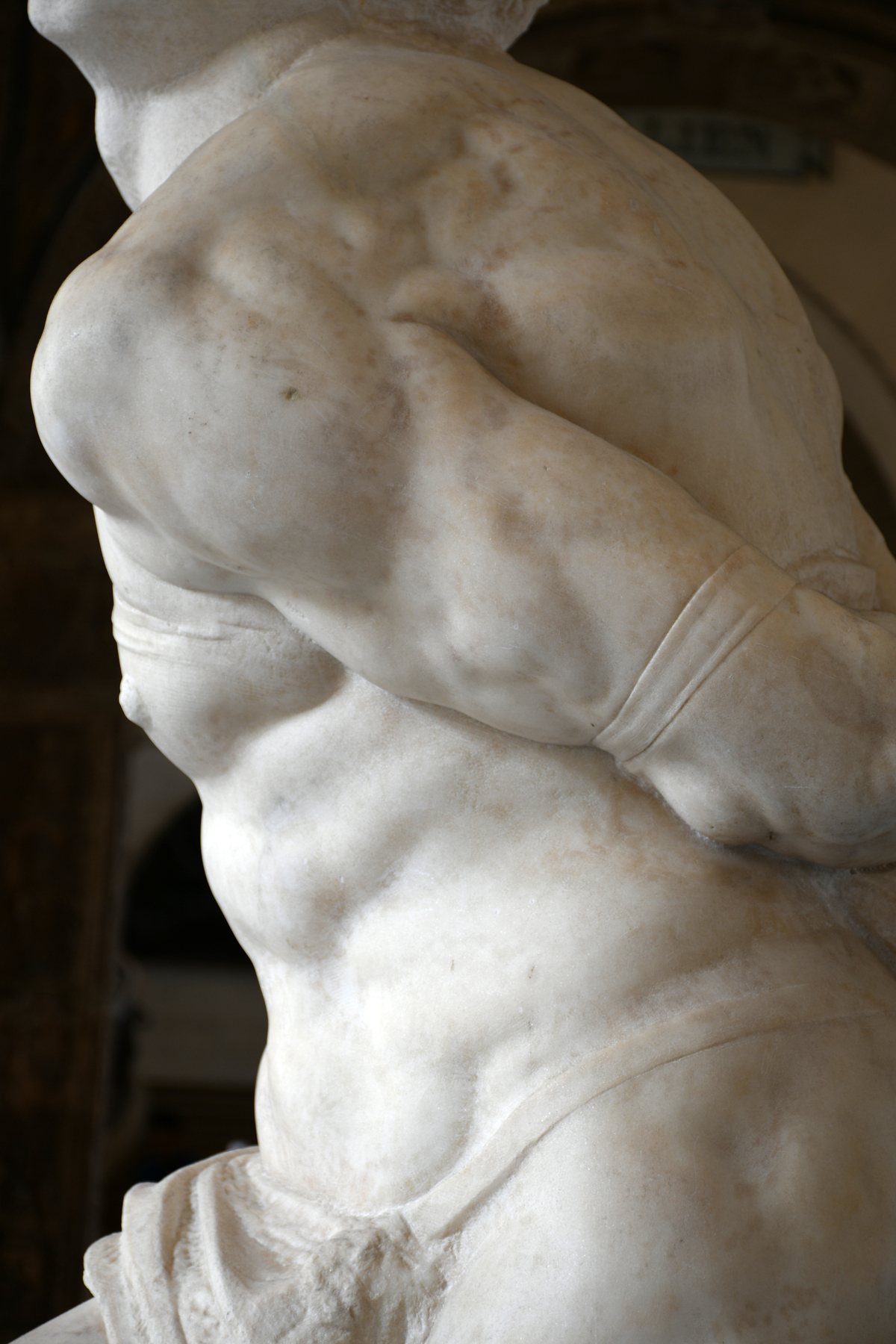
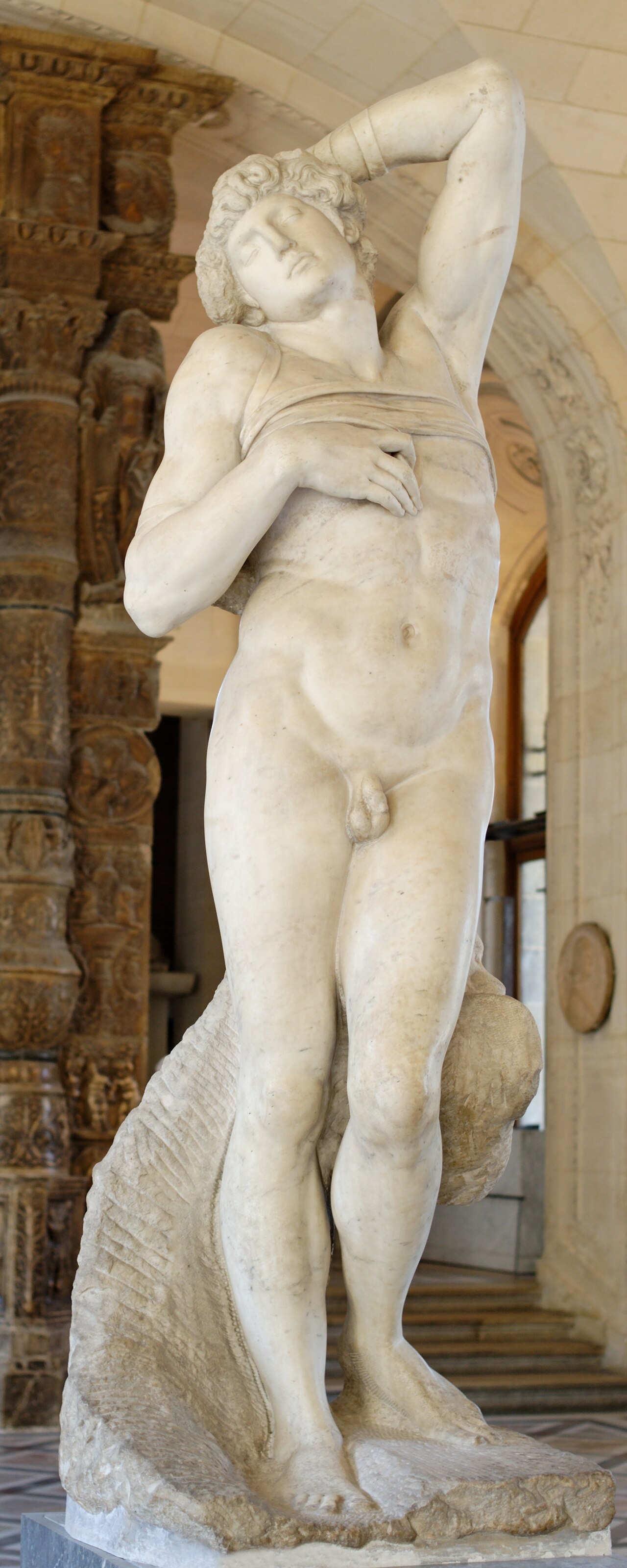
The six Captives were begun between 1513 and 1534 for what would have been the largest sculptural commission of the Renaissance: the tomb of Pope Julius II, a project that haunted Michelangelo for four decades and was never completed to his satisfaction. Two of the Captives \u2014 the Rebellious Slave and the Dying Slave \u2014 were finished enough to enter the collection of the Louvre. The other four remained in Michelangelo’s workshop in Florence, and today they stand in the Accademia, directly across from his David, as if in dialogue with perfection itself.
\n\n
Struggle Made Visible
\n\n
The Rebellious Slave twists against an invisible bond. His head turns sharply, one arm raised, the other pressed against his chest. Every muscle is engaged in a struggle we cannot see the source of \u2014 he fights something only he can feel. The Dying Slave, by contrast, surrenders. His head falls back, his arm drops limply, his body curves in what could be exhaustion or ecstasy or both. Art historians have debated for centuries whether these figures represent the human soul struggling against the prison of the body, or perhaps the artist’s own struggle against the limitations of his medium.
\n\n
\n\n
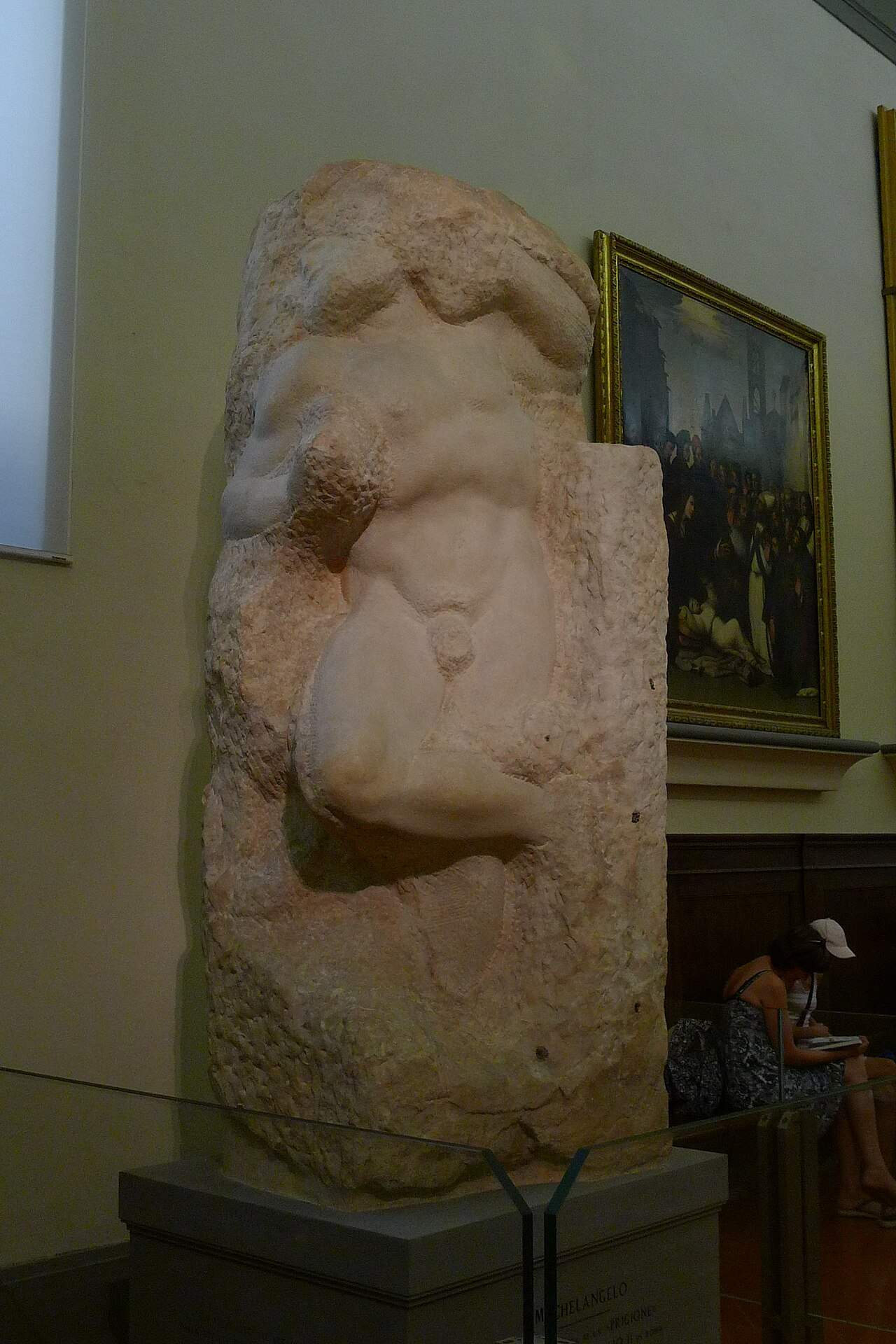
But the four unfinished Captives in Florence are more eloquent still. The Young Slave has only his upper body freed from the block \u2014 his legs remain entirely encased in stone, as if he is sinking back into the quarry. The Awakening Slave (sometimes called the Atlas Slave) strains upward with the weight of stone still pressing on his back. The Bearded Slave and the Saint Matthew show faces and torsos emerging from rough matrix, tool marks still visible across their surfaces.
\n\n
\n\n
These are not failed sculptures. They are the process made legible.
\n\n
The Aesthetics of the Unfinished
\n\n
Michelangelo’s non-finito \u2014 the deliberately unfinished \u2014 was not a product of laziness or circumstance alone. In his late work, the unfinished quality becomes an aesthetic choice, a way of keeping the figure alive in a state of perpetual becoming. The Rondanini Piet\u00e0, on which he was working days before his death at 88, is barely more than a suggestion of two figures locked together \u2014 limbs fused, faces barely distinguished from the marble. It is the body reduced to its essential gesture: a mother holding her son, stripped of all anatomical detail.
\n\n
There is a profound honesty in this. The finished nude in Renaissance art \u2014 the perfectly proportioned David, the serene Venus of Botticelli \u2014 presents the body as a resolved statement, a completed thought. But our bodies are never truly finished. We are always in the process of becoming: growing, aging, healing, breaking down. Michelangelo’s unfinished slaves capture this truth more powerfully than any polished surface ever could.
\n\n
The Body as Process
\n\n
This idea ripples forward through art history. Rodin’s Walking Man (1907) is a headless, armless torso striding forward \u2014 a fragment made monument. Giacometti’s attenuated figures seem to dissolve at their edges, as if the body is perpetually receding from view. In contemporary sculpture, the unfinished, the partial, the fragmentary have become languages of their own.
\n\n
What Michelangelo understood \u2014 and what his Captives demonstrate with breathtaking directness \u2014 is that the body is not a fixed thing. It is an event. It emerges. It struggles. It is never quite free of the stone it comes from. And perhaps that is exactly what makes it beautiful.
\n\n
The next time you look at a finished nude, ask yourself: what if the artist had stopped earlier? What if the shoulder had been left in the stone, the face left half-formed? Would the body speak more honestly in its incompleteness?
\n\n
Michelangelo’s slaves suggest that the answer is yes.
\n\n
All images: Michelangelo’s Slaves \u2014 Public Domain via Wikimedia Commons. Michelangelo di Lodovico Buonarroti Simoni died in 1564; all his works are in the public domain worldwide.
\n