Nudity vs. Sexuality in Art: Why the Distinction Matters (and Who Gets to Decide)
Walk through any major museum and you’ll pass dozens of naked bodies. They lounge on marble pedestals, float across cathedral ceilings, stare out from canvases that are centuries old. No one blinks. But put one of those same bodies on Instagram — a photograph, a painting, even a classical sculpture — and suddenly there’s a content warning, a blurred screen, a removal notice.
Welcome to the weird, inconsistent, constantly shifting boundary between nudity and sexuality in art. It’s a line that artists have been testing for five hundred years, and no one — not the courts, not the platforms, not the museums — has managed to draw it in a way that holds.
The Classical Ideal: When the Nude Was Simply Divine
For most of Western art history, the nude body wasn’t sexual — it was spiritual. Ancient Greek sculptors didn’t carve the kouros to titillate. They carved it to represent the ideal human form, a vessel for philosophical perfection. The Renaissance inherited this framework: when Botticelli painted The Birth of Venus in the 1480s, he wasn’t selling sex. He was painting Neoplatonic love, divine beauty descending from heaven on a scallop shell.
Titian’s Venus of Urbino (1538) is a fascinating hinge point. At first glance, it’s an idealized mythological nude — Venus reclining, hand placed precisely, the classical pose inherited from Giorgione. But look closer. She’s in a domestic interior, not a mythological landscape. She’s looking directly at the viewer. Her hand doesn’t just cover — it invites. The dog curled at her feet symbolizes fidelity, but the maids in the background busy themselves with a cassone (a wedding chest). This is a painting about marriage, about sanctioned sexuality, about the fine line between the ideal and the intimate.
Titian got away with it because he operated within the codes of his time: mythology, allegory, classical proportion. The nude was acceptable so long as it meant something else.
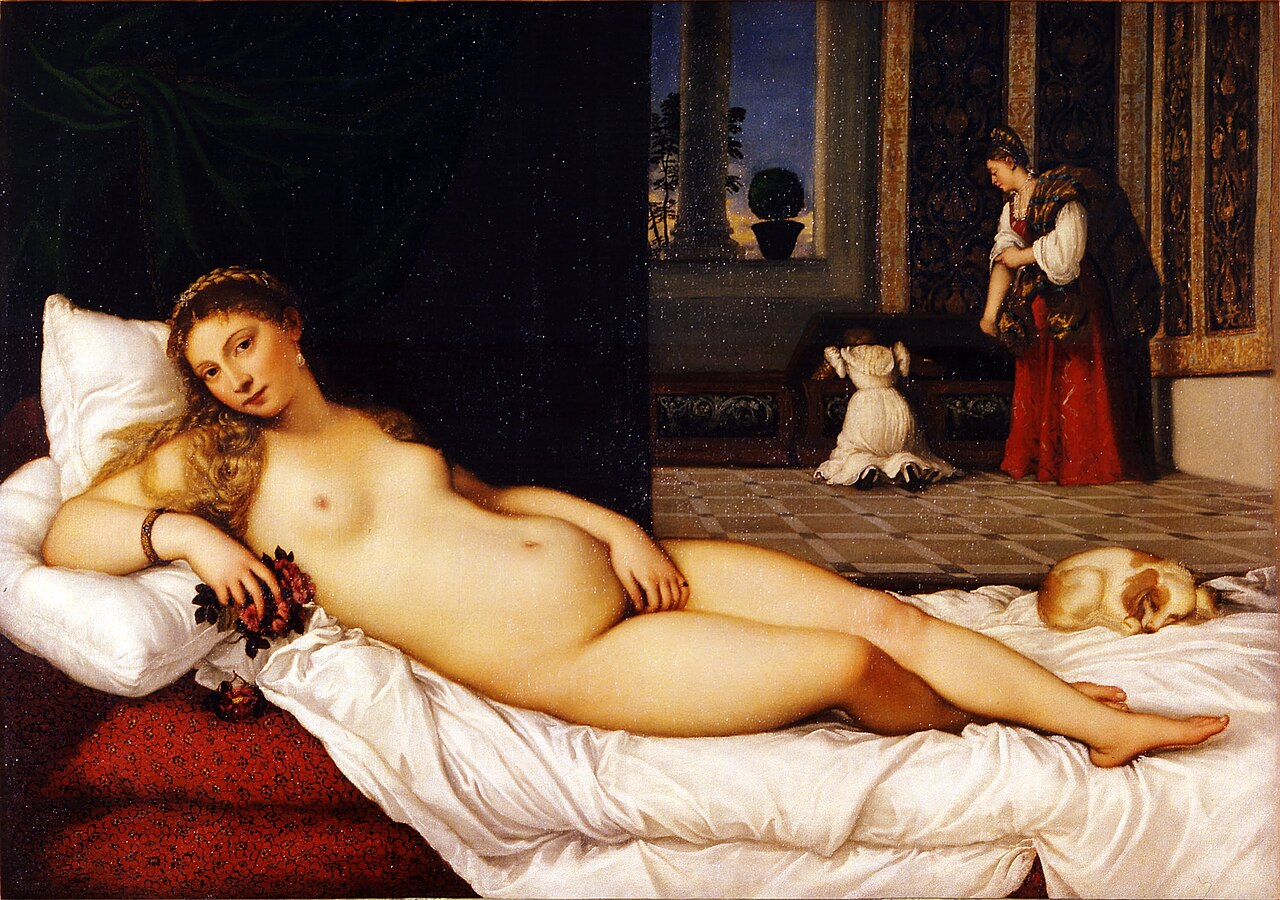
Titian, Venus of Urbino, 1538 — a Renaissance masterpiece that sits exactly on the line between allegorical ideal and intimate portrait.
Olympia: The Nude That Broke the Code
Fast-forward to 1865. Édouard Manet’s Olympia arrives at the Paris Salon, and the art world loses its collective mind. Not because Olympia is nude — the Salon was full of nudes that year. Cabanel’s The Birth of Venus (a perfectly smooth, academically acceptable nude) was exhibited at the same Salon and won the medal of honor.
So what was different about Olympia? Everything that made the nude safe in art — mythology, allegory, idealization — Manet stripped away. Olympia isn’t Venus. She’s a Parisian sex worker, reclining on her own bed, wearing nothing but a black ribbon around her neck and a flower in her hair. She makes no pretense of being a goddess. She looks straight at the viewer with an expression that says: I see you seeing me, and I’m not ashamed.
The critics howled. They called her “vulgar,” “a female gorilla,” “the courtesan with yellow belly.” What they really meant was: this nude refuses to be allegory. She insists on being a person. And a person — a real, modern, unidealized woman — made the nude sexual in a way that mythology never could.
This is the first crack in the Western framework: the nude is art as long as it’s abstract, idealized, or historical. The moment it’s specific, contemporary, and personal, it becomes something else. Something dangerous.
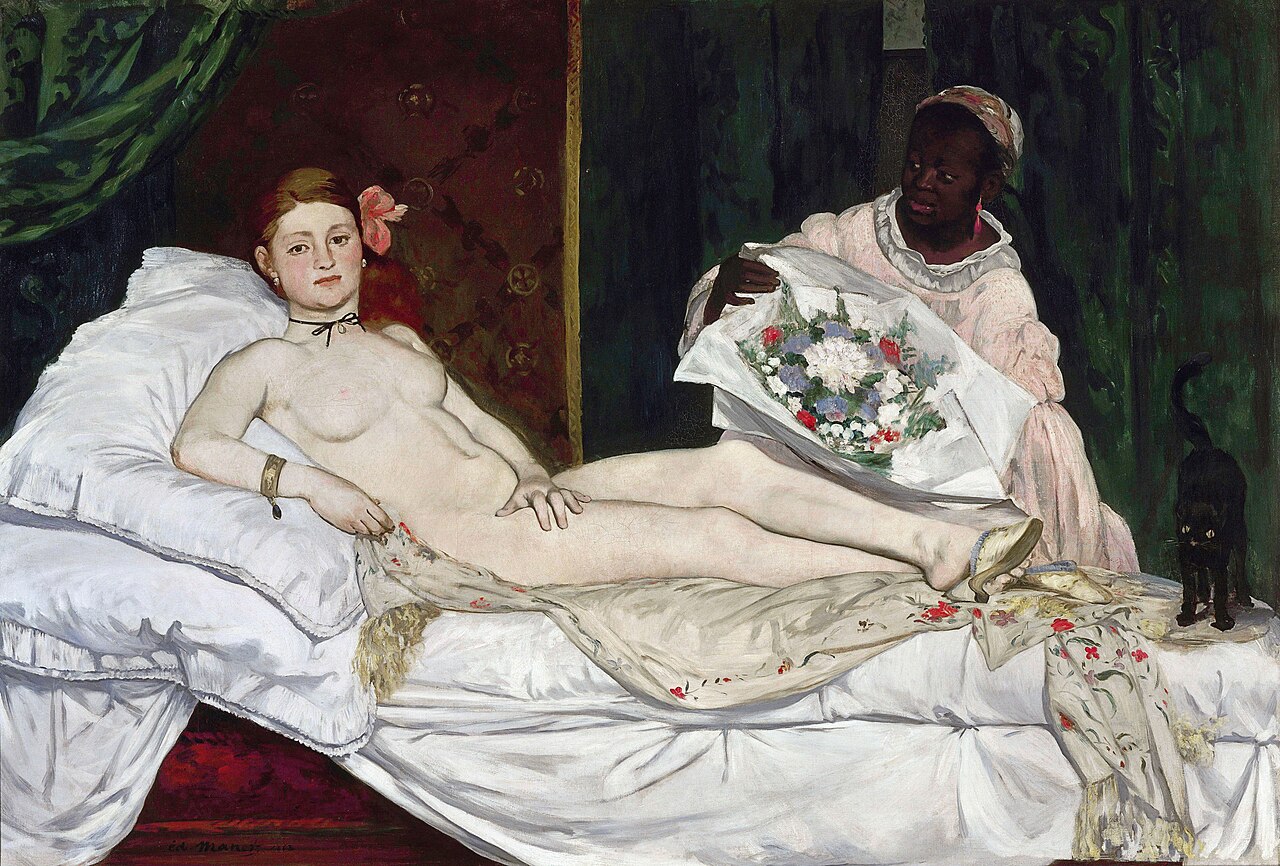
Édouard Manet, Olympia, 1863 — the nude that broke the code by refusing to be allegory.
The Legal Framework: Miller, the NEA, and the Rules Nobody Agrees On
In 1973, the U.S. Supreme Court tried to codify the line in Miller v. California. The Miller test asks three questions: (1) Does the work appeal to prurient interest? (2) Does it depict sexual conduct in a patently offensive way? (3) Does the work lack serious literary, artistic, political, or scientific value?
Sound clear? It’s anything but. What counts as “serious artistic value” changes with every generation. Robert Mapplethorpe’s photographs — formally exquisite black-and-white compositions of gay BDSM subcultures — were prosecuted as obscene in Cincinnati in 1990. The jury acquitted. Was the art different after the verdict? No. Only the cultural frame had shifted.
More recently, the culture war has moved to social media. Meta’s content moderation policies explicitly allow nudity in art — “photographs of paintings, sculptures, and other art that depicts nudity” is permitted — but the enforcement is notoriously inconsistent. A Renaissance fresco gets flagged. A classical statue gets blurred. A photograph of a nursing mother gets removed. The algorithm can’t tell the difference between Titian’s Venus and something else, because the algorithm doesn’t see intention. It sees flesh tones and triggers a rule.
The Missing Ingredient: Context and Intent
The real problem with the nudity-versus-sexuality distinction is that it treats the image as if the meaning is in the image itself. It’s not. Meaning lives at the intersection of the artist’s intent, the viewer’s context, the cultural moment, and the institutional frame.
A photograph of a nude body in a museum is art. The same photograph, cropped and shared without context, can be flagged as pornography. The body hasn’t changed. The frame has.
Auguste Rodin’s The Kiss (1889) is one of the most famous sculptures in the world. Two nude bodies, entwined, mouths nearly touching. It sits in museums from Paris to London to Tokyo. Children walk past it on school trips. No one questions whether it’s art. But if you encountered the same composition — two real human bodies in that exact pose — on a social media feed, how would you categorize it? Art or pornography? The answer depends entirely on context.
Who Gets to Decide?
This is the question that NALA exists to explore — and the question that has no fixed answer. In the 16th century, the church decided. In the 19th, the Salon jury and the critics. In the 20th, the courts and the NEA. Today, the decisions are made by Meta’s content moderators, by museum curators, by algorithmically enforced community guidelines that apply inconsistently across cultural contexts.
The distinction between nudity and sexuality in art has never been stable because it’s not a distinction that nature makes. It’s a cultural agreement, renegotiated with every generation. And like any agreement, it can be questioned, challenged, and changed.
That’s what artists do. That’s what museums are for. And that’s the conversation worth having — not where the line is, but who gets to draw it, and whether they’re the right person for the job.
NALA (Nude Art LA) is a live figure-painting and body-art experience in downtown Los Angeles that has been celebrating the human form since 2019. We believe the nude body is one of art’s oldest and most powerful subjects — and the conversation about who gets to see it, and how, is far from over.