Sandro Botticelli Died 516 Years Ago Today. His Venus Was the Nude That Defined the Renaissance.
On May 17, 1510, Sandro Botticelli died in Florence at roughly sixty-five years old. He had outlived his patron Lorenzo de’ Medici by eighteen years, witnessed the bonfires of the vanities under Savonarola, and watched the artistic center of gravity shift from his delicate, linear grace toward the muscular monumentality of Michelangelo and Raphael. He died nearly forgotten — his workshop quiet, his reputation eclipsed. And then, four centuries later, the Pre-Raphaelites rediscovered him, and suddenly Botticelli’s nudes became the most famous bodies in Western art.
Today, 516 years after his death, Venus rising from her scallop shell is arguably the single most recognizable nude in the world. But Botticelli’s relationship with the naked body was more complex, more philosophical, and more radical than a single image can convey.

The Neoplatonic Nude: Why Botticelli’s Bodies Are Different
Botticelli painted in the orbit of Lorenzo de’ Medici’s Florence, where Marsilio Ficino’s Neoplatonic academy had revived Plato’s theory of ideal forms. In this intellectual climate, beauty wasn’t merely aesthetic — it was a ladder to the divine. The nude body, properly rendered, wasn’t flesh to be ogled; it was the closest visible approximation of a celestial idea.
This is why Botticelli’s nudes look so different from those of his contemporaries. Where Masaccio’s bodies are weighty and volumetric, where Michelangelo’s are muscular and tectonic, Botticelli’s figures seem to exist in a different physics entirely. Venus doesn’t stand on her shell — she hovers above it, weightless. Mars doesn’t sprawl in post-coital exhaustion — he floats in a dream state. The bodies are elongated, impossibly proportioned, wrapped in lines that flow like melody. They are not anatomically real. They are spiritually real.
This was the Neoplatonic nude: a body so beautiful it could lift the soul toward God.
Venus and Mars: The Nude as Narrative
Botticelli’s Venus and Mars (c. 1485) is among his most sophisticated treatments of the nude. It depicts the goddess of love reclining in a white gown, awake and watchful, while the god of war lies naked and deeply asleep beside her. Four impish satyrs play with Mars’s armor — one blows a conch shell in his ear without stirring him. The meaning is unmistakable: love conquers war. Venus’s clothed alertness versus Mars’s nude vulnerability is a deliberate inversion of Renaissance gender conventions. Here, the male nude is the object, the passive one, the one undone by desire. It’s a remarkably modern gesture tucked inside a classical frame.
The painting hung in the Villa di Castello, alongside the Primavera, as part of a decorative cycle celebrating the Medici family’s values: love, beauty, peace, and the civilizing power of art.
The Birth of Venus: The Nude That Broke the Renaissance
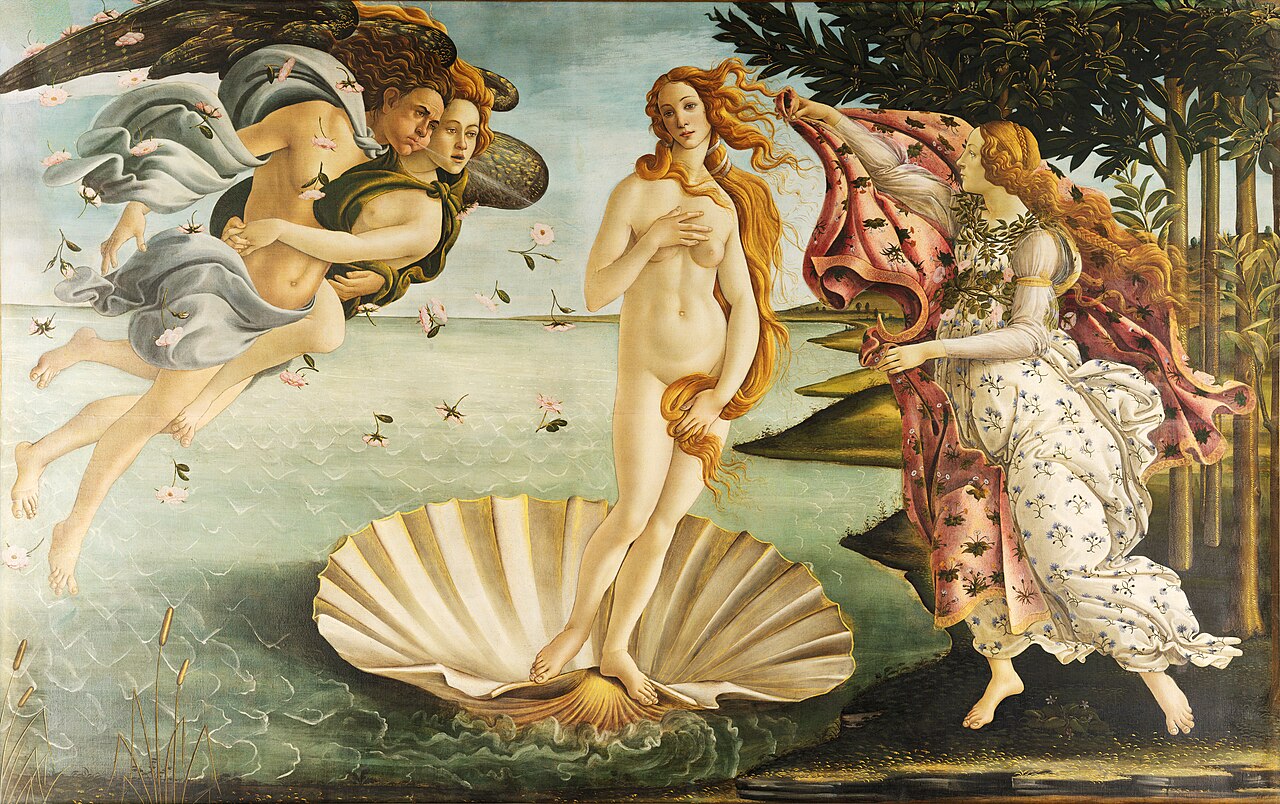
The Birth of Venus (c. 1484–1486) was radical for its time — not because it depicted a nude woman, but because of what that nude woman signified. In medieval and early Renaissance art, female nudity was almost exclusively reserved for Eve (sinful, shameful, postlapsarian) or for saints being martyred. Venus’s nudity was something else entirely: classical, mythological, celebratory. She is not ashamed. She is not being punished. She is arriving.
Venus stands on a giant scallop shell, blown ashore by Zephyr and Chloris (tangled in an erotic embrace), as a handmaiden rushes to cover her with a flower-embroidered cloak. Her pose echoes the Venus Pudica (modest Venus) of classical sculpture — hands covering breasts and genitals — but with Botticelli’s characteristic reinterpretation. Her hair flows in golden waves that would become the visual signature of Renaissance beauty. Her skin is pale, almost translucent. Her expression is not quite welcoming, not quite distant. She looks, as the critic Walter Pater wrote, “like a flower in spring.”
The Birth of Venus was the first large-scale painting of a female nude from classical mythology created in Florence since antiquity. It announced that the nude could be sacred without being Christian, spiritual without being biblical, and that physical beauty was not the enemy of the soul but its messenger.
Primavera and the Three Graces
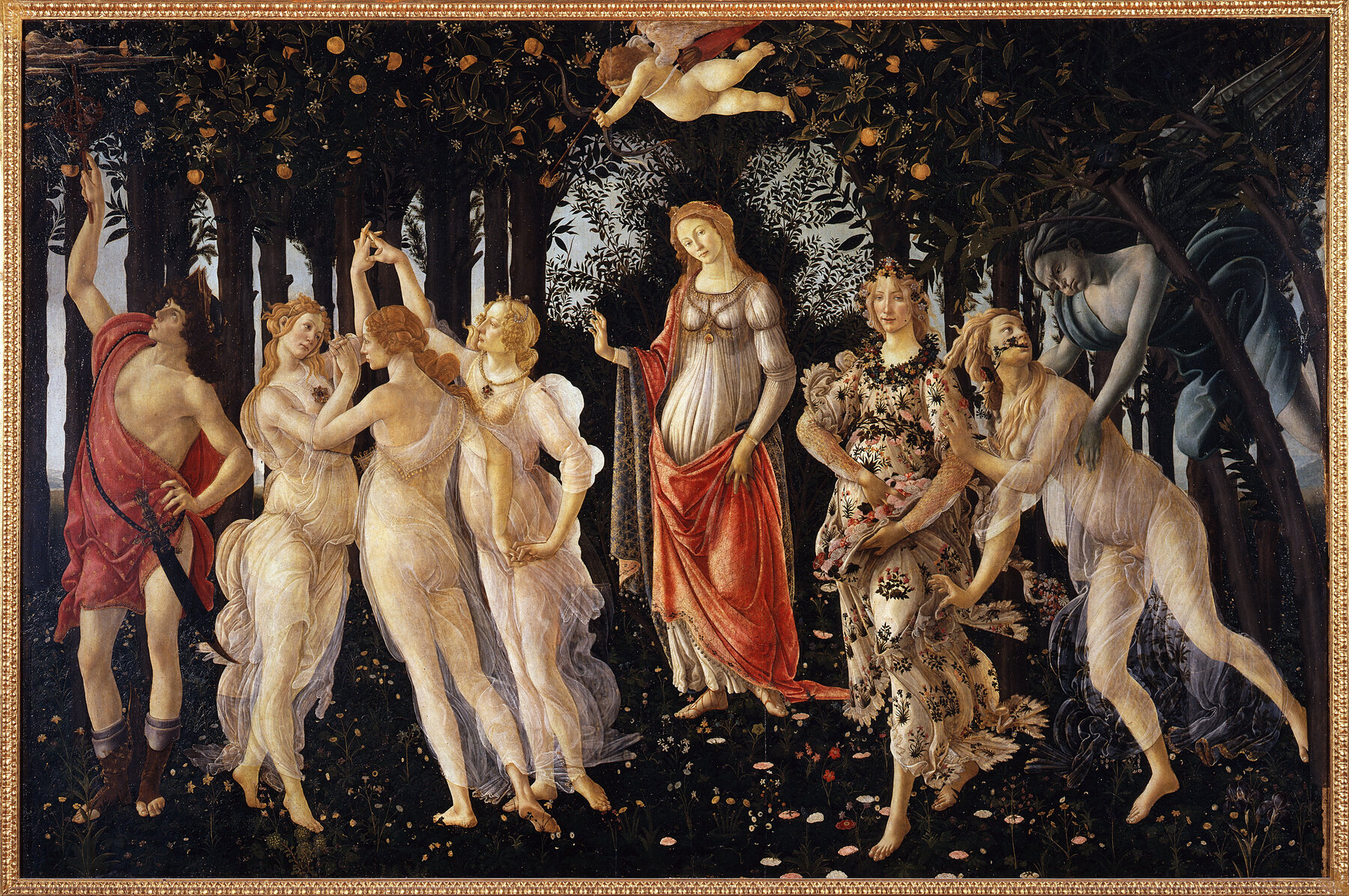
Botticelli’s Primavera (c. 1482) completes his great mythological trilogy. While not all the figures are nude, the Three Graces — sisters who embody charm, beauty, and creativity in classical mythology — are rendered in diaphanous gowns so sheer they might as well be nude. They dance in a circle, their interlocked hands creating a rhythm that pulls the eye across the painting’s seven-foot width.
The Graces represent a different kind of nudity from Venus’s. They are neither arriving nor vulnerable nor eroticized in the conventional sense. They are simply being. Their near-nakedness is their natural state, the unselfconscious grace of beings who are beautiful because they exist. This is Neoplatonism made visible: the body as a manifestation of divine harmony, dancing in measure and proportion.

The Rediscovery: From Obscurity to Icon
After Botticelli’s death in 1510, his reputation declined sharply. The High Renaissance’s taste for grandeur and monumentality made his delicate, linear style look old-fashioned. Vasari, in his 1550 Lives of the Artists, praised Botticelli’s draftsmanship but noted that he “wasted much time” on poetry and allegory. By the eighteenth century, his name had nearly disappeared from art histories.
The revival came in the nineteenth century, when the Pre-Raphaelite Brotherhood — John Ruskin, Dante Gabriel Rossetti, Edward Burne-Jones — found in Botticelli a kindred spirit. Here was an artist who placed beauty above realism, line above volume, and meaning above mimesis. Ruskin called Botticelli’s work “the most precious piece of art in all Italy.” Suddenly, the Birth of Venus was everywhere: on postcards, in photography studios, referenced by poets and painters across Europe.
The twentieth century cemented Botticelli’s place. His Venus has been reproduced, parodied, merchandised, and memed more than almost any other artwork. She has appeared on everything from museum gift-shop magnets to fashion editorials. And yet the original painting, hanging in the Uffizi Gallery in Florence, retains its strangeness, its otherworldliness, its quiet power to stop you in your tracks.
Why Botticelli Still Matters
Botticelli’s nudes matter not because they are realistic — they aren’t — but because they are aspirational. They depict a world in which the human body is not a source of shame or a site of sin but a vessel of divine beauty. In a culture that constantly debates what the naked body means, who gets to show it, and under what circumstances, Botticelli’s Venus offers a fifteenth-century answer that still resonates: the nude body, at its best, can lift the mind toward something higher.
It’s a vision worth preserving — and worth defending.
—
At NALA, we believe the nude body in art deserves space to be seen, understood, and celebrated — on its own terms. Learn more about our mission.